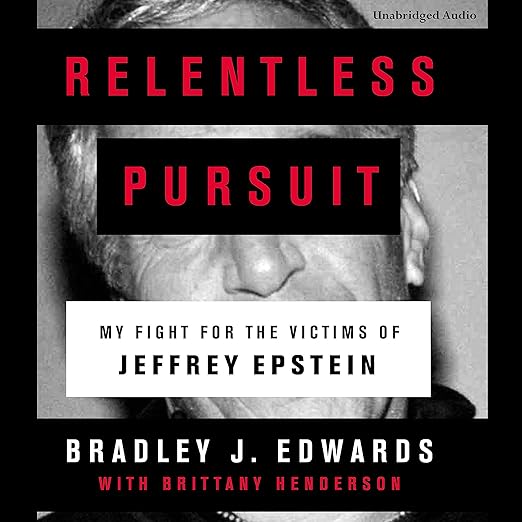
Relentless Pursuit is told entirely from one side of the courtroom: Bradley J. Edwards, the victims' rights attorney who represented more than twenty of Jeffrey Epstein's victims over more than a decade. Steven Weber narrates the audiobook, which the synopsis bills as 'the definitive story of the case against Jeffrey Epstein and the corrupt system that supported him and Ghislaine Maxwell.' Simon & Schuster Audio UK is the listed publisher, a small signal of the book's cross-market release that does not affect the content or narration for US listeners.
Threats and Schemes Straight Out of a Spy Movie
Its origin point is specific and dated: in June 2008, a then-32-year-old Edwards, who had 'just started his own law firm,' was approached by a young woman named Courtney Wild, who described being 'sexually coerced at the age of fourteen' by Epstein. Per the synopsis, Edwards 'had never heard of Epstein' at that point and had no idea the encounter would change the course of his life. What follows, per the synopsis, is a pursuit that 'came close to losing everything in the process': Edwards traces Epstein's operation 'from Florida, to New York, to Europe, to a Caribbean island,' eventually becoming, in the book's own words, 'the one person Epstein most feared could take him down.'
Reviewers consistently frame this as new information rather than a rehash of widely reported coverage. Amazon Customer calls out 'detailed facts that lead to charges not discussed in media,' describing the book as 'more like the back story' than a news recap on television or in print, a distinction that matters for a case this thoroughly covered elsewhere. grayce erickson goes further, calling it a 'favorite of all the Epstein literature' read so far, after reading 'nearly all of it published.'
Shawn's review frames the book's dual focus precisely, covering 'Jeffrey Epstein's crimes, his power, and Bradley Edwards' fight for the victims of these crimes' as equally important threads. X's shorter review adds a specific credibility marker, describing it as 'well writen by the prosecuting attorney,' identifying Edwards' own professional vantage point as the source of the book's authority. The synopsis does not undersell the resistance Edwards faced along the way, describing 'threats and attempting schemes straight out of a spy movie' from Epstein's side, met by what it calls 'his small team of committed lawyers and, most of all, the victims, who were dead-set on seeing their abuser finally put behind bars.' Its own closing description of Edwards, 'the gutsy lawyer who took on one of the most brazen sexual criminals in the history of the US,' sets the tone reviewers echo throughout.
Weber Narrates a Case Built on Access
Steven Weber narrates a book built on firsthand legal access rather than secondhand reporting: the synopsis puts it plainly: Edwards 'tracked down and represented more than twenty of Epstein's victims,' giving the account a vantage point most journalism on this case cannot claim. grayce erickson's review credits that access directly, calling Edwards 'a talented author and prosecutor' whose writing 'kept me engaged to the last page.'
According to the synopsis, the scope of what Edwards uncovered is not softened: a network of 'contacts and friends' that included 'Donald Trump, Bill Clinton, Ghislaine Maxwell and Prince Andrew,' alongside a legal team on the other side that 'were able to manipulate the FBI and the Justice Department.' Leweycat's brief but pointed review distills the book's core argument into five words: 'Removes any doubt about how money corrupts.' At 13 hours and 40 minutes, the audiobook has room to cover a decade of legal work in real detail, which tracks with Amazon Customer's point that the book goes deeper than typical media coverage. A shorter treatment of the same material would likely have to cut the kind of specifics reviewers single out, the kind of granular fact that Amazon Customer specifically credits for going beyond what mainstream coverage typically includes.
Five Reviews Cluster Six Years After Release
This listing's rating data has its own timeline worth noting: the badge shows a single counted vote at 4.6, next to five written reviews, none of which is mathematically possible from one whole-star rating. What stands out is not just the mismatch but its timing: all five reviews were posted within a tight four-month window, November 2025 through February 2026, nearly six years after the book's original March 2020 release. A sudden cluster of reviews on an older title, paired with a rating counter stuck at one, points to something unusual in how this specific listing has been tracked over time.
A small imprecision is worth flagging: two reviews, grayce erickson's and X's, both describe Edwards as a 'prosecutor,' while the synopsis itself identifies him specifically as a 'victims' rights attorney,' a related but distinct role in how the American legal system pursues these cases. That is a minor point of reviewer shorthand rather than a factual problem with the book itself.
Legal Detail Goes Further Than News Coverage
Readers of true crime and investigative journalism focused on institutional failure, not just individual wrongdoing, are the clear audience: the synopsis frames the real subject as 'the corrupt system that supported' Epstein as much as Epstein himself. Anyone specifically interested in how Edwards' decade of legal work uncovered facts 'not discussed in media,' per Amazon Customer's review, should find this delivers exactly that firsthand angle. This is also, per its own framing, as much about Edwards' profession as about Epstein: the synopsis repeatedly returns to what it took, professionally and personally, to represent 'more than twenty' victims against a defendant backed by 'high-priced lawyers.' Readers drawn to legal-process narratives, not just the crimes themselves, will find that throughline as central as the case's outcome.
Given the subject matter, sensitive listeners should know going in that this concerns the sexual abuse of minors and the legal system's failures around it, even though both the synopsis and the reviews keep their focus on Edwards' pursuit of accountability rather than graphic detail. Readers wanting a broader true-crime survey rather than one attorney's specific, decade-long case should look for a wider-angle account instead. Readers already familiar with Epstein coverage from news media specifically, rather than book-length treatments, may find the level of legal and procedural detail here goes further than they are used to, which several reviews frame as a strength rather than a slog.
Is Relentless Pursuit based on Bradley Edwards' own legal work?
Yes. Edwards is the account's central figure: the synopsis frames him as a 'victims' rights attorney' whose decade of casework forms the entire narrative, not a supporting thread. Amazon Customer's review backs this up, noting that the book surfaces facts largely absent from press coverage of the case.
Why does Relentless Pursuit show only one rating despite five written reviews?
A single whole-star vote cannot produce the 4.6 average shown, since only flat numbers like 4.0 or 5.0 are possible from one rating. What makes this case distinct is timing: all five reviews were posted within a four-month window in late 2025 and early 2026, years after the book's 2020 release, suggesting the counter fell out of sync at some point rather than gradually.
Does the Relentless Pursuit audiobook name the powerful people connected to Jeffrey Epstein?
Yes. The synopsis states that Edwards' investigation 'shined a light on his network of contacts and friends, among them Donald Trump, Bill Clinton, Ghislaine Maxwell and Prince Andrew.' The book's focus, per reviews, stays on Edwards' legal pursuit rather than turning those names into a sensationalized angle.
Is the Relentless Pursuit audiobook appropriate for readers new to the Epstein case?
It can work as an entry point, though it is written from deep inside the legal case rather than as a general overview. grayce erickson's review, a self-described reader of 'nearly all' the published Epstein literature, still called it a favorite, which suggests it rewards both newcomers and readers already familiar with the broader case.