At a Glance
- Narration: Robin Sachs brings deep familiarity with English historical cadence and a measured gravitas that suits Meyer's dense, essayistic prose; the 24-hour runtime never drags because Sachs manages tonal variation across the dynasty's long arc with real skill.
- Themes: Power and dynastic fragility, religious upheaval as political instrument, the cost of succession obsession
- Mood: Rich and immersive, with the weight of five centuries pressing against every chapter
- Verdict: G.J. Meyer's structural choice to alternate between narrative and contextual background chapters rewards patient listeners and produces one of the more analytically serious Tudor audiobooks available.
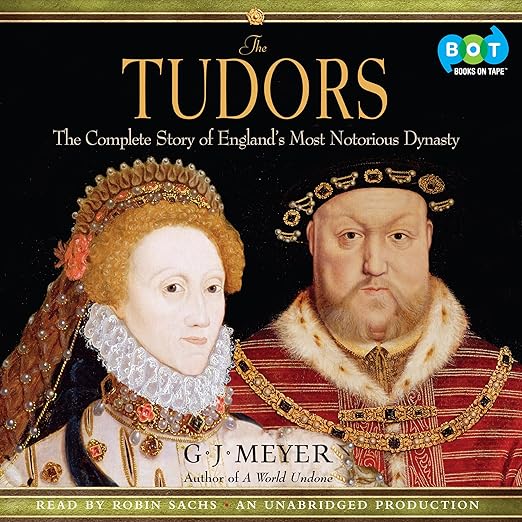
Robin Sachs, the late British actor whose audiobook catalog was one of the most distinguished in historical nonfiction, narrates G.J. Meyer's The Tudors with exactly the kind of authoritative, unsentimental voice the subject requires. This is a New York Times bestseller covering the full arc of the dynasty from Henry Tudor's improbable 1485 landing at Milford Haven through Elizabeth I's long and costly reign, and at 24 hours and 34 minutes it is a genuinely substantial audiobook - one that rewards listeners who want a complete account rather than a curated highlights package. Meyer's approach is structural as much as narrative: the book alternates between chronicle chapters and what reviewers call background chapters, which zoom out to contextualize the religious, political, and economic forces shaping each monarch's reign in ways that the chronicle alone cannot provide.
Meyer's particular gift is the ability to take a period so thoroughly mined by popular history and find the institutional rather than the personal story. Where most Tudor narratives organize themselves around the psychology of individual monarchs - Henry VIII's desire architecture, Elizabeth's calculated virginity - Meyer keeps returning to the structural conditions that made the dynasty's choices possible or necessary. The 1534 break with Rome is not primarily a story about Anne Boleyn in Meyer's telling; it is a story about what a monarch needed to seize in order to redirect ecclesiastical revenue and consolidate nobility-level land tenure. The dissolution of the monasteries that followed was not spiritual housecleaning but the largest property transfer in English history since the Norman Conquest, and Meyer keeps that material fact visible throughout his account of the reformers' theology. That framing frustrates readers who come to Tudor history for the personal drama, and one reviewer notes that the book can feel like a history of the Tudor era rather than a chronicle of the Tudors themselves - which is accurate as a description and is probably the correct scale at which to write a single-volume account of five consequential reigns. Meyer is also notably unwilling to assign heroism or villainy along the expected denominational lines. His account of the Protestant reformers is not flattering; his account of the Catholic resistance is not hagiographic. Both sides of the English Reformation emerge as driven by a combination of genuine conviction and self-interest that the cleaner versions of the story tend to obscure. One reviewer finds the author's willingness to look at both sides fairly - to see that the Pope and English Catholics were not entirely evil, nor the English reformers entirely good - refreshing rather than evasive.
Highlights
Sachs's voice does something specific for this audiobook that a different narration style could not accomplish: he carries the essayistic stretches - the background chapters explaining canon law, or the economic pressures on the monastic system, or the logistical realities of sixteenth-century English foreign policy - without letting them become lecture. His reading has the quality of a guided tour by someone who finds the material genuinely compelling rather than obligatory, and at 24 hours that consistency matters enormously. The alternating chapter structure that Meyer uses is easier to follow aurally than it might appear on paper: each background chapter functions as a breathing interval that gives the listener room to absorb the preceding narrative chapter, and Sachs handles the gear-shift between modes with natural authority. Listeners who have previously bounced off Tudor history because of its density will find that Sachs makes the material more navigable than print allows. The structural choice to alternate narrative and context also means that the audiobook rewards listening in longer sessions rather than in short fragments: the pattern of advance and zoom-out that Meyer establishes accumulates meaning over multiple chapters in a way that occasional ten-minute listens would disrupt.
Things to Know Before Starting The Tudors
Meyer's treatment of the three Tudor children who followed Henry VIII is where the book is most revisionist and most interesting. Edward VI's fervent evangelical reformism gets more sympathetic treatment than popular history usually provides; Meyer is attentive to the genuine theological conviction behind what is often dismissed as the scheming of his council. Mary's failure to consolidate the Catholic restoration is analyzed structurally rather than attributed to her personal rigidity - she was working against institutional and financial incentives that Henry's reign had spent twenty years cementing, and the Protestant landowners who had acquired monastic properties were not going to surrender them regardless of the queen's religious preferences. Elizabeth's famous personal sacrifices, the deliberate refusal of marriage and succession, are read here not as strategic genius but as a compounding failure of dynastic responsibility that left England genuinely vulnerable at her death. This is revisionist history in the most useful sense: it does not invert the traditional narrative, it complicates it in ways that hold up under scrutiny and that change how you hear the familiar story.
Is This One for You?
Listeners who want a comprehensive single-volume Tudor history that prioritizes structural analysis over dramatized biography. Fans of British history who have read the standard popular accounts and want something that handles the religious transformation of England with genuine intellectual rigor. Anyone who finds that Robin Sachs's narration voice makes long historical audiobooks sustainable across multiple listening sessions. Skip this if you want the soap-opera register of the dynasty's personal dramas - Meyer acknowledges those dramas but is consistently more interested in their institutional causes and consequences than in their human texture.
Frequently Asked Questions
Is The Tudors audiobook suitable for listeners who know very little about English Tudor history?
Yes, though it rewards attention. Meyer's background chapters are specifically designed to give readers context they would otherwise need to bring to the book, so prior Tudor knowledge is helpful but not required. The main narrative chapters assume the listener is following Meyer's contextual explanations carefully.
Does Robin Sachs's narration make the 24-hour runtime manageable for audiobook listeners?
Substantially, yes. His cadence has the kind of sustained authority that makes long historical nonfiction audiobooks work - he distinguishes between narrative and analysis without overplaying the shift, and he never sounds tired of the material even in the denser background chapters.
Does the audiobook address the accusation that Meyer has an anti-Protestant bias?
Some reviewers have raised that concern, but others find Meyer's treatment notably even-handed - skeptical of both the Protestant reformers and the Catholic hierarchy in ways that refuse the usual denominational sympathies. The book is better read as anti-institutional than anti-Protestant specifically.