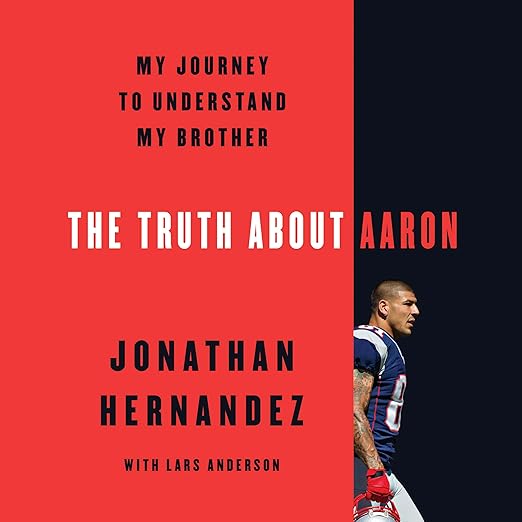
I listened to The Truth About Aaron on a morning run, which turned out to be the wrong decision, not because the book is unlistenable but because it stopped me in my tracks somewhere around the third chapter, when Jonathan Hernandez begins describing what it was like to watch his brother transform. There is a specific kind of sadness in this book that is hard to shake: not the sadness of someone who did not see it coming, but of someone who saw it and could not find the words or the means to stop what was already in motion.
Jonathan Hernandez, formerly known by the nickname DJ, was Aaron's older brother and perhaps the person who knew him best. The account he gives here draws on thousands of pages of prison letters alongside personal memory, and the picture that emerges is neither a martyrdom nor a monster story. Aaron Hernandez was a superstar in the making at the University of Florida, a record-setter alongside Rob Gronkowski and Tom Brady at New England. He was also, by the time of his death at twenty-seven, a man convicted of first-degree murder with two additional indictments pending, whose brain showed CTE at the level typically found in a sixty-seven-year-old.
The Verdict, Briefly
Reviewer Will Fuller put it well: Jonathan Hernandez writes in a style that is simple and achingly raw. He does not try to canonize Aaron. He is explicit about the beatings from their father, a man described as otherwise loving, and about Aaron's long-concealed sexuality and the costs of that concealment in the hypermasculine environments he inhabited from high school onward. He is honest about the crimes without pretending to fully understand them.
What makes the book genuinely significant rather than simply interesting is the CTE finding. Scientists determined that upon Aaron's death, his brain showed the condition at a severity associated with a person four decades older. Jonathan does not use this as a get-out clause, he states directly that he is not laying blame for Aaron's crimes at the illness's door, but he asks the reader to hold the finding alongside everything else and sit with the discomfort of what it implies about the sport that made Aaron a star.
The Best Parts of The Truth About Aaron
Josh Bloomberg's narration is appropriately understated for this material. He does not impose emotional cues on passages where Jonathan Hernandez is clearly working hard to stay neutral; he lets the words do what they are designed to do, which is to convey the specific texture of a sibling relationship that included admiration, concern, loyalty, and grief in proportions that shifted constantly over time.
The book is five hours and fifteen minutes, which feels right. It does not overstay its welcome or pad out the narrative with tangential NFL history. The football career is present because it is essential context, not because Jonathan is trying to give Aaron's story the production values of a sports biography. The prison letters are used sparingly but to powerful effect.
Points to Consider
Reviewer Jess, writing in April 2025, added a postscript that the book itself cannot contain: Jonathan Hernandez was convicted in early 2025 for behavior that observers describe as eerily consistent with CTE symptoms. The diagnosis cannot be made in living patients, it requires autopsy, but the possibility that both brothers were affected by the same condition adds a dimension to the book that its original readers could not have anticipated. It does not change what Jonathan wrote, but it changes the frame through which the book is now read.
Listeners should also be aware that the book addresses Aaron's sexuality with the clarity and specificity that Aaron himself was never publicly able to achieve. Jonathan treats this aspect of his brother's life with care and without prurience, but it is a significant element of the portrait.
Who Should Listen to The Truth About Aaron
This is strong listening for anyone interested in the CTE crisis in American football, in the sociology of hypermasculinity and its costs, or in the particular genre of sibling memoir where loyalty coexists with horror. Sports fans who followed the Hernandez story in the headlines will find layers here that the news cycle never reached. Those who prefer to avoid content involving murder, suicide, childhood abuse, and discussion of concealed sexuality should approach with awareness of what the book contains.
Before You Listen
Does Jonathan Hernandez defend his brother's crimes or try to explain them away?
No, he is explicit that he is not portraying Aaron as a victim or attributing the murders to his illness. He presents the CTE finding alongside everything else and lets the reader sit with the complexity rather than resolving it.
Is Josh Bloomberg's narration a good match for this kind of personal memoir?
Yes, Bloomberg reads with restraint and doesn't impose emotional cues the text does not call for. The material is inherently affecting and a lighter touch in narration serves it better than a more performative approach would.