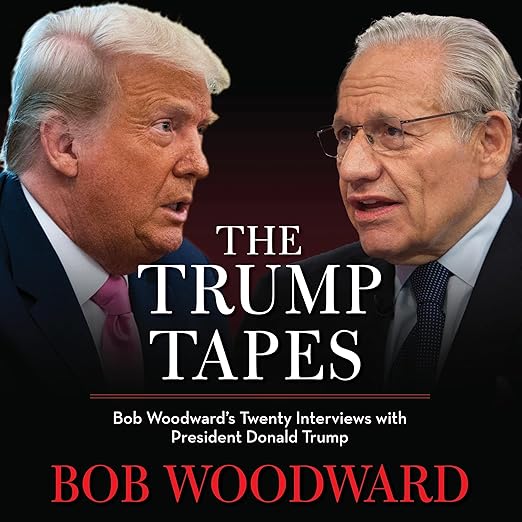
Quick Take
- Narration: Donald Trump narrates his own conversations with Bob Woodward – the self-incrimination is in the performance itself, unfiltered and unedited.
- Themes: Presidential accountability, media access, political self-revelation
- Mood: Unnerving and compulsive, like watching someone confirm your worst suspicions in real time
- Verdict: An audio document without precedent in American political publishing – what you hear will depend entirely on what you already believe, but the primary source value is undeniable.
I came to The Trump Tapes the way most people probably do – with a mixture of resistance and curiosity. The thought of spending eleven hours listening to Donald Trump speak is not anyone’s idea of comfort listening. But Bob Woodward has spent fifty years earning the title of America’s preeminent political interviewer, and the existence of these recordings – 27 conversations, conducted between December 2019 and July 2020, covering the coronavirus pandemic, foreign policy, and the operational reality of the Trump presidency – represents something genuinely rare: a sitting president speaking at length, on record, to the reporter most likely to understand what he was revealing.
The Guardian called it the most memorable contribution to that year’s American political literature. That framing matters. This is not a book about Trump in the traditional sense. It is a primary source document in audio form, and the fact that Trump himself is the narrator – not an actor, not a voice performer, but the man himself across 27 taped phone calls – makes it something that cannot be replicated or approximated. You are hearing the 45th president speak about his own performance in office.
Our Take on The Trump Tapes
Woodward’s method here is worth understanding. The Guardian reference to the interviews as a reporter’s laboratory is accurate. Woodward gets Trump talking by telling him that he wants to be sure he does not fail to quote him accurately – a line that one reviewer describes as nothing if not masterful. The result is a man who speaks freely, circling back repeatedly to his poll numbers, his grievances, his certainties. One reviewer with caregiving experience in dementia noted something specific and clinically interesting: Trump’s fixations are consistent and purposeful rather than scattered. Whatever one concludes about him politically, the recordings reveal a coherent set of obsessions, not cognitive chaos.
The 27 letters between Trump and Kim Jong Un, included in the package, add a dimension that pure print biography cannot capture. Reading those letters is one thing. Having them contextualized within the recorded conversations gives them a different kind of weight.
Why Listen to The Trump Tapes
The primary reason to listen rather than read the companion book is the voice. Trump’s speech patterns – the repetitions, the self-corrections, the sudden pivots into flattery or aggression – are the content. A transcript captures the words but not the register, and register is where the self-revelation lives. Jake Tapper described it as an uncharacteristic warning from one of the most respected, non-partisan journalists in the world. Gayle King said she could not get enough of it. These are not frivolous endorsements; they reflect the listening experience of people who process political information professionally and found the audio distinctly more revealing than the print summary.
One reviewer, who found the transcript form almost unendurable in its density, still found the audio compelling – which is itself a useful data point. The recordings reward the medium in ways that print-based political journalism rarely does.
What to Watch For in The Trump Tapes
This is not a neutral document, and Woodward does not pretend otherwise. The framing and selection of which exchanges to include, and in what order, reflect editorial judgments. One reviewer found Trump more cooperative than expected and paired the audio with a reading of another psychological study of his presidency for additional context, which is a reasonable approach for listeners who want multiple analytical frameworks.
The Simon and Schuster Audio Originals release makes this production feel definitively like a publishing event rather than a companion disc. At eleven hours and twenty-nine minutes, it requires sustained attention. The conversations can be repetitive – Trump returns to certain themes across multiple sessions – and some listeners will find that repetition confirming while others find it enervating. The book is recommended alongside the audio, since the companion text provides the transcript with Woodward’s annotations.
Who Should Listen to The Trump Tapes
Anyone with a serious interest in American political history from 2019 to 2020 – particularly the early management of the coronavirus pandemic and the state of foreign relations during that period – will find this an irreplaceable primary source. Listeners who process politically charged material with difficulty may find extended exposure to Trump’s unfiltered voice taxing; one reviewer called it Migraine Marathon territory, which is worth knowing in advance. Those who want a clean, linear narrative analysis of the Trump presidency will need to look elsewhere – what this offers instead is something rarer and stranger: the subject, in his own voice, constructing his own case.
Frequently Asked Questions
Is The Trump Tapes just raw recordings, or does Woodward provide framing and context?
Woodward provides framing throughout. The audio package includes his editorial organization of the 27 conversations, and the companion print book offers transcripts with his annotations. Multiple reviewers recommend listening alongside the print book for full context.
Do the 27 letters between Trump and Kim Jong Un add meaningfully to the listening experience?
Reviewers who mention them find they add a notable dimension, particularly when contextualized within the recorded conversations. They are part of the audio package rather than a separate bonus.
How does listening to Trump speak directly compare to reading Woodward’s prior Trump books?
Reviewers consistently find the audio more revealing than print summaries. The speech patterns, repetitions, and tonal shifts carry information that transcripts flatten. This is the most common reason people cite for preferring the audio format here.
Is this production politically one-sided, and does that affect its value as a historical document?
Woodward’s editorial framing reflects his assessment of the Trump presidency, which he does not hide. That said, the primary source value of the conversations themselves is real regardless of one’s political perspective. Most reviewers approach it as a document first, with their own political reading layered on top.