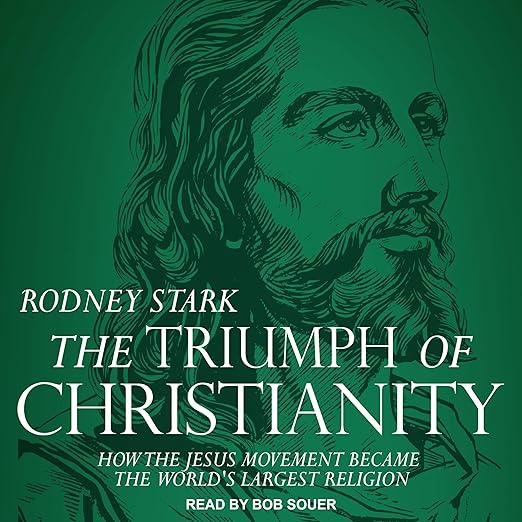
Quick Take
- Narration: Bob Souer’s measured, authoritative delivery suits the academic register of Stark’s historical argument without making it feel inaccessible to general listeners.
- Themes: The sociological conditions for Christianity’s growth, revisionist church history, faith confronting its own mythology
- Mood: Scholarly and direct, intellectually challenging without being combative
- Verdict: Rodney Stark’s most accessible synthesis of his career-long research into Christianity’s rise, essential for readers who want their religious history without mythological embellishment.
I spent a Sunday afternoon listening to the first four hours of The Triumph of Christianity, which is not the kind of book I typically associate with Sunday afternoons, and yet it fit perfectly. Rodney Stark, the sociologist of religion whose earlier books The Rise of Christianity and God’s Battalions established him as one of the most challenging historians working in this territory, gathers decades of research here into a single volume that is designed to be readable rather than comprehensive. That design choice is either the book’s strength or its limitation depending on what you bring to it.
What strikes me most about Stark’s method is that he approaches Christianity’s history as a social scientist rather than as either a believer or a skeptic. He is interested in the structural conditions that allowed a small Jewish sect in first-century Palestine to become the world’s largest religion, and he is willing to challenge both devout and secular received wisdom about how that happened. One reviewer, a pastor, noted that the book contradicted things he had taught from the pulpit for years and awarded it five stars specifically for that quality.
Our Take on The Triumph of Christianity
The format of the book, organized around pivotal episodes and controversies rather than chronological survey, is both its most distinctive feature and a genuine service to listeners. Stark explicitly avoids the dense chronologies that make institutional church history so difficult to penetrate. He arrives, instead, at the moments that actually determined the shape of Christianity: the conditions of the Roman Empire that made the new religion attractive, the theological controversies that defined orthodoxy, the relationship between Christianity and the sciences, and the reform movements that prevented the institution from collapsing under its own weight.
The argument about why Christianity spread is Stark’s most counterintuitive and most thoroughly documented contribution. He argues that Christianity grew not primarily through dramatic conversion events but through social networks, that it was adopted first among the educated and relatively prosperous rather than exclusively among the desperate, and that its theological egalitarianism on matters of gender and class gave it competitive advantages over other mystery religions of the period. These arguments have been contested in academic literature, but Stark presents the evidence for them carefully enough that listeners can evaluate the claims rather than simply accepting the conclusions.
Why Listen to The Triumph of Christianity
Bob Souer’s narration is a good match for Stark’s prose. Stark writes with the efficiency of a sociologist trained to say exactly what the evidence supports and no more, and Souer delivers that efficiency without flattening it into monotony. At thirteen and a half hours, the book is substantial, but the episodic structure means individual sections are self-contained enough that listeners can pause and return without losing the thread.
The book arrived in audio in 2020, well after the original print publication, and the production quality reflects that later timing. The pacing is confident throughout. Souer does not rush the more complex analytical passages or overpronounce the historical proper nouns, both of which are common failures in academic audiobook production.
What to Watch For in The Triumph of Christianity
Stark’s treatment of certain periods, most notably the Crusades and the Inquisition, challenges the popular secular narrative significantly, and readers who bring strong priors about those events will find themselves either illuminated or frustrated depending on how they receive revisionist historiography. He is not apologetic on behalf of Christianity, exactly, but he is rigorous about distinguishing documented history from later Protestant anti-Catholic polemics that embedded themselves in the standard narrative. Some of that revisionism is well-supported. Some of it reflects Stark’s own interpretive choices about which evidence to foreground.
The book does not engage deeply with the theological content of Christian belief itself. Stark is a sociologist, and his frame is sociological throughout. Listeners who want a history of Christian theology or biblical scholarship will find this book addresses those dimensions only where they intersect with the social and institutional history he is tracing. That is a feature of the book’s design rather than an oversight, but it shapes what kind of completeness listeners can expect from the thirteen hours.
Who Should Listen to The Triumph of Christianity
This book is for readers who want to understand Christianity’s historical development without the mythologizing that both devout histories and hostile secular accounts tend to impose on the material. It is equally useful for Christians who want an honest reckoning with their tradition’s history and for skeptics who want to understand the structural reasons for the religion’s durability rather than dismissing it. One reviewer who is a pastor described it as mandatory reading for serious Christians; one secular reviewer found it the most fair-minded account of the subject they had encountered. That range of reception suggests Stark is doing something genuinely balanced rather than merely moderate.
Frequently Asked Questions
Is Rodney Stark himself a Christian, and does his religious position shape his historical argument?
Stark describes himself as a non-denominational Christian, and while this does not make him a neutral observer in the way a secular sociologist might claim to be, his method throughout this book is sociological rather than theological. He challenges church mythology as readily as secular mythology, and the positive reviews come from readers across the religious spectrum.
How does this book relate to Stark’s earlier works, particularly The Rise of Christianity, and is it necessary to read those first?
This book is explicitly a synthesis of Stark’s career-long research and is designed to stand alone. It draws on the arguments from The Rise of Christianity and God’s Battalions but condenses and refines them, making it the most accessible entry point to his work. Reading the earlier books would add depth but is not required.
Does Stark’s argument that Christianity spread through social networks rather than dramatic conversion events hold up to scrutiny, or is it contested?
It is contested in academic literature but is supported by substantial sociological and demographic evidence that Stark presents in the book. His argument is that the evidence points more strongly toward gradual network spread than toward mass conversion events, and he invites readers to evaluate the data. Not all historians of early Christianity agree with his interpretation.
Is this appropriate for listeners who are skeptical of Christianity and want an honest historical account, or does it read as a defense of the faith?
It reads as neither a defense nor an attack. Stark is critical of specific historical behaviors within the church, including elements of the Inquisition and the Crusades, while challenging the most extreme secular narratives about those events. Skeptical readers report finding it fair-minded; devout readers report finding it challenging. That combination suggests it is working as intended.