Quick Take
- Narration: Nicholas Guy Smith delivers Alexander Stubb’s arguments with appropriate authority. His pacing suits the analytical nature of the text, keeping complex geopolitical frameworks accessible without oversimplifying.
- Themes: the fracturing of the post-WWII multilateral order, US-China competition, the Global South as the decisive variable in the coming century
- Mood: Urgent and sobering, with moments of cautious optimism from someone who has seen diplomacy from the inside
- Verdict: An unusually lucid and personal framework for understanding the current geopolitical moment, best appreciated by listeners who want both analysis and lived experience from the same source.
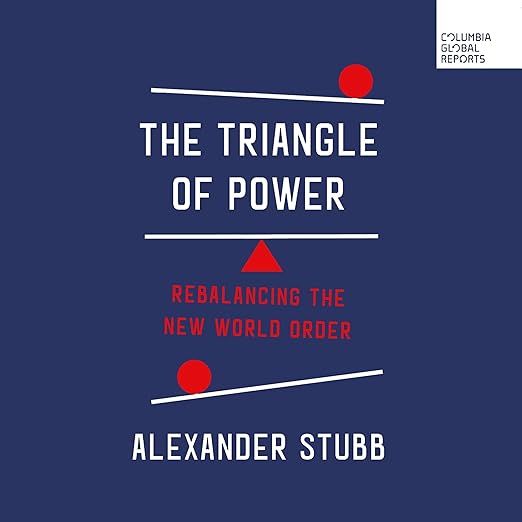
I started The Triangle of Power on a morning when the news was, as it frequently is these days, difficult to parse. Who was talking to whom. What the implications of a particular trade announcement might be. Whether the institutions built in the mid-twentieth century still functioned or had simply not yet recognized that they did not. Alexander Stubb, the President of Finland, has spent decades at the intersection of these questions in ways that most analysts have not. He has sat across the table from the people making these decisions, and The Triangle of Power is his attempt to offer a framework for understanding what is happening and why it matters.
The framework he proposes divides the current world into three blocks: the Global West, the Global East, and the Global South. The escalating competition between the United States and China sits at the center of the model, but Stubb’s argument is that the Global South, rather than either of the dominant powers, will ultimately determine whether the coming decades tilt toward cooperation or fragmentation. This is a genuinely interesting claim, and Stubb makes it not as an academic exercise but as someone who has watched it play out in real negotiating rooms.
Our Take on The Triangle of Power
Stubb’s strength here is the combination of analytical clarity and personal authority. One reviewer described the model as perhaps too simple, which is a fair observation and also, I think, precisely the point. Stubb is not writing a monograph for specialists. He is writing a book that people who play golf and talk tariffs with heads of state and then explain the results to Finnish citizens can use as a shared framework. The simplicity is deliberate. The comparison to Kissinger’s World Order that one reviewer reaches for is instructive: Kissinger is comprehensive and exhausting; Stubb is focused and accessible. For the general intelligent listener who wants to understand where the world is without needing a PhD in international relations, Stubb’s framework is more useful precisely because it is more constrained.
Why Listen to The Triangle of Power
Nicholas Guy Smith narrates this with the clean authority the material requires. This is analytical nonfiction rather than narrative history, and Smith does not try to dramatize it beyond what the text warrants. His pace is measured, which helps with the denser passages of geopolitical analysis, and he handles Stubb’s personal anecdotes, which appear throughout the text as illustration rather than memoir, with a lighter touch that prevents the analytical sections from feeling airless. At seven hours and eighteen minutes, this is a book that can be completed in a long weekend of commute listening, which seems appropriate for material this immediately relevant.
What to Watch For in The Triangle of Power
The book was published in early 2026, and Stubb is writing into a moment rather than from a settled historical vantage. Some of his specific observations will date faster than his structural framework. The chapter on the US-China relationship in particular is anchored to a geopolitical situation that has been shifting visibly week to week. The framework, the triangular model of Global West, East, and South, has longer shelf life than the specific examples used to illustrate it. Listeners should treat the framework as the durable contribution and the specific predictions as the more perishable element. One reviewer noted the book as essential reading precisely because of when it arrived; that temporal urgency is both the book’s greatest asset and its only real limitation.
Who Should Listen to The Triangle of Power
Anyone trying to make sense of the current global order without wanting to spend a hundred hours on the academic literature. This is particularly valuable for listeners who have consumed the news coverage but lack a framework for organizing what they are seeing. Stubb’s insider perspective, the fact that he has watched these dynamics from inside negotiating rooms rather than reading about them afterward, gives the analysis a texture that most geopolitical commentary lacks. Skip it if you want exhaustive treatment or a comprehensive historical account. This is a pointed, personal argument, not an encyclopedia. But as a framework for thinking about the next decade, it earns its seven hours.
Frequently Asked Questions
Is The Triangle of Power accessible to listeners without a background in international relations?
Yes, deliberately so. Stubb has written for a general audience, and the Global West, East, South framework is designed to be comprehensible without specialist knowledge. Reviewers consistently note the accessibility as one of the book’s strengths.
How does Alexander Stubb’s position as Finnish President affect his analysis?
Significantly and in interesting ways. Finland’s position as a small democracy that joined NATO after decades of careful neutrality gives Stubb a perspective on the Global West that differs from American or British analysts. His experience negotiating within European institutions and dealing directly with heads of state from multiple blocs gives the analysis a practitioner’s texture.
Will the book’s specific geopolitical observations date quickly?
Some will. Published in January 2026, the book addresses a rapidly shifting situation, and specific assessments of US-China dynamics or particular diplomatic relationships may look different within months. The framework itself, the triangular model, has longer shelf life than the specific examples.
How does Nicholas Guy Smith’s narration serve the book’s mix of personal anecdote and geopolitical analysis?
Well. Smith adjusts his register between the more personal passages and the denser analytical sections, which prevents the book from becoming monotonous across its seven-plus hours. He does not over-dramatize the anecdotes, which keeps the analytical authority intact.