Quick Take
- Narration: Gregg Jarrett narrates his own work with the conviction of a lawyer and the clarity of a broadcast journalist, making legal complexity accessible without oversimplifying the stakes.
- Themes: Free speech and intellectual freedom, the Scopes Trial as American legal landmark, Clarence Darrow’s courtroom legacy
- Mood: Engaged and propulsive, with the energy of someone who finds genuine drama in legal and constitutional history
- Verdict: A well-researched and readable account of the 1925 Scopes Trial that delivers on its promise as accessible legal history, despite a contested epilogue that some listeners will find difficult to set aside.
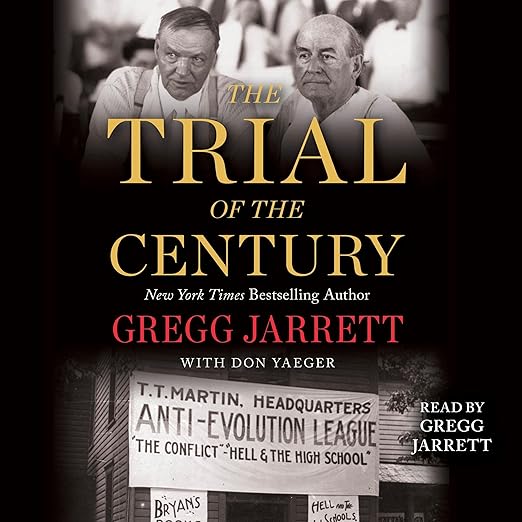
The Scopes Monkey Trial of 1925 is one of those events that most people know as cultural shorthand. The moment when evolution went on trial in Dayton, Tennessee, with Clarence Darrow defending schoolteacher John Scopes and William Jennings Bryan prosecuting, has been simplified into a kind of morality play about science versus religion, reason versus faith. The cultural version is accurate enough but flattened in ways that lose the human complexity, the economic calculations, and the constitutional stakes of what actually happened in that courtroom. Gregg Jarrett’s The Trial of the Century sets out to restore those dimensions, and it largely succeeds.
I came to this with measured skepticism about Jarrett as a historian. He is primarily known as a Fox News legal analyst and bestselling author of politically engaged books, and his positioning in that landscape inevitably colors how some readers approach his historical work. But The Trial of the Century, for its first several hours, reads as conscientious legal history rather than advocacy, and the care with which Jarrett documents the personalities and constitutional context of the 1925 trial is evident throughout the narrative.
Clarence Darrow as the Book’s True Subject
Jarrett frames this as a book about a trial, but it is more accurately a sustained profile of Clarence Darrow, the liberal attorney who defended John Scopes and who had already built one of the most significant careers in American legal history by the time he arrived in the small town of Dayton. Jarrett is clearly fascinated by Darrow, and that fascination generates the book’s best material. The legal philosophy, the rhetorical strategy, the biographical context that made Darrow who he was in 1925, all of this is handled with genuine depth and with the enthusiasm of a lawyer admiring a predecessor of exceptional capability.
One reviewer described Jarrett as likely the best lawyer who, as a writer, can guide the layman through the weeds of American law. That assessment is useful. Jarrett writes about legal concepts with the clarity of someone who has spent years making them accessible to television audiences, and the book’s explanation of the First Amendment implications of the Scopes Trial is appropriately rigorous without requiring a law degree to follow. The constitutional argument is never obscured by the drama surrounding it.
Historical Texture and the Town of Dayton
One of the book’s structural strengths is its attention to the social and economic context of Dayton, Tennessee in 1925. The trial was not merely an intellectual confrontation between two famous adversaries; it was a civic event that local business leaders saw as an opportunity for publicity, economic activity, and putting their town on the national map. That dimension, the trial as spectacle and economic calculation alongside its significance as a legal and cultural moment, gives the narrative a texture that purely intellectual history often lacks. Jarrett documents the human ecosystem around the trial with evident enjoyment.
The narration by Jarrett himself is a significant asset throughout. His broadcast background gives him a natural authority that keeps the material moving at a pace that academic legal history often fails to sustain. He reads his own courtroom descriptions with the enthusiasm of someone who finds the drama genuinely compelling, and the Darrow-Bryan confrontation in the final days of the trial benefits particularly from that quality.
The Epilogue Problem
The book’s most discussed weakness is its epilogue, and multiple reviewers with varying political orientations flagged it as a problem worth noting. One reviewer described it as a thinly veiled defense of contemporary political positions and a confusion of politically-altered history for freedom of speech. Another noted repetition in the later chapters and a missed opportunity to explore why John Scopes himself was so willing to serve as the test case in the first place. A third found the book well-researched and well-written overall but noted that the epilogue weakened its credibility as objective historical reportage.
These criticisms reflect something real and structural. Jarrett’s framing of the Scopes Trial’s legacy in relation to contemporary education debates is where the book’s advocacy instincts most visibly surface, and listeners who found the historical account balanced may find the shift jarring. Whether they find the epilogue’s argument compelling or not will depend considerably on their prior views, which is a reliable sign that the author has moved from historical territory into political territory without fully marking the transition.
What This Book Delivers and What It Does Not
For the history of the Scopes Trial itself, Jarrett’s account is well-researched, eminently readable, and genuinely informative. The character portraits of Darrow and Bryan, the reconstruction of the trial’s atmosphere, and the explanation of its First Amendment significance are all handled with skill and with appropriate attention to the historical context that made 1925 the right moment for this particular confrontation. The 4.3 rating across over 270 listeners reflects an audience that found the historical content strong while having mixed responses to the contemporary framing in the later sections.
Listeners who want a comprehensive intellectual history of the evolution-creationism debate, or who want deeper engagement with John Scopes as a character in his own right, may find gaps. But as an accessible, well-told account of one of American legal history’s most memorable proceedings, The Trial of the Century delivers what it promises, with the important caveat that the epilogue’s contemporary applications are better received as opinion than as history.
Frequently Asked Questions
Does The Trial of the Century require prior knowledge of the Scopes Trial to follow?
No. Jarrett builds the historical context from the ground up, covering the legal background, the personalities of Darrow and Bryan, the social dynamics of Dayton in 1925, and the trial’s First Amendment significance. Listeners coming in knowing only the cultural shorthand of the trial will find everything they need to follow the account and understand what was at stake.
How does Jarrett handle the religious and scientific dimensions of the Scopes Trial without taking sides?
He is largely successful in maintaining balance for most of the book, presenting both Bryan’s anti-evolution position and Darrow’s defense of academic freedom with their internal logics intact. The epilogue, where Jarrett draws contemporary parallels, is where the balance becomes more contested. Several reviewers noted that the epilogue reads as advocacy in a way that the historical sections do not.
Is the audiobook narrated by Gregg Jarrett himself, and does that affect the experience?
Yes, Jarrett narrates his own work. His broadcast background gives him a professional clarity and appropriate pacing that serves legal history well. He reads the courtroom sequences with genuine enthusiasm, and his legal expertise means he conveys the significance of procedural moments without over-explaining them. The self-narration is a clear asset for this particular book.
Some reviewers mention repetition in the later chapters. How significant is this for the overall listening experience?
A few reviewers noted that the middle and later sections revisit certain points, particularly around the trial’s promotion by Dayton’s business community, without adding substantially new information. This is more noticeable in audio than in print because the listener cannot skim. For most listeners, the pace and narrative engagement outweigh the occasional redundancy, though it is worth knowing about going in.