Quick Take
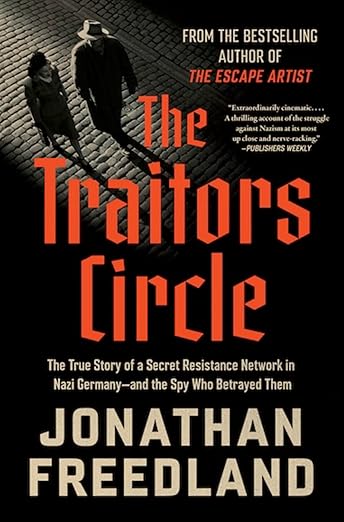
- Narration: Seth Andrews brings journalistic authority to Freedland’s narrative, keeping the historical pacing precise without losing the human drama that gives this true story its emotional force.
- Themes: resistance under totalitarianism, betrayal from within, the moral cost of courage in a collapsing society
- Mood: Taut and morally serious, with the propulsion of a thriller and the weight of documented history
- Verdict: A riveting reconstruction of a forgotten pocket of German resistance that asks hard questions about what it takes to stand against tyranny.
There is a particular kind of historical narrative that I find almost irresistible: a small group of people, circumstances that should make resistance impossible, and the question of how they found the courage to try anyway. Jonathan Freedland’s The Traitors Circle falls squarely into that category, and it does so with the craft of a writer who has spent decades understanding how to make the past feel present. I listened to the opening chapters on a quiet Tuesday afternoon and did not stop until well into the evening, which is my most reliable measure of whether a narrative history has done its job.
The story is set in Berlin in 1943. A group of anti-Nazi dissenters, drawn from the German social elite, gather for what appears to be a tea party. Two countesses. A diplomat. An intelligence officer. An ambassador’s widow. A pioneering headmistress. They have been quietly defying Hitler for more than a decade, performing acts of resistance that range from meeting in secret to actively sheltering Jews. And one of them, at that afternoon gathering, is prepared to hand them all to the Gestapo. This is Freedland’s starting point, and the question he pursues across twelve hours is how a circle of principled, courageous people, people who had successfully evaded the Reich for years, walked into a trap of this particular lethality.
Our Take on The Traitors Circle
Freedland is the author of The Escape Artist and is known for constructing historical narratives with the structure of thrillers. That instinct serves this material exceptionally well. The tea party frame at the opening functions like the first chapter of a heist novel in reverse: you know the end before you know the beginning, and the narrative works backward and sideways through these six lives to show you how they arrived at that fatal afternoon. The device creates genuine suspense even in scenes of relative quiet, because you are always aware of what is waiting. Mick Herron, the author of Slow Horses, called it an astonishing true story of courage, love, and betrayal, told with the verve of a thriller, and that assessment is precise.
Why Listen to The Traitors Circle
Seth Andrews as narrator is a considered choice for this material. His voice carries a quality of measured authority that is appropriate for documented history without becoming academic. The emotional beats in Freedland’s writing, and there are genuine ones, come through in Andrews’s delivery without being sentimentalized. The twelve-plus hours pass at a pace that reflects the material’s structure: the earlier chapters that establish the characters and their world of resistance are given room to breathe; the later chapters, as the net closes, tighten accordingly. Andrews adjusts his rhythm to match that construction.
What to Watch For in The Traitors Circle
This book has no reviews in the database yet, given its late 2026 release date, and the synopsis contains only broad strokes of its subject matter. What I can say from the material at hand is that Freedland’s subject, the German resistance as it existed among elites rather than among military conspirators or organized political opposition, is genuinely underrepresented in English-language narrative history. Most accessible accounts of internal German resistance focus on the July 1944 plot against Hitler. Freedland is writing about something earlier, quieter, and in some ways more morally complex: people who resisted not through action aimed at assassination but through protection, shelter, and refusal, at enormous personal risk and ultimately, for some of them, at the cost of everything.
Who Should Listen to The Traitors Circle
Listeners who have read Erik Larson’s In the Garden of Beasts or Daniel James Brown’s The Boys in the Boat, writers who combine meticulous research with thriller-level pacing in historical nonfiction, will find Freedland a natural next listen. This also works for anyone whose interest in World War II has tended toward the military and strategic, and who wants to understand what resistance looked like for civilians who had no access to weapons or armies. Skip it if you need your narrative history to stay at a distance from moral difficulty; Freedland is explicitly asking what it takes to stand against tyranny, and he does not let that question rest easily.
Frequently Asked Questions
Is The Traitors Circle based on documented history or partly fictionalized?
Freedland is a journalist and nonfiction author, and The Traitors Circle is based on documented historical events and figures. His approach combines rigorous research with thriller-style narrative construction, but the core events and people are real.
How does this book compare to other World War II resistance narratives?
It covers less familiar ground than most. Where popular WWII resistance histories often focus on the July 1944 military plot or French resistance networks, Freedland concentrates on a circle of German social elites who resisted through protection and quiet defiance over more than a decade. The perspective is genuinely distinctive.
Is prior knowledge of the period required to follow The Traitors Circle?
Freedland provides the historical context needed to understand the events. Familiarity with the general outline of Nazi Germany is helpful, but the book does not presuppose specialized knowledge. Readers new to this period can follow the narrative without difficulty.
Does Seth Andrews’s narration work for a book with multiple historical figures?
Yes. Andrews maintains enough vocal distinction between the major figures to keep the ensemble clear, and his journalistic delivery keeps the historical scaffolding from weighing down the narrative. This is a style better suited to narrative nonfiction than to fiction with elaborate character performance.