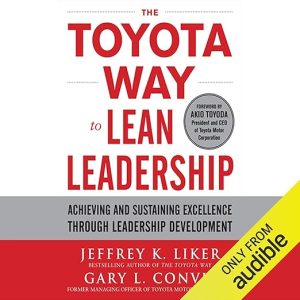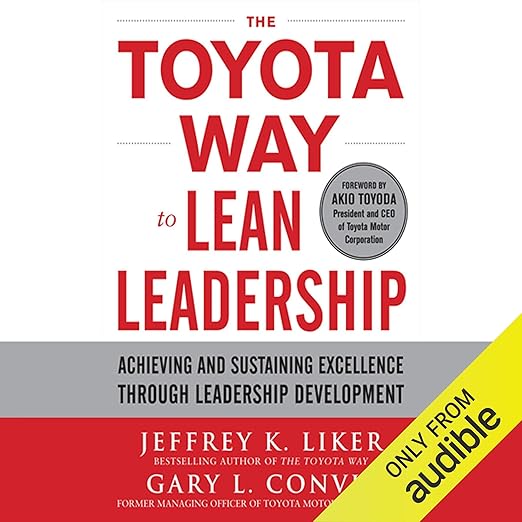
Gary L. Convis spent years as a Toyota executive vice president before becoming CEO of Dana Holding Corporation, a $6.1 billion auto-parts supplier he helped guide out of bankruptcy, and this audiobook opens from exactly that vantage point, a leader who ran Lean principles from inside Toyota and then had to prove they'd transfer to a company in crisis. Jeffrey Liker, the University of Michigan professor behind the popular Toyota Way series, teams up with Convis here specifically to answer the question their case studies keep circling: why has no company matched Toyota's sustained Lean results despite decades of manufacturers copying its methods? Their answer, argued across ten hours, is leadership, not process.
A Closer Look at The Toyota Way to Lean Leadership
Reviewer M's review lays out the book's core thesis efficiently: it's 'all about leadership,' specifically the Japanese concept of shu ha ri, learn the rules, break the rules, transcend the rules, as a framework for developing leaders rather than just optimizing processes. That reviewer, having read over thirty other lean and business-excellence books, ranks this one ahead of the field specifically for tackling leadership development head-on rather than treating it as a footnote to process improvement, which tracks with how much of the book's runtime goes to case studies of how Toyota actually grows leaders internally rather than hires them from outside.
Reviewer CHM DE BEER frames the book's real contribution as filling a specific gap: understanding how a lean organization gets 'built up, nurtured, and continuously improved' over time, not just implemented once and left alone. That distinction matters because so much Lean literature treats implementation as a project with an end date; Liker and Convis argue, through Toyota's own multi-decade track record, that leadership development has to be continuous and self-sustaining, or the process improvements eventually erode.
The book's case-study method deserves a specific mention: rather than working purely from abstract principle, Liker and Convis walk through named internal Toyota programs and specific plant-level leadership transitions, giving listeners concrete decision points to follow rather than only high-level philosophy. That groundedness is part of why reviewer M rates it so highly relative to the broader lean and business-excellence category, since a lot of adjacent business literature stays comfortably abstract in a way this book, built from two authors who each spent real time inside Toyota's own systems, does not.
What Makes The Toyota Way to Lean Leadership Worth Hearing
Narrator Jim Meskimen has the job of making dense case-study material, executive decision-making, organizational structure, internal leadership pipelines, land with clarity across ten hours without either flattening into corporate monotone or overselling the material with false motivational energy. Business audiobooks live or die on exactly that balance, since listeners need enough authority to trust the material but enough warmth to stay engaged through case study after case study, and that specific register is what a book built on real operational detail, rather than pure inspiration, requires from its narrator.
Convis's insider perspective is the book's real differentiator from Liker's earlier, more theory-focused Toyota Way titles: reviewer Harun Tuygan highlights the book's direct contrast between hero-leader style, effective only in the moment, and lean leadership built for an organization designed to last well beyond any one executive's tenure. Hearing that argument delivered with the specific, lived case-study detail Convis brings from his own Toyota-to-Dana career arc gives the ten hours a concrete throughline that a purely academic treatment of the same ideas wouldn't have.
Meskimen's own career sits mostly outside the business-nonfiction category, which raises a fair question about fit that's worth answering directly: audiobooks in this genre often benefit most from narrators who bring range rather than pure industry-insider credibility, since the material's authority already comes from Liker's academic standing and Convis's executive record, leaving the narrator free to focus purely on pacing and clarity rather than performing expertise the text already establishes on its own terms.
Things to Know Before Starting The Toyota Way to Lean Leadership
The genre tagging here undersells what this book actually is: filed under money and finance with an investing-and-trading tag, this is squarely an operations and leadership development title, not a personal finance or investment guide, and listeners searching for portfolio strategy or market analysis are in the wrong book entirely. Approach this as a business leadership and organizational-development title specifically, closer in spirit to a case-study-driven MBA course than anything about managing money.
Reviewer Harun Tuygan raises a fair broader critique worth carrying into the listen: this is an era that values short-term results, and Liker and Convis's whole argument depends on convincing an audience trained to want quarterly wins that multi-year leadership development is worth the patience. Listeners looking for quick tactical fixes rather than a genuine philosophy of sustained organizational change should recalibrate expectations; this book's payoff is cumulative, not immediate.
The book also assumes some baseline familiarity with Lean or Toyota Production System vocabulary, kaizen, gemba, standardized work, even though it defines key terms as they come up; listeners completely new to Lean manufacturing concepts may want a general primer first, since this book builds specifically on that foundation to make its leadership-specific argument rather than re-teaching Lean fundamentals from scratch.
Who Jeffrey Liker Is Writing For
This suits operations managers, executives, and anyone responsible for developing leadership pipelines inside a mid-size or large organization, particularly listeners already familiar with Lean or Six Sigma frameworks looking for the leadership layer those methodologies often skip. Fans of Liker's earlier Toyota Way books will find this a natural next step, built specifically around the leadership-development gap those earlier titles left open. Consultants and corporate trainers who teach Lean methodology professionally will also find fresh case-study material here worth incorporating directly into their own curriculum, particularly the leadership-development content that goes beyond the process-mapping work most Lean training already covers.
Listeners who've encountered Lean thinking mainly through startup or software contexts, where it's often compressed into agile methodology or minimum-viable-product thinking, will find real value in seeing the concept applied at its original scale and pace, decades-long organizational commitment rather than a single product cycle. That contrast alone reframes what Lean actually asks of an organization when applied with the patience Toyota itself brings to it, rather than the accelerated version many industries have since adapted for faster-moving markets. Human resources and organizational development professionals specifically, not just operations staff, will find the leadership-pipeline material directly applicable to succession planning and internal promotion criteria well beyond manufacturing contexts.
Entrepreneurs or small-business owners without an existing multi-layer management structure may find some of the case studies, built around large-scale automotive manufacturing and multi-decade executive pipelines, harder to translate directly to a smaller operation. Anyone drawn in by the money-and-finance genre tag expecting investment content should redirect toward a title actually built around personal finance instead, since nothing here addresses markets, portfolios, or investing strategy.
- Voice: Jim Meskimen balances authority and warmth across dense case-study material, avoiding both corporate monotone and false motivational energy.
- Big ideas: Leadership development over process optimization, sustaining Lean culture long-term, the shu ha ri framework
- Atmosphere: Professional and case-study driven, patient rather than punchy
- Worth it?: A substantive leadership-focused Lean title best suited to managers building internal leadership pipelines, not general listeners hunting quick tactical fixes.
Is the Toyota Way to Lean Leadership audiobook about personal finance or investing?
No, despite its genre tag. This is a business leadership and operations title focused on developing Lean leadership within organizations, not investment strategy.
Do I need to read Jeffrey Liker's earlier Toyota Way books before this audiobook?
No. It stands alone, though it works especially well as a follow-up for listeners already familiar with the earlier Toyota Way titles' process-focused material.
Does the Toyota Way to Lean Leadership audiobook work for small businesses, or is it aimed at large companies?
It leans toward larger organizations. The case studies center on large-scale automotive manufacturing and multi-decade executive pipelines that may not translate directly to a small operation.