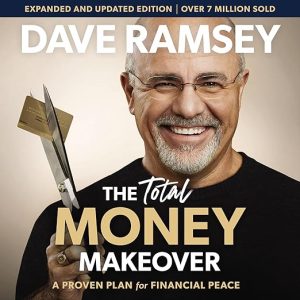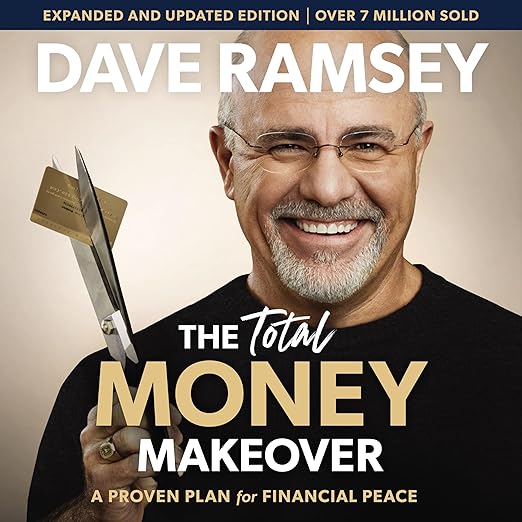
Dave Ramsey has been giving the same essential advice for decades, and the persistence of that advice is not a weakness. The Total Money Makeover Updated and Expanded audiobook works precisely because Ramsey has not tried to make his framework fashionable or complicated. The seven Baby Steps, the debt snowball method, the emergency fund, the instruction to live like no one else so you can later live like no one else, these are the same principles that have helped millions of people get out of debt, and they are delivered in Ramsey's own voice with the conviction of someone who has watched them work in the field rather than theorized them in an office. At seven hours and fifty minutes, this is one of the longer personal finance audiobooks in its tier, but the runtime reflects a genuine attempt to cover the full arc from crisis to stability rather than simply selling a framework and leaving the implementation to the listener.
The self-narration is essential to the audiobook's effectiveness. Ramsey's voice has a quality that is difficult to separate from his content: it is direct, slightly combative in its refusal to accept excuses, and fundamentally warm in its belief that the people in financial trouble who read this book are capable of getting out of it. Reviewer Kristin B. describes discovering Ramsey through a church recommendation and finding the book genuinely transformative, which captures the communal, almost pastoral dimension of Ramsey's project. The updated and expanded edition includes new material on marriage conflict and college debt, and the companion PDF referenced in the audiobook provides testimonies and QR codes that extend the material beyond what the audio can contain.
Ramsey Targets Behavior, Not a Knowledge Gap
What Ramsey understands better than most personal finance writers is that the primary barrier to financial improvement is behavioral rather than intellectual. Most people who are in debt already know that they should spend less than they earn. What they do not have is a behavioral system that makes that knowledge actionable and sustainable under the emotional pressure of real financial stress. The Baby Steps function as a behavioral scaffold: they give you a sequence, a celebration mechanism in the debt snowball, and a community of practice in the broader Ramsey universe. The audiobook is most effective as a delivery vehicle for that behavioral system rather than as a source of novel financial information.
Reviewer StylishTraveler77 describes the book as laying out specific steps to tackle debt and build an emergency fund with clear action steps, which is accurate. The actionability is the point. Reviewer J, who has bought the book multiple times as a gift, notes that it provides simple common sense information to get out of debt and stay out of debt, and that simplicity is deliberately chosen rather than inadvertently reductive. Ramsey's genius is the refusal to complicate a framework that does not need complication to work.
Ramsey's Radio Roots Explain the Audio's Power
The audiobook format is particularly well-suited to this material for the same reason that Ramsey built his audience primarily through radio. The message is inspirational in the classical sense: it needs to enter through the ear and activate something that written text alone is slower to reach. Hearing Ramsey deliver his argument, his impatience with the get-rich-quick schemes, his insistence on the 10 most dangerous money myths, his specific characterization of the debt snowball as a psychological tool as much as a mathematical one, carries a motivational charge that the page version of the same content does not replicate with equal force. Reviewer Kristin B. describes the book as genuinely changing the way she and her husband manage finances, and that kind of behavioral change is the outcome the audiobook is designed to produce.
The companion PDF is a meaningful addition for listeners who want the testimonial and visual elements. The QR codes that Ramsey references throughout the audio point to supplementary content that deepens certain sections, and some of that material may be particularly valuable for the new content on marriage conflict and college debt. If you intend to use this audiobook as an active working tool rather than a passive listen, downloading the PDF companion is worth doing before you begin.
Ramsey's Skepticism Toward Conventional Financial Advice
Ramsey's approach has a specific perspective on debt, financial planning, and economic behavior that is worth understanding before you begin. He is skeptical of many conventional financial instruments, including certain types of investment and borrowing, and his advice on those subjects reflects a particular philosophical orientation rather than the consensus of the broader financial planning field. The Baby Steps framework works for a large number of people in debt, but it is not the only credible approach to personal finance. Listeners who want a broader sampling of strategies should treat this audiobook as one well-developed perspective rather than the final word.
His faith background also surfaces occasionally in the material, and the updated edition includes content encountered through church community connections according to several reviewers. This dimension is present but not so dominant that it prevents engagement from listeners who do not share it. The practical financial framework operates independently of the spiritual framing, though the two are clearly connected in Ramsey's own thinking. Know what you are engaging with and the audiobook will deliver exactly what it promises.
Best for Listeners Who Want Direct Motivation
People in debt who want a concrete, behavioral framework for getting out of it, and who respond well to direct, motivational delivery, will get the most from this audiobook. The self-narration by Ramsey is a specific asset for this audience: hearing the argument from the person who built it has a different effect than hearing it read by a professional narrator. Listeners who are already familiar with the Baby Steps framework from Ramsey's radio show or earlier editions of the book will find the updated content on marriage conflict and college debt adds genuine new material. Those who find Ramsey's style too prescriptive, or who want a more analytically balanced personal finance framework, should look elsewhere; this audiobook is not attempting to present multiple perspectives on debt management. It is presenting one, with conviction and at length.
A Few Questions About The Total Money Makeover Updated and Expanded
Does Dave Ramsey narrate this audiobook himself, and does it matter?
Yes, Ramsey reads it himself. It matters considerably. His delivery carries the direct, motivational quality of his radio work in a way that a professional narrator reading the same text would not replicate. Multiple reviewers describe the impact as particularly strong in audio form. If you are choosing between print and audio for this title, the self-narration is a genuine argument for the audiobook.
What is the companion PDF that comes with this audiobook, and should I download it?
The listing specifically notes a companion PDF available in your library alongside the audio. It includes testimonies and QR codes that point to supplementary content referenced during the recording. Downloading it before you begin listening is recommended if you plan to use this audiobook actively rather than just passively, particularly for the new content on marriage conflict and college debt in the updated edition.
Is this audiobook suitable for someone already familiar with Ramsey's Baby Steps?
Yes. The updated and expanded edition includes new material not in earlier versions, specifically content on marriage and money conflict, college debt, and additional testimonies. Long-time Ramsey followers who have read earlier editions will find genuine new content alongside the familiar framework.
Does this audiobook present a balanced view of personal finance, or is it specifically Ramsey's method?
It presents Ramsey's method specifically, with his characteristic direct conviction. He is skeptical of many conventional financial instruments and debt management approaches that other credible advisors recommend. This is one well-developed perspective on debt elimination, not a survey of the field. Listeners who want multiple frameworks should read this alongside other personal finance resources rather than treating it as a comprehensive guide.