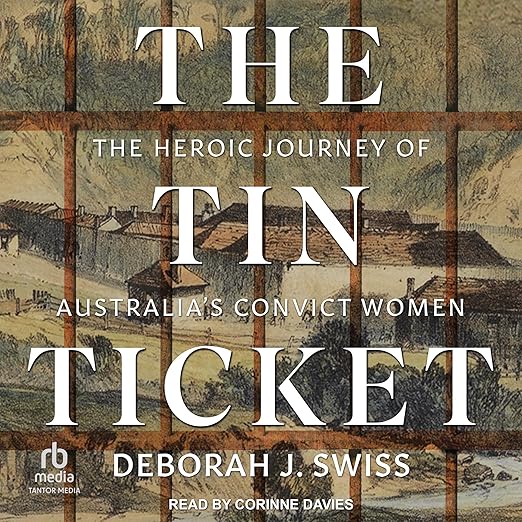
Quick Take
- Narration: Corinne Davies delivers a warm, empathetic performance that honors the raw material without melodrama, though the pacing occasionally flattens during the statistical sections.
- Themes: Female resilience, colonial punishment, found sisterhood
- Mood: Heavy and intimate, slowly accumulating toward something like hope
- Verdict: A careful work of recovered history that earns its emotional weight, best for listeners who want individual lives braided into broader social catastrophe.
I started listening to The Tin Ticket on a wet Sunday afternoon when I had nothing urgent pulling me elsewhere, and I was still thinking about Agnes McMillan three days later on my commute. That kind of staying power usually signals something real in the underlying history, and Deborah J. Swiss gives Agnes and her companions genuine texture: not martyrs, not statistics, but women with specific grievances, specific friendships, specific acts of defiance that got them transported across an ocean.
The premise is both simple and staggering. In the early nineteenth century, thousands of women convicted of offenses ranging from petty theft to more serious crimes were shipped from Britain and Ireland to Van Diemen’s Land, what we now call Tasmania. Historian Swiss focuses on four of them: Agnes McMillan, her friend Janet Houston, Ludlow Tedder, and Bridget Mulligan. The tin ticket of the title was the document these women carried, a small physical object that marked their status as convicts and shaped every transaction they had with the colonial system. Swiss knows what she is doing with that image. Objects carry history in ways that abstract arguments sometimes cannot.
What the Four Women Actually Carry
Swiss structures the book around individual biographies, weaving back and forth between the Scottish wynds where Agnes and Janet knew each other before transportation and the institutional machinery of Van Diemen’s Land. The approach works because it refuses to let the women blur into collective suffering. Ludlow Tedder’s situation is among the most wrenching things in the book: she was forced to choose which one of her four children could accompany her to the other side of the world. Swiss does not editorialize that moment. She does not need to. She just reports what the records show and lets the reader sit with it.
One Audible reviewer noted that the author may do some conjecturing about the inner lives of her subjects, and that is a fair observation. When the documentary record runs thin, Swiss sometimes fills the gap with carefully hedged speculation about what a woman might have felt or thought. In a strict academic history, this would be problematic. For a narrative history aimed at a general audience, it feels like a reasonable choice, provided listeners understand they are occasionally in reconstructed territory. Swiss signals these moments, but not always with the clarity a more cautious writer might prefer.
Elizabeth Gurney Fry and the Reform Thread
The book’s fifth major figure, Quaker reformer Elizabeth Gurney Fry, provides the political counterweight. Fry’s efforts to improve conditions for transported women were real and documented, and Swiss uses her as a way to examine the reformist impulse that coexisted with the brutality of the system. This thread is genuinely interesting, though it occasionally pulls focus from the four convict women whose stories are more compelling. There is something slightly uncomfortable about giving significant narrative space to the philanthropist when the transported women are the ostensible heart of the book. Swiss is aware of this tension, and she navigates it with more skill than not, but listeners who come for Agnes McMillan may find themselves impatient during the Fry sections.
The Continent These Women Built
Swiss’s central argument is one that historians of colonial Australia have been making with increasing force over recent decades: the women who were transported, labeled criminals and discarded by their homeland, became foundational to the society that emerged in Van Diemen’s Land. Bridget Mulligan’s line of descendants extends to the present. The liberated society that Swiss describes in her subtitle is provocative framing, and the book earns it partially rather than fully. The argument is that these women, having had nothing to lose, created a social order with more practical equality than anything they had left behind. It is a resonant argument, and Swiss makes it with evidence. Whether listeners find it wholly convincing may depend on how much weight they give to the ongoing violence and dispossession of Indigenous Tasmanians, which The Tin Ticket does not substantially address.
That gap does not invalidate what Swiss has accomplished. This is recovered history of a serious kind, and the four women at its center deserve to be known.
Corinne Davies and the Particular Challenge of This Material
Reading stories of systematic deprivation requires a narrator who can hold the listener inside the reality without becoming a buffer between the listener and what is being described. Corinne Davies manages this more often than not. Her warmth is calibrated, not excessive, and the passages describing the Cascades Female Factory, where conditions were deliberately brutal, she reads with a controlled steadiness that serves the material well. Where the book shifts into denser contextual exposition, the kind of passage that was clearly written for the eye rather than the ear, Davies’s delivery flattens noticeably. This is a limitation of the underlying text as much as the narration, and it does not seriously diminish an otherwise well-matched performance.
Who Should Listen, Who Should Skip
Listeners drawn to narrative social history in the tradition of Adam Hochschild, who provides a blurb here, will find The Tin Ticket deeply rewarding. It suits anyone interested in women’s history, colonial Australia, penal transportation, or the nineteenth-century reform movement. Listeners wanting strict academic rigor or significant engagement with Aboriginal perspectives on the same period should supplement this with other titles. The runtime of nearly fourteen hours feels justified, and the four women at its center are worth every hour of it.
Frequently Asked Questions
Does The Tin Ticket cover all transported women, or does it focus on specific individuals?
Swiss centers the narrative on four specific women: Agnes McMillan, Janet Houston, Ludlow Tedder, and Bridget Mulligan. These four are traced in detail from their lives in Britain through their time in Van Diemen’s Land. The broader context of transportation is provided, but the book works through individual lives rather than comprehensive survey.
How much of the book is documented history versus reconstruction?
The majority rests on public records, court documents, and archival sources. Some reviewers note that Swiss occasionally conjectures about the inner thoughts and feelings of her subjects when the record is thin. She signals these moments, but the book sits closer to narrative history than strictly sourced academic history.
Does the book address the impact of transportation on Indigenous Tasmanians?
Not substantially. The Tin Ticket focuses on the convict women and the colonial society they helped build. Listeners looking for a more complete picture of what that colonial settlement meant for Aboriginal Tasmanians will need to read additional titles alongside this one.
Is Corinne Davies’s narration a good fit for this material?
For the narrative sections, yes. Davies reads with empathy and restraint, which suits the emotional weight of the subject. The book’s more textbook-like historical passages are slightly less dynamic in her delivery, but this is a minor issue in what is otherwise a well-executed performance.