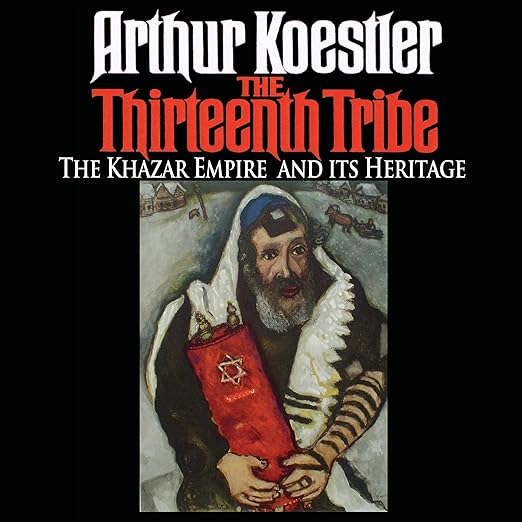
Did a Dark Ages empire really convert its ruling class to Judaism, then vanish so thoroughly that most listeners today have never heard its name? That's the historical puzzle Arthur Koestler chases across this audiobook, tracing the Khazar Empire from its seventh-century rise between the Black Sea and the Caspian to its destruction by Genghis Khan's forces. The Thirteenth Tribe runs 8 hours and 13 minutes, and Koestler, better known for the novel Darkness at Noon, builds his case here as historical argument rather than fiction, tracking a theory that the Khazars migrated toward Poland and became part of the foundation of Western European Jewry.
Choosing Judaism to Resist Byzantium and the Caliphate
Koestler frames the Khazars as a genuine third power caught between two empires: pressured toward Christianity by Byzantium and toward Islam by the Caliphate, they chose neither, converting instead to Judaism as a way of resisting both. The book spends real time on the strategic logic behind that choice, and on the Khazars' role stopping Muslim expansion toward Byzantium, before turning to the harder-to-prove migration theory that carries the book's second half.
The synopsis notes this is 'all original edition, nothing added, nothing removed,' meaning listeners get Koestler's 1976 argument exactly as written, without any updated modern introduction contextualizing it against newer research. Per the original text, Koestler's stated aim was research detailed enough to make the term 'anti-Semitism' 'void of meaning' if his Khazar-descent theory held. That's a significant, and significantly contested, claim to build an entire book around, and it's worth knowing that ambition going in.
Koestler works hard to make a genuinely obscure medieval empire feel consequential to listeners with no prior background; the synopsis itself acknowledges the Khazars 'may seem infinitely remote today' before arguing for their real historical weight. He anchors the timeline with a familiar reference point, noting the Khazars' territorial peak roughly coincided with Charlemagne's reign in the West, a useful trick for placing an unfamiliar Eastern European power against history most listeners already have some grounding in.
The book's geographic sweep is genuinely wide for eight hours: Koestler tracks the Khazars' territory from the Black Sea to the Caspian and the Caucasus to the Volga, positions them against both the Byzantine and early Islamic worlds, and only then turns to the harder-to-verify migration theory. That structure, extensive scene-setting before the contested claim, gives listeners real context before the book asks them to weigh its central argument.
That eventual military defeat gets treated almost as an epilogue rather than a climax, a reminder that Koestler's real interest lies less in the Khazars' military history than in what became of their population and legacy afterward, which is where the book's more consequential and more contested claims actually live.
J. R. Moorland's Steady Clarity Across Shifting Borders
J. R. Moorland's narration needs to carry a lot of dense geographic and historical detail, borders shifting between the Black Sea, the Caspian, the Caucasus, and the Volga, multiple empires and centuries in play at once, and does so with the steady, unhurried clarity that this kind of argumentative history needs. Nothing here is narrated for drama; it's narrated for comprehension, which is the right call for material this dense.
Reader HJ approached the book cautiously, as 'the first and probably last book' they'd read on the topic, judging it purely on 'internal logic, reasoning and methodology in choosing authoritative history from various competing sources.' Their verdict: 'I find no fault with the author's endeavour.' That's a useful benchmark for a listener without prior grounding in Khazar history, since it suggests the argument holds together as a piece of reasoning even for a skeptical newcomer.
Reviewer Joe Briggs offered a useful structural note: the underlying book runs 'about 200 pages, with about another 50 in references,' meaning a meaningful quarter of Koestler's source material is citation and documentation rather than narrative argument. That ratio signals a writer building his case on documented sources rather than speculation alone, whatever you ultimately conclude about where those sources lead.
Reader Dennis Anderson called the underlying research 'excellent' and 'scholarly researched,' a characterization worth weighing alongside the more skeptical framing above; listener reactions to this book vary considerably depending on how each person independently assesses Koestler's methodology and conclusions, which is itself a sign of how genuinely contested this material remains decades after publication.
Population Genetics Has Complicated a 1976 Theory
This needs to be said plainly: the Khazar-origin hypothesis for Ashkenazi Jewry remains a minority position among historians, and it has been significantly challenged by later population-genetics research that Koestler, writing in 1976, could not have accounted for. Listen to this as a historical document of one writer's argument and its era, not as settled or current scholarship on Jewish origins.
Because the edition is unaltered original text, no narrator's note or updated foreword weighs in on how the theory has aged, which some listeners may want going in. This is 8 hours of sustained historical argumentation rather than narrative history, so it suits listeners already comfortable following competing sources and methodology more than casual history listeners looking for a straightforward story.
With 484 ratings behind a 4.4 average, this has a substantial listener base for a dense historical argument nearly 50 years old, which suggests the book still finds an audience well beyond specialists in medieval Jewish history. That said, a large rating count doesn't settle the underlying historical debate; it just confirms the book remains actively read and discussed.
It's worth listening with some outside context in hand, ideally a secondary source or two on how Khazar-origin theories have been received and challenged since 1976, rather than treating Koestler's argument as the complete picture on its own. That's true of any single-author historical argument this old, but especially one built around a claim this consequential.
Judged as a Sustained Argument, Rather Than a Survey
Recommended for listeners interested in medieval Eastern European history, the history of Judaism and Jewish identity debates, or Koestler's nonfiction work beyond his novels. It's also worth a listen for anyone interested in how a serious, research-driven argument gets built and defended across a full book, regardless of where you land on its central claim.
It's also a reasonable choice for listeners who enjoy nonfiction built around a single, sustained argument rather than a broad survey, closer to sitting in on a debate you get to judge for yourself than reading a settled textbook account.
Skip it if you're looking for current, consensus-reflecting scholarship on Ashkenazi Jewish origins; this is a 50-year-old argument that predates the genetic research that has since complicated it substantially. Approach it as one writer's contested historical thesis from its specific moment, not the final word on the subject.
Key Details
- Voice: J. R. Moorland gives Koestler's dense historical argument the steady, unhurried clarity it needs across shifting centuries and geography.
- Big ideas: contested Jewish history, empire and religious conversion, the politics of identity and origin
- Atmosphere: Dense, argumentative, and deliberately provocative
- Worth it?: Worth hearing as a historical document of its own era's debate, not as settled modern scholarship.