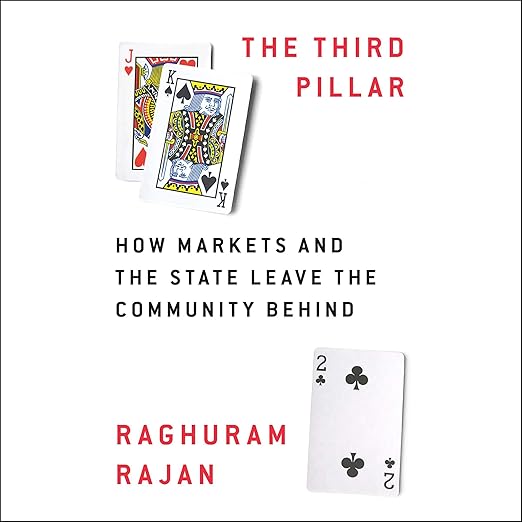
Quick Take
- Narration: Jason Culp delivers Rajan’s dense, scholarly prose with clarity and appropriate gravity, keeping a 19-hour intellectual argument listenable throughout.
- Themes: The balance between state, market, and community, populism as symptom not cause, decentralization as democratic remedy
- Mood: Measured and scholarly, with underlying urgency about contemporary political fracture
- Verdict: A serious, deeply researched argument that makes a compelling case for why economists have been asking the wrong questions about globalization.
I came to The Third Pillar during a period when I was reading several books about populism and the fracturing of liberal democracies, trying to understand what the arguments from different disciplines were actually saying to each other. Most of what I encountered was either ideologically predictable or analytically thin. Raghuram Rajan’s book was neither. It’s one of the more genuinely illuminating books I’ve listened to on the subject, precisely because Rajan refuses to reduce the problem to either market failure or government incompetence.
Rajan’s credentials are formidable: former chief economist at the IMF, head of India’s central bank, University of Chicago professor, and author of Fault Lines, which won the FT-Goldman Sachs Book of the Year in 2010 and was one of the few books to anticipate the 2008 financial crisis. He brings that institutional vantage point to a question that most economists sidestep entirely: what happens to the communities that get left behind when markets and states scale up together?
Our Take on The Third Pillar
The central argument is elegant in its framing, if demanding in its execution. Rajan identifies three pillars of a functioning society: the state, markets, and communities. Most economic thinking, he argues, treats the relationship between the first two as the whole picture and leaves communities, what he calls the “third pillar,” for sociologists and political scientists to worry about. That’s not just intellectually incomplete; it’s dangerous, because communities are where human beings actually live and where the social capital that makes markets function is generated and sustained.
One reviewer here, a skeptic, noted that Rajan’s “inclusive localism” is basically direct democracy with different vocabulary, and that his “managed globalization” amounts to slowing it down. That reading isn’t entirely fair, but it’s not entirely wrong either. Rajan is genuinely difficult to place on a conventional political spectrum, which is part of what makes his argument interesting and part of what makes it frustrating to readers who want clear prescriptions. He’s a reluctant critic of the status quo who has spent enough time inside major institutions to know their limitations from the inside.
Why Listen to The Third Pillar
Jason Culp’s narration is the right choice for material this dense. His delivery is measured and authoritative without being soporific, which is a real achievement across 19 hours of economic history and sociological analysis. Rajan’s prose is erudite and occasionally prolix, as one reviewer diplomatically observed, and Culp finds the line between academic register and accessible comprehension without losing the precision that Rajan’s argument requires.
The historical sweep here is genuinely impressive. Rajan traces the relationship between states, markets, and communities across centuries, including the technological disruptions that have historically preceded populist backlashes, and connects those patterns to the present moment with a specificity that most books on this topic lack. The comparative examples drawn from multiple countries give the argument a credibility that purely American or purely European accounts tend to undermine.
What to Watch For in The Third Pillar
One honest reviewer called this a “slow but very deep book,” which is accurate. The opening historical survey is where many listeners will either commit or disengage. Rajan is not trying to entertain you; he’s building an intellectual architecture that the later policy prescriptions depend on. If you skip through the history, the final third loses its grounding.
The book was shortlisted for the FT/McKinsey Business Book of the Year Award, which reflects its positioning within the policy and business intellectual world rather than the popular economics shelf. It’s closer in register to Daron Acemoglu and James Robinson’s Why Nations Fail than to Malcolm Gladwell, and listeners should calibrate their expectations accordingly.
The prescriptions for “inclusive localism” will strike some as too vague to be operational and others as a genuine alternative to the centralizing tendencies of both the left and right. Rajan himself acknowledges that his argument is easier to diagnose than to implement. That intellectual honesty is a strength, but it means the book ends with a direction rather than a roadmap.
Who Should Listen to The Third Pillar
Essential listening for policy-minded readers who want a serious intellectual framework for understanding the rise of populism in developed economies. Also rewarding for anyone who felt that most economic commentary on globalization was missing something without being able to name what. Less recommended for listeners who want prescriptive step-by-step solutions, or who are looking for a shorter, more accessible introduction to these themes. The 19-hour length is earned but requires genuine commitment.
Frequently Asked Questions
Do I need an economics background to follow Rajan’s argument?
Not a formal one. Rajan writes for an educated general audience, and Culp’s narration makes the economic concepts accessible without dumbing them down. Readers of books like Why Nations Fail or Capital in the Twenty-First Century will find the register familiar.
How does The Third Pillar relate to Rajan’s earlier book, Fault Lines?
Fault Lines was a diagnosis of the structural vulnerabilities that produced the 2008 financial crisis. The Third Pillar is a broader sociological and historical argument about why markets and states, left to their own dynamic, consistently damage the communities they operate within. They share Rajan’s analytical approach but are independent arguments.
Is Rajan’s ‘inclusive localism’ a conservative or progressive prescription?
Genuinely neither, which is part of what makes the book interesting and occasionally frustrating. Rajan’s argument for devolving decision-making to communities will appeal to certain strands of both traditions and will also frustrate both. Several reviewers noted he reads as a reluctant populist who arrived at his conclusions through institutional experience rather than ideology.
How does Jason Culp handle the 19-hour length of this material?
Very capably. His delivery is measured and clear, which is the right register for dense academic-adjacent prose. He doesn’t try to make the material more exciting than it is, but he keeps it from becoming inert, which across this length is a real accomplishment.