The Short Version
- Narrator: Phil Robertson self-narrates, and his recognizable Duck Dynasty cadence lends real authenticity to material that's explicitly autobiographical in places.
- Subjects: conservative Christian cultural critique, biblical apologetics, personal testimony
- Tone: Direct and homily-like, unapologetically opinionated
- Bottom line: A clear match for Robertson's existing audience and like-minded conservative Christian listeners, a hard pass for anyone wanting politically neutral commentary.
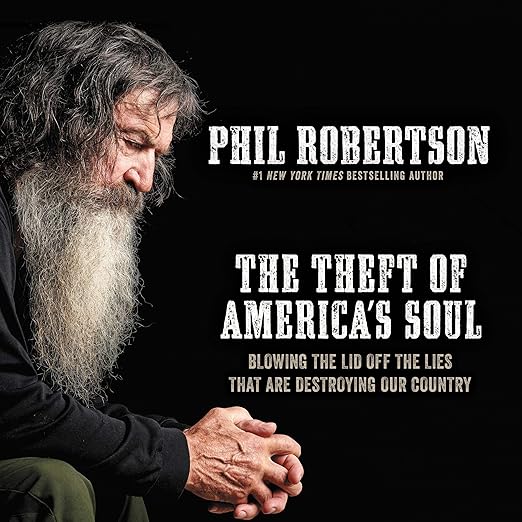
Phil Robertson built his public voice on Duck Dynasty, and he brings that same folksy directness to this audiobook, narrating his own case against what he calls ten cultural lies eroding the country. The Theft of America's Soul pairs each lie, claims like God is dead or truth is relative, with what Robertson frames as a corresponding biblical truth, across just under six hours.
Where This One Lands
The structure is straightforward: ten specific cultural claims, each rebutted with scripture-based counterargument, building toward Robertson's stated goal of restoring what he calls a God-honoring culture. The book blends this argument with pieces of personal testimony, one reviewer specifically notes it tells some of Robertson's own background, tracing his path from a wayward younger life to the public figure known from A&E's Duck Dynasty.
Two named endorsements appear directly in the synopsis: Eric Metaxas, author of the biography Bonhoeffer, and Tony Perkins, president of the Family Research Council. Both are worth noting plainly as a signal of exactly which audience and ideological lane this book is written for and endorsed within, rather than a general-market spiritual guide.
A few of the ten lies named directly in the synopsis give a real sense of the book's specific targets rather than a vague summary: God is dead, truth is relative, and Christians should shut their traps each get paired with a corresponding scriptural counterpoint, the God of the Bible is not dead, absolute truth comes from God, God's people represent his voice in the world. That one-to-one lie-and-truth structure is the book's actual argumentative engine, repeated ten times across its runtime.
One reviewer describes Robertson himself as a man who was once wayward and lost before turning his life around, and that biographical detail matters for how the book positions its own authority. Robertson isn't arguing purely from doctrine or abstract cultural theory, he's grounding the case in his own lived reversal, which gives the testimonial chapters a different weight than the more argumentative ones built around the ten lies themselves.
The Best Parts of The Theft of America’s Soul
Robertson narrating his own words carries the same recognizable cadence his television audience already knows, and that familiarity does real work here. The book is explicitly autobiographical in places, and hearing Robertson narrate his own turnaround story in his own voice adds a layer of authenticity a hired narrator simply couldn't replicate.
At just under six hours, the treatment of each of the ten lies stays fairly compact rather than deeply argued chapter by chapter, closer to a series of homilies than an academic treatise. That brevity suits listeners who want Robertson's take delivered directly rather than a footnoted theological defense.
Do the rough math and each lie-and-truth pairing gets somewhere in the neighborhood of thirty minutes once you account for an introduction and closing chapter, closer to a single sermon's length than a lecture. Listeners who want Robertson to linger and build a sustained scriptural case for each point individually should recalibrate toward a more compact, statement-then-verse structure instead.
It helps to understand the platform Robertson is speaking from. Duck Dynasty was a genuine ratings hit for A&E, and that reach is precisely why his particular blend of folksy humor and conservative Christian conviction carries weight with this audience in a way a less recognizable author's identical argument might not. The book trades directly on that built-in audience relationship rather than trying to win over skeptical readers from a standing start.
What Gives Us Pause
Be upfront with yourself about the framing before starting: this is explicitly conservative Christian cultural commentary fused with political stance-taking, not a neutral or ecumenical spiritual guide. The Family Research Council endorsement in particular signals a specific political and religious lane, and listeners should know that going in rather than discover it mid-book.
Rating data is thin: 4.9 stars from only four ratings on this listing, a number too small to read as a broad consensus regardless of how positive it looks at a glance.
The bite-size lie-and-truth structure makes this easy to listen to in short standalone segments rather than one continuous sitting, which suits listeners wanting devotional-style engagement spread across several days over a single long session.
The book's own framing as a prophetic wake-up call, promising peace of mind, harmony, and prosperity as the payoff for embracing its ten biblical truths, follows a familiar structure in Christian cultural-commentary publishing: diagnose societal decline, prescribe a return to scripture, promise restoration. Recognizing that pattern going in helps calibrate expectations about how the argument unfolds rather than being surprised by its rhetorical shape partway through.
One reviewer explicitly connects their enjoyment to the current political climate, describing it as refreshing to hear this argument made now specifically. That timing context matters: the book isn't positioned as timeless theology so much as a direct response to a particular cultural moment, which is worth knowing whether that immediacy appeals to you or feels like it will date the material quickly.
Who Should Listen to The Theft of America’s Soul
A strong fit for Robertson's existing Duck Dynasty audience, conservative evangelical Christian listeners who want cultural commentary paired directly with scripture, and anyone drawn to testimonial-style personal turnaround stories.
Less suited to listeners wanting secular or politically neutral cultural analysis, or those who prefer devotional material without explicit political framing woven through it.
Given the runtime, this fits neatly into a single solo sitting, a weekend afternoon or a long commute, rather than needing to be broken into a family listening project the way a much longer book would. That makes it a reasonable choice for an individual listener who already knows their own position on the cultural questions Robertson raises and wants his specific take delivered directly, rather than a piece of shared devotional listening for a mixed audience.
Questions Listeners Ask
Does Phil Robertson narrate this audiobook himself, or is it read by a professional narrator?
Robertson narrates it himself, and his familiar Duck Dynasty voice carries real weight given how much of the book is grounded in his own personal testimony.
Who are Eric Metaxas and Tony Perkins, and why do they appear in this audiobook's endorsements?
Metaxas is the author of the biography Bonhoeffer and Perkins is president of the Family Research Council; both lend their names as endorsers, signaling the specific conservative Christian audience this book is written for.