Quick Take
- Narration: Navalakshmi’s voice carries a quality of reverence that suits the sacred nature of the texts without slipping into monotony, a fine match for material originally composed to be heard aloud.
- Themes: Atman and Brahman, the nature of consciousness, spiritual liberation and the limits of conventional knowledge
- Mood: Contemplative and demanding, best absorbed in short sessions rather than extended listening
- Verdict: A meaningful entry point into Upanishadic thought, though the brevity of the translation means it opens doors rather than walks through them.
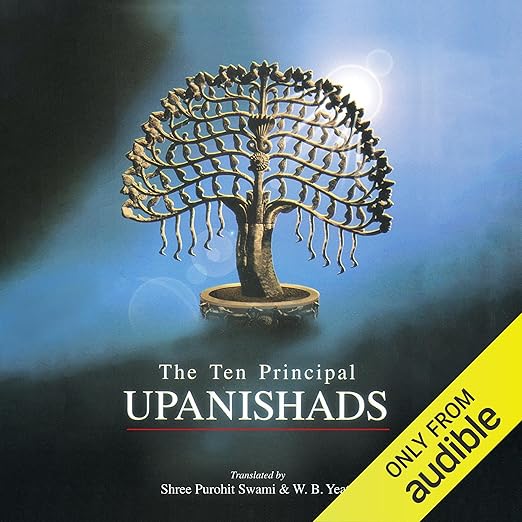
I first encountered the Upanishads in an undergraduate course on comparative religion, where our professor assigned a translation I found syntactically tortured and philosophically distant. Years later, when I came across the Shree Purohit Swami and W.B. Yeats collaboration on the ten principal texts, I understood what a difference translation choices make. This is a rendering that prioritizes accessibility and poetic quality over scholarly exactitude, and the audiobook edition, narrated by Navalakshmi and running to four hours and forty-four minutes, brings that quality into an acoustic medium that feels unusually appropriate for texts that were, as one reviewer noted, composed and not written.
The Upanishads are central documents in Hindu philosophy, dealing with questions of ultimate reality, the nature of self, and the relationship between individual consciousness and the cosmic ground of being. The ten principal texts gathered here represent the tradition’s most systematic and influential articulations of those questions. They range from the brief Isa Upanishad, which can be read in minutes, to the immense Brihadaranyaka, which demands sustained philosophical attention. This edition treats all ten in four hours and forty-four minutes, which tells you something about the translation’s approach.
Our Take on The Ten Principal Upanishads
The Swami Purohit and Yeats translation, which dates to the 1930s, has a literary quality that newer scholarly translations sometimes sacrifice for precision. One reviewer described the poetry as alive, which is the right word. Yeats’s fingerprints are present in the diction, particularly in the shorter texts, and what the translation gives up in philosophical granularity it gains in readability and emotional resonance. For a listener new to the Upanishads, this is an important trade-off to understand. You are receiving a poetic interpretation as much as a literal rendering.
Navalakshmi’s narration handles this well. Her voice has a measured quality that allows the paradoxical formulations of Upanishadic philosophy, statements like tat tvam asi, that thou art, to settle rather than rush past. She does not dramatize the texts, and she should not. The material requires a quality of attention that theatrical delivery would undermine. A reviewer noted that some passages are simply beyond immediate comprehension, and Navalakshmi’s pace at least gives the listener room to sit with that incomprehension without feeling steamrolled.
Why Listen to The Ten Principal Upanishads
The most compelling case for the audio format is the original context of these texts. They were composed to be spoken and heard, teacher to student, in oral transmission. Listening to them, even in English translation, recovers something of that relationship. An Oxford course student who used this translation for an end-of-term essay described it as providing a good overview and immersion, which is perhaps the most honest description of what a four-hour introduction to ten major philosophical texts can accomplish.
For listeners who follow Hinduism as a practice rather than an academic study, this edition offers something specific: a translation with a spiritual rather than merely intellectual orientation. Swami Purohit Swami was himself a practitioner, and that orientation shapes the rendering in ways that more academically produced translations do not replicate. The reverence is built into the language.
What to Watch For in The Ten Principal Upanishads
The brevity that makes this an accessible entry point also imposes real limitations. The Brihadaranyaka Upanishad alone, in scholarly translation, runs to hundreds of pages and contains some of the most philosophically dense material in the Indian tradition. In this edition, it receives proportional rather than equitable treatment. A listener who arrives expecting depth on every text will find instead an introduction that orients without exhausting.
One reviewer who rated the book two stars noted finding some texts simply incomprehensible. That is an accurate response to Upanishadic philosophy in general, not a failure of this particular translation. The texts are designed to destabilize ordinary conceptual categories rather than to explain things in conventional terms. Listeners who approach them expecting philosophical argument in the Western analytical sense will encounter a different kind of reasoning altogether.
Who Should Listen to The Ten Principal Upanishads
This edition is well suited to listeners who want a first acquaintance with Upanishadic philosophy and appreciate the literary quality of the Yeats involvement. It works as a complement to a course on world religions, as preparation for a deeper reading of any individual Upanishad, or simply as a meditation on questions of consciousness and being that recur across traditions. The four-hour length makes it manageable as a weekend listen or distributed across several sessions.
Those who require a scholarly apparatus, commentary, or notes on Sanskrit terminology will need a different edition. Valerie Roebuck’s Penguin translation or Patrick Olivelle’s Oxford edition both offer that kind of depth. But for listeners who want to enter the territory without an academic guide, this Audible edition of the Swami Purohit and Yeats translation is a graceful beginning.
Frequently Asked Questions
Is this the W.B. Yeats co-translation of the Upanishads, and does that affect the quality of the text?
Yes, this is the Shree Purohit Swami and W.B. Yeats translation from the 1930s. Yeats’s involvement gives the language a literary quality that more recent scholarly translations exchange for precision. One reviewer praised the poetry as alive, but listeners requiring strict fidelity to Sanskrit terminology should seek an academic edition.
Is four hours and forty-four minutes enough time to meaningfully cover all ten principal Upanishads?
It is enough for a meaningful introduction to each text’s central concerns. It is not enough for a deep philosophical reading of any one of them. The Brihadaranyaka Upanishad alone, for context, fills multiple volumes in scholarly editions. Treat this as an orientation rather than a comprehensive study.
Does the audiobook work for listeners with no background in Hinduism or Indian philosophy?
Yes, though some passages will be opaque regardless of background. The Upanishads are intentionally paradoxical texts designed to push beyond ordinary understanding. The Yeats-Swami translation mitigates some of the difficulty through poetic accessibility, and Navalakshmi’s measured narration gives the listener space to absorb what can be absorbed.
Is this edition appropriate for Hindu practitioners as well as academic listeners?
Yes. The Swami Purohit Swami’s own spiritual orientation shapes the translation in ways that make it resonant for practitioners who want to listen to the texts devotionally. It sits comfortably between the scholarly and the devotional uses.