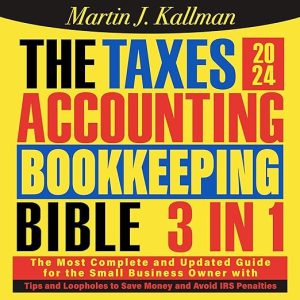
![The Taxes, Accounting, Bookkeeping Bible: [3 in 1]](https://audiobookdaily.com/wp-content/uploads/2026/03/the-taxes-accounting-bookkeeping-bible-3-in-1.jpg)
Tax season has a particular quality of dread for small business owners that most employees never fully experience. The quarterly estimates, the receipts, the question of what counts as a deductible business expense and what the IRS will challenge: these are not abstract worries but recurring practical problems. Martin J. Kallman's three-in-one audiobook bundles taxes, accounting, and bookkeeping into a single nearly eight-hour reference that tries to address all of them, and the ambition of that project is both its strength and its constraint. The title's claim that it reveals the secret to saving money, avoiding penalties, and outsmarting the IRS is marketing language, but the underlying content is more straightforwardly practical than that framing suggests.
Ivan Busenius narrates with the kind of measured, professional pace that suits dense reference material. He reads lists and step-by-step processes without making them feel either rushed or laborious, which matters when the content includes things like the seventeen essential tips for maintaining accurate financial records that appear in the bookkeeping section. This is not audiobook material that rewards passive listening. It rewards active engagement, pen in hand or notes app open, pausing to apply what you hear to your specific business situation before moving to the next chapter.
Three Subjects Compressed Into One Listening Experience
The bundle format compresses three full subjects into a single listening experience, and the structure reflects that compression in both its virtues and its limits. The taxes section covers small business filing requirements, deduction strategies, IRS audit preparation, and the payroll and contractor distinctions that trip up many first-time business owners. The accounting section addresses cash flow, budgeting, and forecasting. The bookkeeping section focuses on day-to-day record organization, receipt management, and the systems that prevent year-end chaos. Together they form a complete picture of the financial administration side of running a small business, which is exactly what the title promises to deliver.
The caveat that appears in reviews deserves honest attention. One reviewer with relevant background notes that readers with no prior accounting knowledge may find the material technical in places. Kallman writes with practitioners in mind, meaning he uses the vocabulary of the field without always pausing to define terms for first-time learners. Listeners who have never encountered concepts like double-entry bookkeeping, payroll tax deposits, or Schedule C classifications may need to supplement the audio with additional introductory resources. The book is most effective for small business owners who have some passing familiarity with these systems and want to deepen and organize that knowledge into something coherent and actionable.
Busenius Grounds Deduction Strategy in Real Examples
The strongest material in the bundle covers the deduction strategies and audit preparation sections, where Kallman's insider framing produces genuinely useful specificity. The discussion of legal methods of reducing tax liability that many small business owners overlook is detailed enough to prompt real action. Multiple reviewers note that the book answered specific questions they had been carrying without resolution, which is the right way to evaluate a reference title. One reviewer noted it helped directly with income taxes; another found it highly informative on things they had not known to be aware of as a small business owner building their financial foundation.
The practical examples and case studies woven through each section give the more abstract principles concrete grounding. Learning that owner meals require specific documentation to survive IRS scrutiny is more useful when you can hear a scenario that illustrates exactly which documentation matters and why the distinction exists in the first place. Busenius keeps these examples from feeling rote even when the underlying advice is fairly standard material for experienced practitioners.
Why Reference Material Struggles as Linear Audio
Reference material in audio format always carries a specific limitation worth naming directly: you cannot flip back, search a section, or skim to the relevant chapter as quickly as you can in a physical book or PDF. Seven hours and forty-eight minutes is a significant investment in content that many listeners will want to navigate non-linearly. If you anticipate wanting to revisit specific sections repeatedly or use this as a quick lookup reference during tax preparation, the digital companion or print edition will serve you better as a working reference tool than the audio alone.
It is also worth noting that tax law changes on an ongoing basis. Some specifics in this title may reflect regulations that have been updated since publication. Cross-reference any specific deduction strategies or filing requirements against current IRS guidance before acting on them, particularly if you are listening more than a year after the title was originally published and regulations may have shifted.
Suited to Financial Novices Building From Scratch
This audiobook serves small business owners and freelancers who want a structured overview of their financial administration responsibilities, particularly those who are early in their business journey and building their knowledge base from a limited foundation. The three-in-one value proposition is genuine for someone who wants the full picture in a single listening pass rather than three separate resources purchased individually. Listeners who have no accounting background at all may find the technical vocabulary challenging in places, and may benefit from pairing this with a more introductory resource first. Those with existing bookkeeping knowledge who want a practical reference for tax strategy specifically will find the taxes section the most immediately valuable part of the bundle and may want to start there rather than at the beginning.
Before You Press Play
- Performance: Ivan Busenius reads with brisk, professional clarity that suits the reference-heavy, list-driven structure of this bundle.
- What it covers: Small business tax strategy, bookkeeping fundamentals, IRS compliance and deduction optimization
- Feel: Dense and practical, with an assumed audience of working small business owners
- Our call: A functional three-part reference for small business owners who want the core principles without hiring a consultant, though listeners with no accounting background should calibrate expectations carefully.
Frequently Asked Questions
Is The Taxes, Accounting, Bookkeeping Bible audiobook appropriate for someone who has never done their own business bookkeeping?
It is possible but moderately challenging. Kallman writes with practitioners in mind, and some of the vocabulary assumes basic familiarity with accounting concepts. One reviewer specifically cautions that listeners with no accounting background will find parts technical. If you are starting from zero, consider pairing this with a more introductory bookkeeping resource first.
How current is the tax information in this audiobook?
The book covers fundamental principles of US small business taxation that change slowly, but specific rates, thresholds, and deduction rules are subject to annual adjustment. Verify any specific figures against current IRS guidance before acting on them, particularly if you are listening well after the original publication date.
Does this audiobook cover independent contractor taxes as well as traditional employee payroll?
Yes. The taxes section explicitly addresses payroll taxes, employee benefits, and independent contractor relationships, which is one of the more complex areas of small business tax compliance. The distinction between contractor and employee classification, and the IRS tests that determine which applies, is covered within the tax section of the bundle.
At nearly eight hours, how is the audiobook organized across the three subjects?
The three subjects, taxes, accounting, and bookkeeping, are structured as sequential sections within the single listening file rather than as three separately navigable audiobooks. The bundle covers the subjects in the order listed in the title. Listeners who want to focus on a specific section may find the lack of discrete track separation a minor navigation inconvenience.