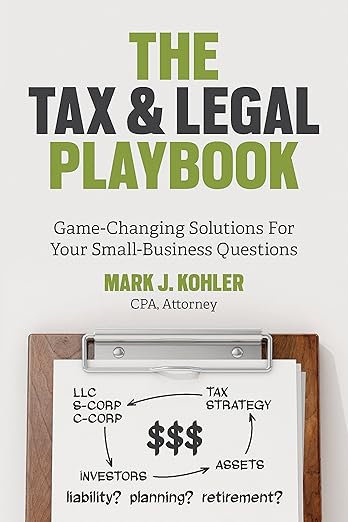
Quick Take
- Performance: Christopher Grove reads with professional competence, this is dense reference material and the narration keeps it organized and clear without adding much interpretive texture.
- What it covers: Tax strategy for small business owners, legal entity selection, asset protection
- Feel: Practical and reassuring, like office hours with a CPA who actually explains things
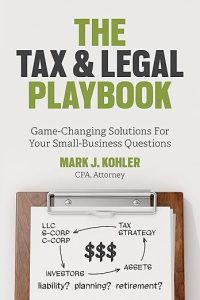
- Our call: Mark Kohler's Tax and Legal Playbook earns its reputation as a reference book that small business owners return to rather than read once and shelve.
Tax law is one of those subjects that most people feel vaguely guilty about not understanding better. I picked up this audiobook during a stretch when I was sorting out some business structure questions and had the nagging sense that I was probably leaving money on the table without knowing exactly where that money was. Kohler's book addresses that feeling directly, which is part of why it has maintained a strong reputation since its 2015 release.
Mark Kohler is both a CPA and an attorney, which means the book spans a gap that many financial guides leave open, the interaction between tax strategy and legal structure. Most books pick one lane. Kohler argues that you cannot really understand one without the other, and the first chapters make a convincing case for why small business owners need to think about them together from the beginning rather than retrofitting legal structure onto an existing business.
Underutilized Strategies, Plus Scams Worth Avoiding
What distinguishes this book from similar guides is Kohler's willingness to be direct about strategies that he describes as underutilized, meaning things that are legal, available, and commonly overlooked because most people do not know to ask about them. These range from entity selection decisions (the LLC versus S-Corp question that confuses many first-time business owners) to retirement planning structures that interact with business income in ways that are not obvious. One reviewer who saw Kohler speak twice at investment clubs and then read two prior books before this one described it as his best work, noting that his ability to make accounting genuinely entertaining comes through in the written material as much as in person.
The book also covers legal scams and deceptions to avoid, a section that grounds the otherwise optimistic tone in some useful caution. A significant portion of financial harm to small business owners comes not from tax law itself but from predatory advisors and misleading structures, and Kohler addresses this with the authority of someone who has seen those situations up close.
Grove Keeps Kohler's Questions Moving in Audio
The audio format has a specific advantage here: Kohler's material, dense as it is on the page, translates well when narrated because it is organized around questions rather than delivered as continuous legal prose. Christopher Grove's narration keeps things moving without losing precision. One reviewer who was previously intimidated by tax information credited Kohler specifically with making the material feel accessible rather than threatening, and the audio version carries that quality.
The book is also designed to function as a reference, you can read it cover to cover or return to specific chapters as questions arise. That modular quality is slightly less useful in audio than in print, where you can flip to a chapter directly, but the chapter structure is clear enough that navigating by topic is manageable.
Sound Frameworks From 2015, Numbers Need Checking
The book was published in 2015, and some specific figures, thresholds, and regulations will have changed. The strategic frameworks Kohler outlines remain sound, but any specific numbers should be verified against current law before acting on them. One reviewer described it as a good basic reference book on how taxes and liability interact with business form, a characterization that accurately reflects both the book's strength and its appropriate scope. This is not a substitute for a relationship with an actual tax professional; it is preparation for making better use of that relationship.
Made for Owners Who Haven't Picked an Entity
Early-stage small business owners who have not yet made entity decisions will find the most immediate value here. Self-employed individuals who have been operating as sole proprietors and have not explored LLC or S-Corp structures are a natural fit. The book is less useful for corporate employees without a side business, and readers looking for advanced tax strategies at significant income levels will likely need more specialized resources. As a starting point and orientation guide, it consistently over-delivers.
Good to Know
Does the audiobook work as a reference format, or is this better read in print?
Print has an advantage for reference use since you can flip directly to chapters. The audio version is organized around questions and topics that make navigation manageable, but if you anticipate returning to specific sections frequently, a print or Kindle copy alongside the audio would serve you better.
Does the book cover both federal and state-level tax considerations?
The book focuses primarily on federal tax strategy and the legal structures relevant to small business owners nationally. State-specific rules vary significantly and would require additional research or a local professional.