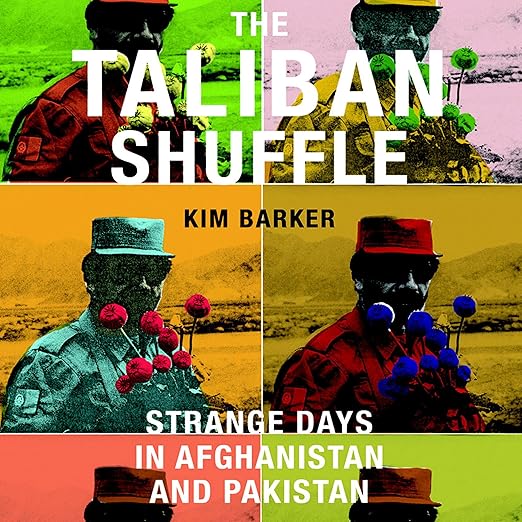
- Read by: Kirsten Potter brings composed, journalistic restraint that serves the memoir's reporting passages more naturally than its looser comic asides.
- At its heart: War correspondence, personal transformation, dark humor under pressure
- Vibe: Wry and unsettled
- Short version: A sharper, stranger listen than its movie adaptation suggests, best for readers who want memoir alongside the reporting.
Tea With Warlords, Absurd and Deadly Serious
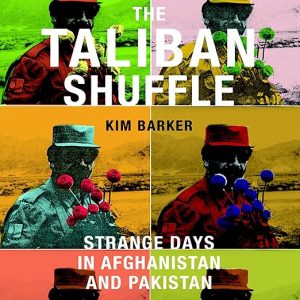
Tea with warlords sounds like the opening line of a novel, but it's genuinely how Kim Barker describes her own working life in the countryside outside Kabul, and that collision of the absurd and the deadly serious runs through this entire audiobook. Barker was a newspaper correspondent covering what she calls Afghanistan and Pakistan's forgotten war, the one competing for attention against Iraq throughout the mid-2000s, and her memoir became the loose basis for the 2016 film Whiskey Tango Foxtrot, starring Tina Fey as a version of Barker herself. Narrator Kirsten Potter takes on nearly ten hours of material that swings between genuine danger and genuine comedy, sometimes within the same paragraph.
The three attached reviews all circle the same core tension in different words. One reviewer, who says she spent those same years in Kabul and Islamabad herself, calls Barker's portrait 'spot on accurate'; another, arriving via the movie, admits the book delivered 'both more and less than expected' once the comedy of Tina Fey's performance met the memoir's harder edges. A third reviewer zeroes in on exactly what makes the book work: the balance between serious, funny, and sad, and Barker's instinct for knowing which register a given moment actually needs.
At a 4.1 average across nearly a thousand ratings, this isn't the kind of book that overwhelms with universal five-star praise, and that tracks with a memoir this tonally slippery. Readers who came for straightforward war reporting and readers who came for movie-adjacent comedy are, per that second review, sometimes both a little thrown by getting the other thing mixed in. That friction is worth knowing about before you start, not because it's a flaw exactly, but because it shapes what kind of listening experience you should actually expect.
Barker wrote as the Chicago Tribune's South Asia bureau chief during these years, a beat that took her across both Afghanistan and Pakistan as the two conflicts increasingly bled into each other, and that dual-country vantage point is part of what makes this memoir broader than a single-nation war account. She's covering two governments, two militaries, and two very different relationships with the American presence in the region, often within the same reporting trip, which adds real geographic and political range to a book that could otherwise have stayed narrowly focused on one theater.
Self-Deprecating Humor as a Structural Choice
Barker's own arc, from what she calls an awkward newbie to a seasoned correspondent, gives the book a real narrative spine beyond just a string of dispatches. You watch her build the instincts, professional and personal, that let her survive and eventually thrive in an environment most reporters treat as a brief, dangerous assignment rather than a years-long posting. That personal transformation, layered under the geopolitical reporting, is what pushes this closer to memoir than straight journalism, and it's the throughline all three reviewers seem to respond to most, more than any single reported event or dateline.
The self-deprecating humor is a genuine structural choice, not just tonal seasoning. Barker uses her own missteps, awkward romantic entanglements, cultural misreadings, moments of pure fear handled badly, as a way to keep the reader oriented inside an unfamiliar, chaotic world without the book ever tipping into either self-pity or false bravado. That's a difficult balance to strike in war reporting specifically, where the temptation toward either grim seriousness or performed toughness is constant, and her willingness to be the joke as often as the reporter is part of what makes the book distinctive within its genre.
For listeners who came to this through Whiskey Tango Foxtrot, real value sits in hearing the source material directly rather than relying on the film's necessarily compressed version of events. The movie assembles a tighter, more conventionally comedic arc out of years of reporting; the book gives you the actual texture, the parties with drunken foreign correspondents in Kabul's officially dry city, the specific fear and boredom that alternate through a long overseas posting, in a way a two-hour film adaptation simply doesn't have room for.
It's worth placing Barker within the specific journalistic moment she was writing from. She was reporting for a major American newspaper during exactly the years when most editorial attention and resources were being redirected toward Iraq, which meant Afghanistan and Pakistan correspondents like her often worked with less institutional support and less audience attention even as the actual security situation on the ground deteriorated. That specific structural neglect, not just individual danger, is part of what she means by calling it a forgotten war, and it gives the memoir's later chapters, covering the Taliban's resurgence largely outside the American public's notice, a genuine sense of urgency that a more attention-saturated conflict memoir wouldn't carry.
Potter's Restraint Serves Gravity Better Than Jokes
That second review's warning is worth taking seriously if the film is your reference point: this book is 'both more and less' than the movie prepares you for. More, in the sense of far greater reported depth and specificity about the actual politics and people involved; less, in the sense that it isn't structured as a continuous comedy the way Tina Fey's performance might suggest. Go in expecting memoir first and comedy second, woven through rather than driving the whole book, and the mismatch that reviewer describes becomes much less likely to catch you off guard.
Kirsten Potter's narration leans toward composed, measured restraint, a register that serves the book's more serious reporting passages naturally, the political context, the danger, the human cost of a conflict most Western readers had already stopped paying close attention to. Whether that same restraint fully serves Barker's looser, more self-deprecating comic asides is a fair open question; a delivery built for gravity doesn't always land a joke about romantic humiliation with quite the same ease. It's not a mismatch severe enough to derail the listen, but it's worth noticing as you settle into the narration's particular rhythm.
More Than the Comedy the Film Promised
This audiobook is a strong fit for readers of foreign-correspondent memoir generally, and specifically for anyone who wants a more complicated, personal companion to the geopolitical history of post-9/11 Afghanistan and Pakistan than a straight policy history would offer. It also rewards listeners who appreciated Whiskey Tango Foxtrot but sensed the film was working from a much richer, stranger true story underneath its comedy, since that richer story is exactly what this memoir delivers in full.
Skip this one if you want a purely comedic listen matching the film's marketing, or if you'd rather avoid the real, sometimes grim texture of covering an active war zone; Barker doesn't sanitize the danger or the toll it took on her personally, even while finding room for genuine humor throughout. Readers wanting a tightly structured policy history rather than a personal, occasionally digressive memoir should also look elsewhere first.
Good to Know
How closely does this audiobook follow the movie Whiskey Tango Foxtrot?
Loosely. The film compresses years of Barker's reporting into a tighter comedic arc; this audiobook gives the fuller, more textured original memoir, and one reviewer specifically warns that fans of the movie may find the book both more substantive and less continuously comedic than expected.
Is this audiobook mostly serious war reporting, or does it lean into memoir and humor?
It's genuinely both, deliberately balanced. Reviewers describe Barker moving between serious, funny, and sad registers within the same book, using self-deprecating humor to process real danger rather than choosing one tone over the other.