Quick Take
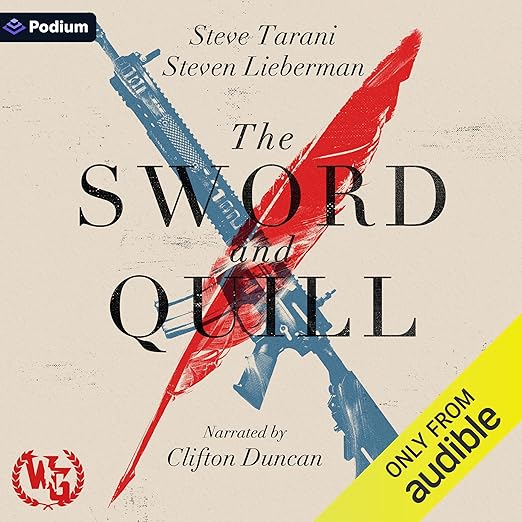
- Narration: Clifton Duncan brings a composed, deliberate authority to Tarani’s philosophical framing, which suits a text concerned as much with mindset as mechanics.
- Themes: Armed citizenship responsibility, the ethics of self-defense, legal and philosophical dimensions of bearing arms
- Mood: Measured and serious, like a careful argument made at close range
- Verdict: A short, substantive examination of armed citizenship that goes well beyond technique into the philosophical and legal obligations of carrying a weapon, valuable precisely because it is not a how-to manual.
I started this one on a rainy afternoon with some skepticism. At three hours and two minutes, it is a short audiobook, and the self-defense genre has a long tradition of trading philosophical pretension for tactical superficiality. Steve Tarani’s Sword and Quill is something different from what I expected. It is not primarily concerned with how to use a weapon. It is concerned with what it means to carry one, and with the distinction between those who bear arms as a responsibility and those who bear them as a credential.
Tarani is a former CIA contractor and federal law enforcement trainer with significant operational background. That credential is not just biography, it shapes what the book is willing to say and how it says it. This is not written from the perspective of someone who theorizes about violence. It is written from the perspective of someone who has been in situations where the theory had operational consequences.
Professionalism at Arms as a Genuine Framework
The book’s central concept, what Tarani calls Professionalism at Arms, is the organizing argument for everything else. The claim is that bearing arms responsibly requires not just skill but a specific kind of mindset, one that understands the legal parameters of use of force, takes seriously the irreversibility of lethal action, and situates personal defense within a broader ethical framework. This is less common in the self-defense literature than you might expect. Most titles in the genre are either tactical manuals or constitutional arguments. Tarani is doing something closer to professional ethics.
The legal content is handled well for a non-lawyer writing for a general audience. A reviewer praises the book for explaining not just the rules but the logic behind them, why constitutional rights are grounded in natural rights arguments, what the legal framework around use of force actually requires and prohibits, why the gap between legal and ethical is worth taking seriously. This is not a substitute for state-specific legal advice, and Tarani does not pretend it is. It is an introduction to a framework for thinking, which is exactly what it should be.
What the Book Does Not Cover, and Why That Is the Right Choice
Tarani explicitly does not provide tactical instruction in the traditional sense. There are no chapters on draw technique, grip, sight picture, or the mechanics of defensive shooting. This will frustrate readers who come expecting a training manual, and that expectation is worth managing before you start. The book’s value is in the philosophical and legal scaffolding it provides around everything else, the decision-making architecture that precedes any technical skill deployment.
One reviewer notes that he has read many articles and books about how to carry firearms but found this one valuable specifically because it provides excellent advice on being smart about carrying. That framing captures what the book is doing: not how but why and when and with what understanding of consequences.
Clifton Duncan and the Right Voice for This Material
Clifton Duncan is a trained actor and narrator with a physical, grounded delivery that works well for content concerned with stakes and seriousness. He does not rush Tarani’s more philosophical passages, and he gives the legal distinctions the pace they need to land clearly. At three hours, the listen does not overstay its welcome, and Duncan’s consistency of tone keeps the register from slipping between sections.
Who Should Listen and Who Should Skip
This is the right listen for anyone who carries a firearm, is considering doing so, or wants to understand the ethical and legal framework around armed citizenship before making any tactical decisions. It pairs well with state-specific legal resources and firearms training courses rather than replacing them. Listeners who want tactical instruction should look elsewhere. The 21 ratings averaging 4.6 suggest the audience it reaches is the right one, engaged citizens who want to think seriously about the responsibilities their choices carry.
Frequently Asked Questions
Does The Sword and Quill cover state-specific concealed carry laws?
No. Tarani addresses the constitutional and philosophical foundation of use of force law and the general legal framework around armed self-defense, but explicitly avoids state-specific legal advice. Consult a local attorney or state-specific legal guide for jurisdiction-specific questions.
Is this book useful for someone who has never fired a weapon, or does it assume an armed reader?
It assumes a reader who is either armed or seriously considering it, but the philosophical and legal content is accessible to anyone thinking about self-defense as a subject. The absence of tactical instruction means no prior shooting experience is required to follow the argument.
How does Tarani’s CIA and federal law enforcement background influence the book’s tone?
It gives the philosophical content an operational seriousness it would lack without that credential. Tarani writes as someone who has had to apply these frameworks in real situations, and that experience filters out abstract moralizing in favor of usable ethical reasoning.
At just over three hours, is this long enough to make a substantive argument?
For the argument Tarani is making, yes. The compression forces clarity rather than padding, and multiple reviewers note that the book is concise and cogent rather than thin. It functions well as a starting point for a deeper reading list rather than a comprehensive treatment.