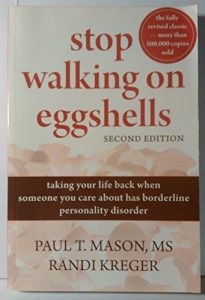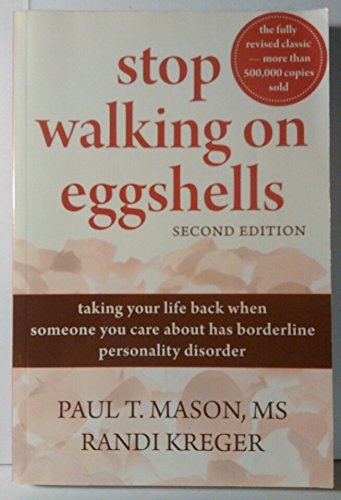
One line of description is all this record offers, and that line names an edition the product address contradicts. The sentence reads: second edition, taking your life back when someone you care about has borderline personality disorder. The address for the same audiobook calls it the third edition. Both cannot be right, and for a book whose value rests on current clinical framing, the gap is not cosmetic. Seven hours and thirty-six minutes, with Kirsten Potter taking the reading, on a page that also carries a release date of January 1, 2000, which is what a catalog prints when it knows a year and no day. What a buyer would actually receive here is genuinely unclear.
A Closer Look at Stop Walking on Eggshells
Set the metadata aside and the book has an unusually clear purpose. Nearly everything published about borderline personality disorder addresses the person carrying the diagnosis. This one addresses the people around them, and a July 2017 five-star describes arriving at it sideways, sent by a member of a reactive attachment disorder group after a family member's therapist agreed that the two conditions overlap, both rooted in an intense fear of abandonment. That entry says plainly that what it loves about the book is that the book exists for the people doing the coping. Whatever else stays uncertain on this page, the intended audience does not.
Metadata on this record deserves spelling out, because it is a mess. The publisher line and the language line both open with a stray invisible character, the publisher name is capitalized as though somebody typed it in a hurry, and the January 2000 date belongs to a print first edition and not to any recording. Add the edition contradiction and a description that never becomes a complete sentence, and this reads as a print catalog row wearing an audio jacket. None of that touches the quality of the writing. All of it touches your ability to know what you are buying, which for a clinical guide in its second or third revision is the entire question.
What Makes Stop Walking on Eggshells Worth Hearing
Usefulness of the blunt, practical kind is what the strongest responses report. An April 2021 five-star credits the book, along with a companion workbook bought at the same time, with making a drinking and violent husband legible, then describes deciding to leave that marriage and never once regretting the decision. That is not a review of prose. It is a report on a tool that did a job, and it names the specific job this book was built for: handing a person enough of a framework to make a decision they had been unable to make alone. Books of this kind deserve to be judged partly on that measure.
Seven hours and thirty-six minutes is a reasonable length for the material and a demanding one for the circumstances. People generally reach this book mid-crisis, and a crisis reader is not a patient reader. Audio helps in one specific way, since a listener can absorb it while doing something else, and emotionally heavy material often goes down easier when your hands are busy. Audio hurts in another, because a framework book invites underlining, re-reading and flipping back to a section you half remember. Potter's reading is a blank on this page: no entry in the column refers to it, and none refers to any audio at all.
Things to Know Before Starting Stop Walking on Eggshells
Not everyone finds what they came for. The column's only one-star, filed in December 2019, says simply that the book was not what was expected or needed, and that is a real risk with this title and not an outlier. A guide written for the people around a diagnosis will disappoint anyone who arrived wanting a guide to the diagnosis itself, or a memoir, or a therapeutic protocol. The one-line description does nothing to prevent that mismatch, since it announces the subject and withholds the standpoint, and standpoint is the whole proposition. A shopper reading only a badge and a title could not predict which of those they were getting.
Edition matters more here than in most categories. Clinical language around personality disorders has moved considerably across the twenty-five years separating a first edition from a third, and revisions to books like this typically update terminology, the treatment landscape, and guidance around legal and custody questions. A listener cannot tell from this page which vintage sits in the file. Worth noting beside it: the five readable grades average four flat, slightly under the 4.2 badge, so the seventeen votes nobody can read are pulling the number upward. Twenty-two grades is a small base for a book this widely used, which suggests most of its readership arrived in print.
Who Paul T. Mason MS Is Writing For
Reach for this if you are the partner, parent, adult child or sibling of somebody whose behavior swings between devotion and devastation, formally diagnosed or not. The premise is that you are allowed limits and needs of your own while still caring about the person, and that premise is worth hearing said out loud by a calm voice at a moment when nobody in your life is saying it. It suits people who want vocabulary and structure ahead of reassurance. Anyone currently weighing whether to stay in a relationship will find the material more directly relevant than most of what this shelf stocks, because it was written for exactly that decision.
Look elsewhere if you carry the diagnosis yourself, since being described from the outside for seven and a half hours is a particular kind of unpleasant and this book never pretends otherwise. Look elsewhere too if you want the current clinical picture with confidence, because the page will not confirm which revision you would be downloading. And if the situation is close to your own, consider keeping print alongside: a framework book rewards marking up and returning to, and a recording supports neither of those things.
A Few Questions About Stop Walking on Eggshells
Which edition does this audiobook contain, the second or the third?
The page does not resolve it. The description calls the book a second edition while the product address for the same item says third. Terminology and treatment guidance in this field have shifted across those revisions, so anyone buying for current clinical framing should confirm with the publisher before paying.
Does an audiobook work for material this practical?
Partly. Seven hours and thirty-six minutes goes down easily while your hands are occupied, which suits emotionally heavy content. A framework book also invites underlining and flipping back to a half-remembered section, and a recording supports neither. Listeners planning to use it as a reference should keep a written copy alongside.