Quick Take
- Narration: Sarah Kuklis reads with the energetic but grounded tone that teen-directed nonfiction requires, accessible without being condescending, which is a harder register to hit than it looks.
- Themes: Executive function, teen time management, emotional regulation for adolescents
- Mood: Practical, upbeat, and direct
- Verdict: A genuinely useful guide for overwhelmed teens that delivers actionable strategies in manageable form, though its short runtime means it functions as an orientation rather than a deep curriculum.
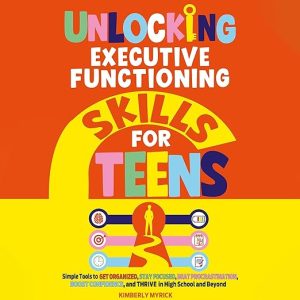
I picked up Executive Functioning Skills for Teens on a Wednesday morning, specifically because I had been talking with a friend whose fifteen-year-old was struggling with the gap between intelligence and follow-through. The school was suggesting testing. The family was exhausted. What they needed was not a clinical framework but a practical bridge, and this book, at four hours and thirteen minutes, turned out to be a reasonable candidate for that role.
Gail A. McHugh’s approach is oriented squarely at the teen listener rather than the parent reading over their shoulder, which is an important distinction. The audience in this book is a teenager navigating homework, sports, friends, and distraction, not a parent designing an intervention. That direct address changes the dynamic of how the strategies land, because a teenager who feels lectured at will tune out in a way that a teenager who feels genuinely spoken to will not.
Translating Clinical Vocabulary Into Daily Life
Executive function is one of those terms that has migrated from clinical psychology into everyday parenting conversation so completely that its specificity has blurred. McHugh does something useful here: she translates the umbrella concept into concrete, nameable skills. Time management. Goal setting. Emotional regulation. Impulse control. Task initiation. Each gets its own treatment, with real-life examples designed for teen relevance rather than adult workplace analogies that make most adolescent listeners’ eyes glaze over.
The step-by-step strategies are described by reviewers as genuinely practical rather than theoretical. One reviewer notes that the book breaks down executive functioning in a way that actually makes sense and does not feel like a lecture, high praise from anyone who has tried to recommend a self-improvement audiobook to an adolescent. The non-lecturing quality comes from McHugh’s decision to frame challenges as solvable puzzles rather than character flaws, which matters when the audience is a teenager who is already aware that they are struggling and does not need that struggle described as a failure.
The Activities Problem in Audio Format
The synopsis mentions activities teens can use right away, and this is where the audio format creates a practical limitation that deserves honest acknowledgment. Activities that involve writing, scheduling tools, or visual organization cannot be interacted with through a listening experience alone. The book works around this better than some in the genre by describing activities in terms that a teen can mentally engage with or verbally process while listening, but anyone who takes the activities dimension seriously will want to have a notebook nearby or revisit sections in a different format.
Another reviewer specifically highlights that the strategies are age-appropriate and based on real research, making them easy to follow and apply in daily life. The research grounding matters: McHugh is not presenting folk wisdom dressed up in psychological vocabulary. The executive functioning science base is real, and the adaptation to teen life is thoughtful rather than perfunctory. The series framing, this is part of the Unlocking Skills for Teens line, suggests companion volumes exist for related skill areas.
Sarah Kuklis and the Teen Listener
Teen-directed nonfiction is one of the hardest audiences to narrate for, because the margin between accessible and patronizing is narrow and the listener knows immediately when a narrator is performing youth rather than genuinely addressing it. Sarah Kuklis avoids the trap. She reads with energy and clarity, keeps the pacing from bogging down in explanatory passages, and treats the teen listener as capable of handling direct, substantive advice. That respect shows throughout the runtime and is probably part of why reviewers describe the book as not feeling like a lecture.
The Feedback From Teens and Parents Both
One reviewer describes the book as a clear, teen-friendly toolkit to tackle the chaos of school, social life, and growing independence, noting that it acknowledges the unique pressures that teenagers face rather than applying adult frameworks with the serial numbers filed off. That acknowledgment of the specific texture of teen life, the social pressures, the identity formation happening in parallel with the academic demands, the way that school failure can spiral into identity failure, is what separates this from generic time management advice. McHugh is writing for teenagers as people, not teenagers as problems to be managed by adults.
Who Should Listen and Who Should Skip
Ideal for teens who are aware that they are struggling with organization, focus, or emotional regulation and who are ready to hear strategies delivered directly to them. Also useful for parents who want to recommend rather than prescribe, something a teen can encounter on their own terms. Skip if you are looking for a deep clinical account of ADHD or executive dysfunction as neurological conditions; this is a practical skills guide, not a diagnostic resource. At under five hours, it is meant to be digestible rather than definitive.
Frequently Asked Questions
Is this book useful for teens with ADHD specifically, or is it written for the general teen population?
The book is written for the broader teen audience but addresses the exact challenges most associated with ADHD and executive dysfunction: procrastination, time management, emotional regulation, and focus. It does not require a diagnosis to be useful.
Can teens listen to this independently, or does it work best as a parent-and-teen resource?
The book addresses the teen directly, which makes it work well as solo listening. Parents can certainly use it as a conversation starter, but the content is designed to reach the teenager rather than to give parents a framework to implement on their behalf.
The synopsis mentions activities. Are those usable while listening, or do they require a companion workbook?
The activities are described verbally and can be engaged with mentally during listening, but they are more fully usable with a notebook nearby. There is no separate companion workbook mentioned in the metadata; a simple journal works as a supplement.
How does this fit into the Unlocking Skills for Teens series, is it a standalone title or does it require other volumes?
Based on the available information, it reads as a standalone guide rather than a volume that depends on prior books in the series. The series structure suggests complementary coverage of related teen skills rather than sequential dependency.