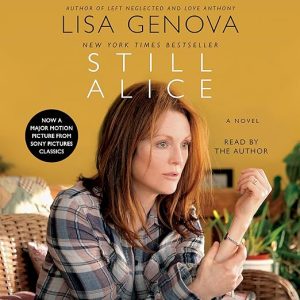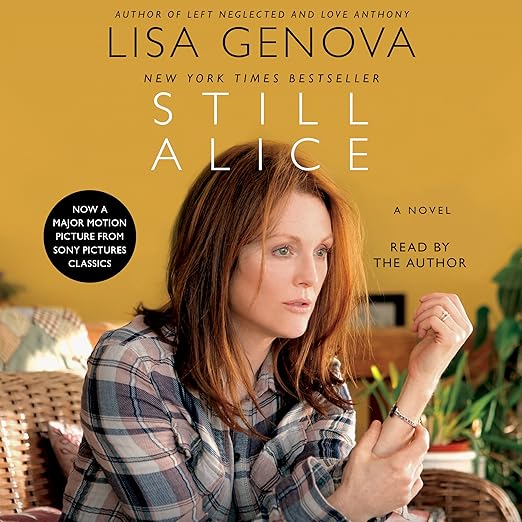
A novel has been filed in the health and wellness aisle on this listing, under a tag reading Aging and Longevity, and nothing about that placement is accidental enough to ignore. The description says the word novel in its first line and the word fiction in its last. What sits in the file is seven hours and forty-six minutes of storytelling about Alice Howland, a Harvard professor with three grown children and a house on the Cape, who notices a forgetfulness creeping into her life and receives a diagnosis of early onset Alzheimer's disease. Anybody arriving at this audiobook expecting guidance will get a story instead, and it is the better thing to have received.
First, the Big Picture
Alice is built to be exactly the wrong person for this to happen to, and that is the design. A professor whose entire identity runs through language, lecturing, conferences and mentoring is handed a disease that dismantles precisely those functions, one at a time, in an order the book refuses to soften. One response from August 2011 describes the result as a love and hate relationship with the book: fascinated by the actual chemical and physical changes being described inside a patient's brain, and unable to bear watching them happen to this particular woman. That is the correct reaction and the book engineers it deliberately.
Memory in fiction usually gets handled through flashback, which lets a reader hold the whole picture while a character cannot. This declines that comfort. The narration stays with Alice as her own reliability erodes, so a listener loses ground at roughly the pace she does, and scenes that would be trivial in another novel become quietly unbearable. The description compares the book to A Beautiful Mind, Ordinary People and The Curious Incident of the Dog in the Night-time, and the third of those is the most useful comparison: the appeal in both cases is a consciousness rendered from the inside without commentary or apology.
Why Still Alice Works as an Audiobook
Neuroscience is what stops this from being a disease-of-the-week story, and the responses noticed. One entry that opens by laying out Alice's diagnosis at fifty also flags that the author holds a doctorate in neuroscience from Harvard, and treats that as the reason the clinical detail can be trusted. The same entry singles out the moment the book uses as its hinge, the day Alice gets lost while running through a neighborhood she has lived in for years. Written badly, that scene is melodrama. Written by somebody who understands what spatial disorientation actually is, it is terrifying and completely undramatic.
First-person decline may be the hardest assignment a reader can be handed, and this recording gives the job to the novelist. The voice on the file belongs to Lisa Genova, who also wrote every sentence of it. The advantage is obvious: nobody has to guess where the deterioration is meant to show in the prose, because the author is making those decisions live. The risk sits on the other side, since novelists reading their own work tend to protect their sentences, and Alice's later chapters need somebody willing to let the language actually fail. That willingness is the thing to listen for in the opening minutes.
A Few Reservations
Twenty pages reprinted in the wrong place cost this book a star. The single four-star in the visible column says so outright, calling the novel amazing and the portrayal of the struggle between remembering and forgetting life-changing, then docking a point because a physical copy arrived with a random twenty pages duplicated later in the book, and blaming somebody in editing. A binding error cannot follow a download. That grade is the only thing holding the average below five in the entries a buyer can see, and the reason for it does not apply to what is being sold here.
Copy on this record comes from two different moments and nobody reconciled them. One sentence announces a major motion picture with four actors named. Another, further down, calls the book the arrival of a strong new voice in fiction, which is debut language. The recording itself is dated January 21, 2009. Nothing on the page says whether the file matches the tie-in edition being advertised or the original one. Worth noting too: one of the five written entries is not in English at all, on a listing whose language field reads English and nothing else, which is one more sign the column was gathered from somewhere other than this product.
Who Should Pick Up Still Alice
Caregivers are the audience this book has found, and the page shows it plainly. A February 2026 entry describes buying three or four copies purely to hand out to friends and family living through the same diagnosis, which is a very specific kind of recommendation and not one that novels usually attract. Listeners with a parent or partner in the early stages should know what they are walking into: the book withholds nothing, offers no recovery, and treats the loss as the whole story rather than as the setup for a lesson.
Expect to be wrecked, and expect it to be worth the trip. Listeners who want practical guidance on dementia care should buy a different kind of book entirely, because this one will not tell you how to manage anything. Listeners who want to understand what the diagnosis feels like from inside a mind that used to be its owner's finest instrument will not find many better accounts, in fiction or out of it. Seven hours and forty-six minutes is short for a novel and quite long enough for this one.
Is this audiobook a novel or a guide to Alzheimer's?
A novel, despite where the listing has filed it. The description opens by calling it a bestselling work of fiction and closes by placing it in fiction outright. Everything reaches the listener through one invented character, Alice Howland, with no chapters of advice, no checklists and no clinical guidance attached anywhere.
How accurate is the medical detail?
The progression is followed at its own speed, not compressed for effect, which is what readers coming from a medical background tend to praise. Forgetfulness arrives first and gets explained away, then confusion, then disorientation in streets Alice has walked for years, with the formal diagnosis landing well after the symptoms have started rearranging her life.
Does the audiobook follow the film with Julianne Moore?
The listing advertises the adaptation and names its cast, yet the recording itself carries a date from well before that film reached anybody. Nothing on the page states whether the file corresponds to the tie-in edition or the original release, so treat the movie line as marketing bolted on afterward.