At a Glance
- Voice: Richard Ferrone brings the measured, long-form stamina he's known for in American biography to a nearly 33-hour runtime, longer than his typical benchmark.
- Big ideas: WWII Allied command, coalition diplomacy, Eisenhower's rise to Supreme Commander
- Atmosphere: Authoritative and detailed
- Worth it?: A rich, research-backed portrait of Eisenhower the general, best suited to listeners ready for a genuine long-haul commitment rather than a brisk overview.
A General's Command Tent Instead of a Garden
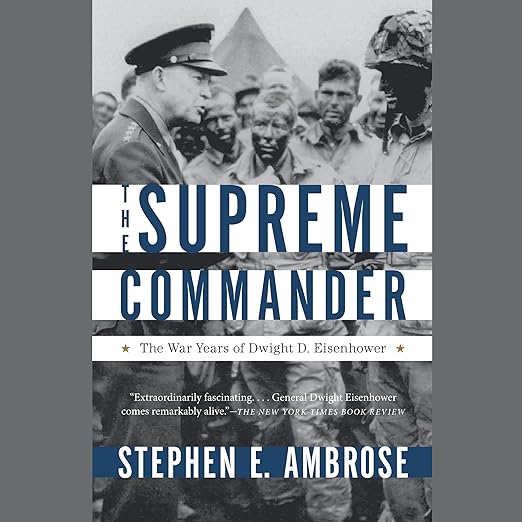
Richard Ferrone built his reputation narrating American landscapes and long-form American biography, and Stephen Ambrose's portrait of Dwight D. Eisenhower gives him a general's command tent instead of a garden to work in across nearly thirty-three hours. This audiobook, The Supreme Commander, is Ambrose's classic account of Eisenhower the soldier, not Eisenhower the president, and it draws on a genuinely unusual vantage point: Ambrose himself served as Associate Editor of Eisenhower's official papers before writing this, giving him direct access to the primary documents behind every major decision the book covers.
The scope runs from Eisenhower's early command in North Africa through the full arc of Allied victory in Europe, tracking not just battlefield strategy but the diplomatic tightrope Eisenhower walked among towering, difficult personalities: Churchill, de Gaulle, Roosevelt, and the famously combustible Patton all get extended treatment. Ambrose's core argument, that Eisenhower's real genius was managerial and diplomatic as much as tactical, holding together an alliance of egos under existential pressure, is the throughline Ferrone has to sustain across the full runtime without losing narrative momentum.
An Earlier Proving Ground for the Same Instinct
Ambrose built his wider reputation on exactly this kind of narrative military history, Band of Brothers, D-Day, and Undaunted Courage among his best-known later works, and The Supreme Commander predates all of them, an earlier proving ground for the same instinct to combine primary-source rigor with genuine storytelling momentum. Readers who know Ambrose only from his later, more famous titles will recognize the same voice here, applied to the man who oversaw the entire Allied command structure those later books' subjects served within.
Eisenhower's first major test as Allied commander came with Operation Torch in November 1942, the landings across French North Africa that put him in charge of an genuinely untested multinational force, American and British units operating under one command structure for the first time in the war. Ambrose treats that early campaign as the proving ground for everything that follows, the place where Eisenhower first had to learn, under real pressure, how to manage competing national egos and military doctrines rather than just enemy forces.
Ferrone's Stamina Asks Nearly Twice the Usual Hours
Ambrose writes with genuine narrative drive for a work this dense with primary-source detail, and reviewer G. Sideman specifically credits the prose with pulling readers through material rich in fact and detail via the many personality clashes among Allied leadership, calling those interpersonal frictions the book's real recurring theme rather than a side note to the military history. That is an unusual thing to say about a WWII command biography, and it signals a book more interested in leadership psychology than pure battlefield chronology.
Reviewer Mazda 6 makes a point worth taking seriously: Ambrose stays objective throughout, neither hagiographic nor hypercritical, portraying Eisenhower's human side, his doubts, his difficult relationships, his moments of genuine uncertainty, alongside his eventual brilliance as a coalition commander. That balance is harder to sustain across thirty-plus hours than it sounds, and a narrator has to carry that same evenhandedness in tone throughout, never tipping into either reverence or revisionism.
Sustaining a single narrator's tone across eighteen or more hours without listener fatigue is already a real achievement in nonfiction narration, and Ferrone is specifically credited with exactly that stamina; The Supreme Commander asks nearly twice that of him, almost thirty-three hours of dense command-level history, and the demand for consistent tonal control only grows with the added length.
MRG4 Was Visiting Normandy During the Listen
At thirty-two hours and forty-eight minutes, this is a genuine long-haul commitment, closer to a full audio education in Eisenhower's WWII command than a casual biography. Listeners should go in expecting real density: extended sections on logistics, diplomatic correspondence, and command-structure decisions that reward patient, focused listening more than background or multitasking use.
One reviewer, MRG4, mentions visiting Normandy as part of a family holiday shortly before or during their listen, and frames the book partly through that personal lens. It is a small, human detail worth mentioning because it points at something real about this material: listeners with an existing personal or historical connection to the European theater tend to get more out of Ambrose's granular command-level detail than those approaching the subject cold, since the emotional weight of specific locations and decisions lands harder with that context already in place.
This book's scope stops firmly at the end of the war; it does not follow Eisenhower into his later career as NATO's first Supreme Allied Commander or into the White House itself. Listeners specifically wanting the presidential years, or the Cold War military leadership that followed, will need a separate, different biography to cover that later chapter of his life.
Listeners who already know Ambrose primarily through Band of Brothers or D-Day should expect a different kind of book here: less ground-level soldier's-eye narrative, more sustained attention to command-level decision-making and diplomatic maneuvering. The two approaches complement each other well as a fuller picture of the same war, but this specific book rewards listeners genuinely interested in leadership and strategy over battlefield action sequences.
Campaign Phases Make a Long-Term Commute Companion
This is a strong match for listeners who already know Eisenhower as a president and want the fuller, earlier picture: the general who had to hold Churchill, de Gaulle, and Patton in the same coalition without any of them walking away from it. Ambrose fans and readers of his other WWII work, particularly Band of Brothers, will recognize his narrative instincts here even though the subject and scale are different.
Skip this one if you want a brisk, single-sitting overview of Eisenhower's career; at nearly thirty-three hours, this rewards genuine commitment rather than casual browsing. Listeners newer to WWII European-theater history may want a shorter primer first before tackling a biography built this deliberately around command-level nuance and interpersonal detail rather than battle-by-battle action.
Listeners who've already worked through other sweeping single-commander WWII biographies and want the next logical addition to that shelf should feel confident here; Ambrose's access to Eisenhower's actual papers as his Associate Editor gives this account a documentary weight that secondhand, non-archival biographies of the same era simply can't match.
The sheer length also suits a specific kind of listening habit well: broken into distinct campaign phases, North Africa, Sicily, Normandy, and the final push into Germany, nearly thirty-three hours becomes far more manageable as a long-term commute companion, a few campaign chapters at a time over several weeks, than as a single marathon listen.
Frequently Asked Questions
Does this audiobook cover Eisenhower's presidency?
No. The book stops at the end of WWII and focuses entirely on his military command; his presidential years require a separate biography.
Is this audiobook mostly about battles or about leadership?
Leadership and diplomacy get equal weight to strategy; reviewers specifically highlight the personality clashes among Churchill, de Gaulle, Roosevelt, and Patton as a recurring focus.