Quick Take
- Narration: McGhee reads her own adaptation with authority and warmth, her policy background lending credibility to passages that could otherwise read as advocacy without substance.
- Themes: The zero-sum fallacy in racial and economic thinking, collective cost of inequality, solidarity as practical policy
- Mood: Urgent and hopeful in roughly equal measure, grounded in reported examples rather than abstraction
- Verdict: A well-structured introduction to McGhee’s core argument about how racism harms everyone, adapted for younger readers but compelling for adults who want the ideas without the academic overhead.
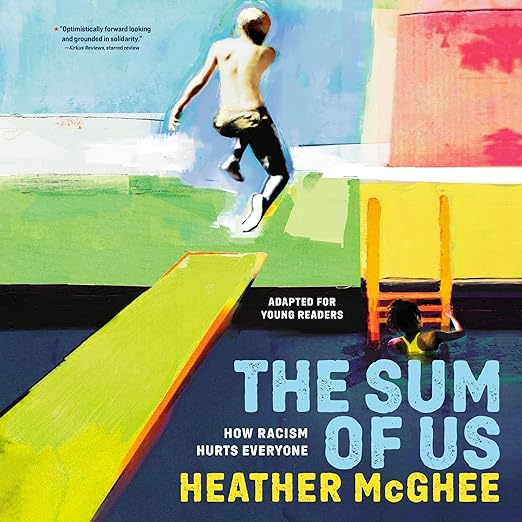
I came to The Sum of Us through the adult edition, which McGhee published in 2021 to significant attention. This adapted version for younger readers arrived in 2023, and I will admit I approached it with some skepticism about what a young-reader adaptation of a dense economic policy argument would actually look like. What I found is that the simplification has, in some ways, sharpened the argument. The core ideas come through more cleanly without the extended footnoting and methodological qualifications of the original.
McGhee’s central claim is both counterintuitive and historically grounded. American racism, she argues, has not simply harmed people of color. It has cost white Americans materially and structurally as well, through the defunding of public goods, the suppression of labor solidarity, and the perpetuation of zero-sum thinking that prevents collective prosperity. The title captures the thesis: the sum of us, as a society, is diminished when any group within it is systematically disadvantaged. McGhee calls this the racism tax, and she documents it through specific historical and contemporary examples.
Our Take on The Sum of Us
The adaptation works because McGhee does not condescend. The writing assumes an intelligent young reader who has direct experience of racial dynamics but may lack the economic and historical context to understand their structural origins. The drained-pool metaphor, in which southern cities literally drained and closed public swimming pools rather than integrate them, becomes a recurring thread that anchors the abstract economic argument in something viscerally comprehensible. That metaphor was the most discussed element of the adult version, and it loses none of its power here. Reviewer Teresa Mobley notes the book is ideal for junior high and high school students, and for background when kids have direct questions. That seems exactly right. This is not a book that sanitizes difficult history to make it comfortable. It presents that history as the context necessary to understand current conditions.
Why Listen to The Sum of Us
McGhee narrating her own adaptation is the right call for the same reason it works in the adult version. She is an economist and policy expert who has spent years making these arguments in public forums, and that experience translates into confident narration that never sounds like she is reading from a script. She speaks with the cadence of someone who has fielded hard questions about her thesis and has good answers ready. For younger listeners particularly, hearing a Black woman with clear expertise delivering this argument has a representational value that matters beyond the content. The audio format also suits the conversational passages where McGhee describes her travels across the country and the people she met who are actively fighting for economic equity. These sections feel reportorial in the best sense, and they land well in audio.
What to Watch For in The Sum of Us
Listeners familiar with the adult version should know this is a genuine adaptation, not an abridgment. Some of the most detailed economic analysis from the original is streamlined here. The argument is preserved but the evidentiary depth is lighter in places. For listeners new to the subject, that is not a problem. For those who want the full treatment of McGhee’s research, the adult edition remains the more complete document. The book also explicitly positions itself as a call to action, which means the final sections carry a prescriptive energy that some readers find motivating and others find slightly thin compared to the analytical rigor of the earlier chapters. That balance is a conscious choice, and it is worth knowing about before you start.
Who Should Listen to The Sum of Us
Educators looking for a substantive but accessible audiobook to use with high school students will find this one of the better options available. Adult listeners who want McGhee’s argument without committing to the full policy depth of the original edition will also be well served. Less suited to listeners who want a complete academic treatment or who are already deeply versed in the economic history of race in America and will find the adaptation’s level of detail insufficient.
Frequently Asked Questions
Is this the young adult adaptation or the original adult edition of The Sum of Us?
This is the 2023 adaptation for young readers. It presents McGhee’s core argument in more accessible language with some of the denser economic analysis streamlined. The original adult edition from 2021 contains more detailed policy analysis and research documentation.
Does McGhee’s self-narration work for younger listeners, or does her academic background make the delivery feel distant?
Her narration is notably warm and conversational, not lecture-style. She has years of public-facing policy communication experience, and that comes through in how she paces and frames the argument. Younger listeners should find her accessible rather than remote.
Is the book politically one-sided, and will listeners who disagree with McGhee’s framing still find it worth hearing?
The book has a clear perspective on structural racism and economic inequality, which it presents as factual rather than ideological. Listeners who approach these issues differently may find the framing tendentious. The strongest sections are the historical ones, where the documented evidence is hardest to dispute.
How does The Sum of Us handle the zero-sum framing it argues against, and is that argument convincing?
McGhee builds the case through historical examples of public goods that were defunded or destroyed rather than integrated, the swimming pools being the most memorable. The argument is that zero-sum racial thinking produced materially worse outcomes for everyone, including white Americans. Whether you find it fully convincing depends on how much weight you give the economic counter-arguments, which the adaptation does not deeply address.