In Brief
- Voice: Christa Lewis narrates with warmth and a measured pace that suits the walking-tour structure, allowing listeners to absorb the biographical portraits without feeling rushed past the geography.
- Big ideas: Parisian history through famous lives, place as biography, cultural memory and the city
- Atmosphere: Leisurely and illuminating, like a long afternoon walk with a knowledgeable companion
- Worth it?: Susan Cahill has written the closest thing to a literary companion for Paris that also functions as a practical guide - this audiobook rewards listeners who want depth behind the city's famous addresses.
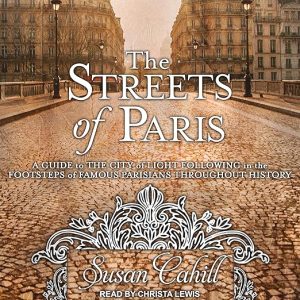
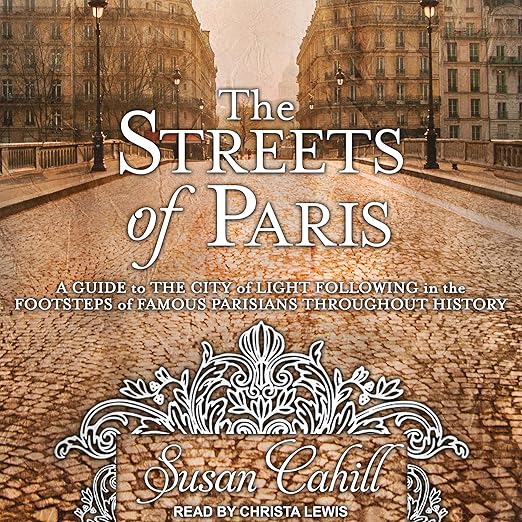
Susan Cahill's The Streets of Paris is not the audiobook you put on to decide where to eat. It is the one you listen to in the weeks before a trip, or on the flight over, or late at night when you are not going anywhere but want to inhabit Paris anyway. Cahill, who also wrote Hidden Gardens of Paris, has organized this as a literary-historical walking guide following twenty-two famous Parisians across eight centuries - from Heloise and Abelard in the medieval period through Edith Piaf and Colette in the twentieth century. The structure is unusual and it is exactly right for the material. Biography organized by address rather than by chronology turns out to be a particularly illuminating way to move through a city.
Christa Lewis narrates with the kind of unhurried authority that suits this kind of cultural geography. She does not perform urgency. The book does not require it. What it requires is the ability to make a dead scientist or a medieval theologian feel like someone you are actually being led toward, through streets that still exist. Lewis largely delivers on that. Her pacing through the biographical portraits gives each figure room to land as a person rather than a historical entry, which is precisely what the format demands over eight-plus hours of continuous listening.
Cahill is explicit about her method: she is not writing a conventional guidebook and she is not writing a straight history. She recounts the lives of her twenty-two subjects and then locates them physically - their homes, the cafes where they worked, the scenes of their triumphs and their disasters, the cemeteries where they ended up. The result is a form of biography organized by address rather than by chronology, and it gives Paris a different kind of legibility than a standard travel book provides.
The twenty-two figures she chose span disciplines and centuries without feeling arbitrary. Madame Curie and Henri IV sit alongside Piaf and Colette not because they were contemporaries but because each of them burned a particular kind of energy against the specific backdrop of a specific quartier. Cahill's skill is in making you feel that these people are still inhabiting their streets - that Pere Lachaise or Montmartre or the Ile de la Cite retains some charge from the people who worked and suffered and loved there. The city becomes a palimpsest, and Cahill reads its layers.
A reviewer who had made Paris his second city described this as his most useful companion to the city, better even than the earlier Hidden Gardens book. Another noted that it has accompanied multiple trips to Paris and continues to add depth with each reading. That kind of durability is a quality marker. This is not a book you use once and put down. The twenty-two figures provide twenty-two different lenses on a city that rewards the kind of sustained attention this book models.
What Stands Out
The audiobook format is a reasonable fit for a walking guide because the format encourages a kind of continuous attention that a print book with maps and sidebars can actually work against. You cannot flip back and forth in an audiobook, which means you have to stay with Cahill's narrative rather than skimming toward practical information. For a book that is fundamentally about sustained attention to place and person, that constraint is an advantage rather than a limitation.
Lewis's narration makes the French names and terms land without affectation. She does not anglicize everything aggressively, but she also does not oversell the French pronunciation in a way that becomes its own distraction. The biographical portraits are the strongest sections in audio - the more analytical passages about Parisian architecture and urban history translate slightly less vividly without the visual support of maps, but these sections are shorter and the loss is manageable across the full eight-hour runtime.
The book also rewards being listened to in short sessions rather than in one sitting. Each of the twenty-two portraits is a self-contained unit, and the sequential nature of the subject-by-subject structure means you can stop between portraits and return without losing the thread. This makes it particularly well-suited to the kind of listening that frames travel preparation: a portrait a night in the weeks before a trip, or revisited in the days after returning.
Things to Know Before Starting The Streets of Paris
One reviewer flagged a factual error in the book's account of the October 17, 1961 Paris massacre, noting that Cahill's figure differs significantly from what other sources report. This is worth knowing for listeners who intend to cite the book or use it as historical reference. The reviewer was careful to note that the error did not undermine the overall book, but it introduces a reasonable caution about treating the historical detail here as authoritative without cross-referencing other sources on specific events.
The audiobook is also best understood as a companion to a physical copy rather than a standalone replacement for it. The book in print form includes walking tour information that is logistically useful in ways that audio cannot replicate - specific addresses, estimated walking times, practical notes about opening hours. You will get the cultural and biographical content fully in the audio edition, but if you are actually planning to use this while walking through Paris, the print or ebook version serves a different and necessary function.
Best Suited For
This audiobook is well suited to listeners who want to understand Paris before or after visiting it - not the Paris of restaurant recommendations and hotel reviews but the Paris that accumulates from eight centuries of people doing extraordinary things in specific streets. It will also appeal to listeners who are interested in any of the twenty-two figures Cahill covers - the range is wide enough that most listeners will find at least one or two subjects they care about and discover others along the way. Anyone who enjoyed Cahill's Hidden Gardens of Paris will find this a natural and worthwhile continuation. Listeners seeking strictly practical travel logistics should use a different format; everyone else should find this a satisfying and genuinely educational listen.
A Few Questions About The Streets of Paris
Is this audiobook useful if you are actually planning a trip to Paris, or is it more of a literary companion?
Both, with caveats. The biographical and cultural content works fully in audio and will enrich any trip considerably. The practical walking information - addresses, maps, itinerary logistics - is better served by the print edition. If you are planning a real trip, consider using both: the audiobook for cultural immersion during the weeks before traveling and the book for logistics once you are on the ground.
How does the audiobook handle the French names, places, and historical terms?
Christa Lewis handles the French material competently without overplaying the pronunciation. The names of famous Parisians and the quartier names land clearly and without confusion. Listeners with no French background will not feel lost, and listeners with French will not be irritated by anglicized distortions.
Do you need to already know who the twenty-two Parisians are to enjoy this audiobook?
Not at all. Cahill introduces each figure with enough biographical context to make them legible to listeners encountering them for the first time. The range of subjects is wide - medieval lovers, scientists, political figures, artists, musicians - so some figures will be familiar and others will be new, but the structure handles both equally well.
How does this audiobook compare to Cahill's earlier Hidden Gardens of Paris?
Several reviewers who read both describe The Streets of Paris as the stronger of the two, calling it 'off the scale' relative to the earlier book. The scope here is broader - twenty-two subjects across eight centuries versus the focused garden theme - which gives the author more material to work with. If you enjoyed Hidden Gardens, this is a natural and apparently worthwhile progression.