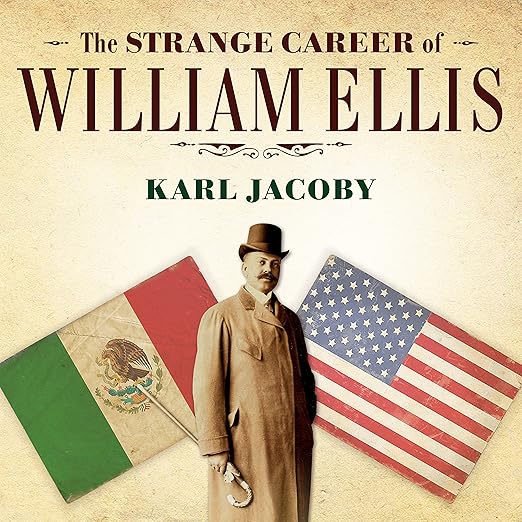
- Read by: JD Jackson handles Karl Jacoby's scholarly prose with authority and warmth, giving William Ellis's remarkable story the gravity it deserves across nearly nine and a half hours.
- At its heart: Racial identity and reinvention, US-Mexico border history, Reconstruction-era America
- Vibe: Absorbing and revelatory, the texture of serious historical research made genuinely readable
- Short version: One of the more quietly astonishing American biographies in recent years, made richer by JD Jackson's narration and Jacoby's meticulous detective work through obscure Gilded Age records.
William Ellis was born a slave on a Texas cotton plantation and died a wealthy man known across Gilded Age Manhattan as Guillermo Eliseo, the Mexican millionaire. Between those two facts lies one of the most audacious acts of self-reinvention in American history, and historian Karl Jacoby has spent years tracing it through obscure records that most biographers never find. The Strange Career of William Ellis, narrated by JD Jackson, is the audiobook result of that research across nine hours and twenty-nine minutes: a biography that reads with the momentum of a novel without sacrificing the intellectual rigor of first-rate historical scholarship.
Jacoby's central argument is not simply that Ellis was a remarkable individual, though he obviously was. The deeper claim is that Ellis's life illuminates the particular absurdity and brutality of American racial classification in the post-Civil War decades. By capitalizing on the Spanish he learned growing up along the Mexican border and his phenotypically ambiguous appearance, Ellis could pass as Mexican in a society that defined Blackness in rigid terms and treated Mexicanness with a very different set of assumptions. His story makes the arbitrariness of those categories viscerally legible in a way that abstract historical argument cannot. Reviewer Casper Mansfield captures this precisely: the book examines how lighter-skinned African Americans could use their ambiguous appearance to carve out new identities under conditions designed to prevent exactly that.
A Central Park Apartment Built on Reinvention
The research behind the book is genuinely impressive. Reviewer Tulip notes that Jacoby tracked Ellis through largely obscure records, and that effort shows on every page. The biography covers the Reconstruction era, the US-Mexico border economy, and the machinery of Gilded Age wealth with the confidence of a scholar who has read the primary sources rather than summarizing the secondary literature. The luxury apartment overlooking Central Park, the Wall Street office, the mines and haciendas in Mexico: Jacoby renders each element of Ellis's constructed world with specificity that makes the eventual unraveling more affecting.
The book's treatment of Ellis's Mexico-facing business ventures is where the biography becomes most analytically interesting. Ellis was not simply escaping American racial categories; he was exploiting the particular moment when US capital was flooding into Mexico under the Diaz administration, and he positioned himself as a broker who could operate in both worlds. Jacoby shows how the racial reinvention and the financial ambition were structurally linked rather than parallel projects. That connection gives the biography its analytical edge beyond the remarkable personal story.
Jackson's Measured Delivery Through the Analytical Passages
JD Jackson is one of the more trusted voices in audiobook narration for American history, and his reading of this material demonstrates why. He handles Jacoby's shifts between biographical narrative, historical context, and analytical argument without losing the human story at the center. The passages describing Ellis's childhood along the Texas-Mexico border, the linguistic and cultural fluency he developed there, and the moment when he understood that fluency could be leveraged into an entirely different life are among the most affecting in the audiobook, and Jackson gives them the space they need.
Reviewer Linda W makes an observation worth highlighting: the book is a fun way to learn history, which sounds like faint praise but is actually the highest compliment a narrative historian can receive. Serious history that reads like narrative is a genuinely difficult thing to write, and Jacoby does it. Jackson's narration preserves that quality in audio form, treating the scholarly apparatus as scaffolding for the human story rather than a competing element. His measured delivery through the analytical passages prevents them from overwhelming the biographical momentum. Listeners who find academic nonfiction tends to lose them in audio format will find this one of the exceptions, in large part because Jackson understands what to emphasize and what to carry through quickly.
The Collapse Read as Diagnosis, Never as Verdict
The final sections, dealing with how Ellis's constructed identity eventually became unsustainable, are handled with care rather than sensationalism. Jacoby is interested in what the collapse reveals about the systems Ellis had navigated, not in dramatic exposure for its own sake. That restraint is the mark of a biographer who trusts his subject's actual story to be sufficient without theatrical amplification. The collapse matters as diagnosis, not as verdict, and Jacoby maintains that distinction carefully across the book's concluding chapters.
Watch also for how Jacoby handles the question of what Ellis's contemporaries knew and chose not to know. The sociology of passing in the Gilded Age is as much about the willful incuriosity of white observers as it is about Ellis's virtuosity as a performer of identity. That dynamic, the active role of the audience in making the reinvention possible, is one of the book's most sophisticated observations and one that lands hardest in the listening experience.
A Case Study for Readers of Coates and Desmond
Listeners drawn to American history, biographies of figures who operated at the margins of official record, or the particular complexities of race in the post-Civil War United States will find this one of the most rewarding recent audiobooks in any of those categories. Reviewer Linda W mentions learning substantially about Texas and Mexico in the period just before and after the Civil War, pointing to the book's value for regional American history as well as the national narrative. This is also a strong choice for anyone who has read Ta-Nehisi Coates on race or Matthew Desmond on systemic inequality and wants a biographical case study that makes those arguments legible through a single extraordinary life.
A Few Questions About The Strange Career of William Ellis
Is The Strange Career of William Ellis audiobook better suited to readers who already know Reconstruction history?
Prior knowledge helps but is not required. Jacoby builds sufficient historical context into the narrative for general listeners, and JD Jackson's narration keeps the scholarly scaffolding from becoming a barrier to the biographical story at the center.
Is JD Jackson's narration a good fit for this kind of scholarly biography as an audiobook?
Jackson is a particularly strong match. He brings gravitas to the historical passages and genuine warmth to the biographical ones, handling the shifts between registers with the ease of a narrator who has read a great deal of American history. His delivery avoids the flatness that can afflict academic nonfiction in audio form.
Does the audiobook cover the US-Mexico border history in enough depth to be valuable on that subject alone?
Yes. Jacoby's research into the Texas-Mexico border economy during the period, including the conditions that made Ellis's linguistic and cultural flexibility possible, is substantive enough to satisfy readers primarily interested in that history rather than the Ellis biography specifically.