- Narration: Jacques Roy brings composed, proper-noun-steady authority to the historical scaffolding, though his even-keeled register is worth sampling against the story's more youthful, impulsive energy.
- Themes: Jazz Age adventure, class and privilege, an ordinary teenager's improbable true story
- Mood: Propulsive in the middle, wistful by the end
- Verdict: A vivid, well-blurbed true adventure story for fans of character-driven narrative history, with a back half some readers find thinner than the vivid middle.
Jumping into the Hudson River the night before an Antarctic expedition's flagship departed is how seventeen-year-old Billy Gawronski's actual adventure began, and Laurie Gwen Shapiro spends this audiobook reconstructing exactly how a Lower East Side teenager with no money, no invitation, and no connections managed to stow away on one of the most ambitious scientific expeditions of the entire Jazz Age. It's 1928: Prohibition-era optimism is running higher than the stock market, Rockefellers and Vanderbilts are begging for spots as mess boys on the same expedition, and a teenager fleeing his family's upholstery business chooses the Hudson River over a predictable future instead.
Roy's Composed Register Against Youthful Energy
Jacques Roy narrates, and his track record across other narrative nonfiction leans toward composed, measured authority well suited to proper-noun-dense historical material, real ships, real Rockefeller and Vanderbilt names, real Antarctic expedition logistics, rather than toward breathless, propulsive delivery. That register serves the book's historical scaffolding well. Whether it fully serves the specific, youthful, impulsive energy of a teenager literally jumping into a river to change his own life is a fair open question, since his composed delivery elsewhere has, on at least one prior listen, undersold a story's more kinetic, high-stakes moments rather than matching their energy.
Shapiro builds the book from real archival research into a story that newspapers across the globe actually covered in real time back in 1928, when Gawronski's stowaway stunt turned him into a genuine celebrity of the era, the kind of story that made him briefly famous as a mascot for up-by-your-bootstraps ambition. That contemporary fame is part of what makes the book possible: enough of Gawronski's story was documented as it happened that Shapiro isn't reconstructing a forgotten figure from scraps so much as retelling a story that was, at the time, front-page news.
Soda Shops to Tahiti to Antarctica's Deadly Cold
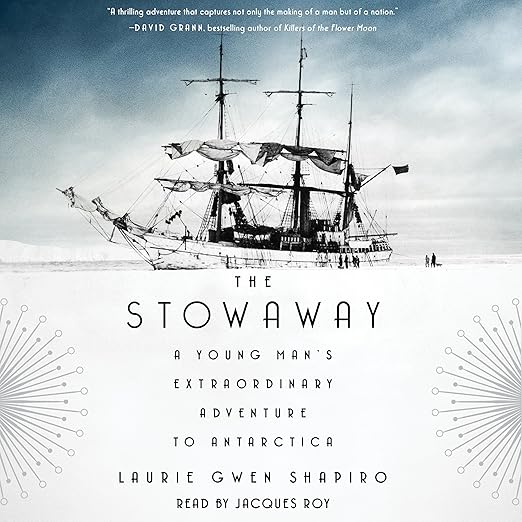
David Grann, the bestselling author of Killers of the Flower Moon, calls the book 'a thrilling adventure that captures not only the making of a man but of a nation,' and the Los Angeles Times specifically credits Shapiro with narrating 'this period piece with gusto,' both blurbs pointing at the same real strength. This is not dry expedition history; it moves at the pace of the teenager at its center.
The book's actual geography is as much a selling point as its history: Gawronski's journey runs from Lower East Side soda shops to the dance halls of Tahiti to Antarctica's blinding, deadly cold, three settings that could not be more different from each other, and Shapiro, per The New Yorker's own assessment, gives the whole arc a genuinely 'novelistic' shape rather than a dry chronological account. That range gives the narration real tonal territory to cover, streetwise New York City energy, tropical excess, and polar-expedition tension, inside a single unified story.
Old Money Angling While a Teenager Climbs In
Real Rockefellers and Vanderbilts wanted the same lowly mess-boy positions Gawronski eventually claimed for himself, a detail worth sitting with: without meaning to, he was out-hustling some of the most privileged families in America simply by refusing to ask permission and jumping in the river instead of waiting for an invitation. That class contrast, old money angling politely through the front door while a working-class teenager climbs in through a side window nobody thought to guard, runs quietly under the entire adventure without the book needing to state it as an explicit argument.
Real dramatic irony sits quietly underneath the whole adventure, though the book lets a listener find it rather than pointing it out directly: 1928's giddy, everyone-wants-in optimism was, in hindsight, less than a year from the crash that would end the decade's party for good. Newspapers covering Gawronski's stunt in real time treated it as pure entertainment, a scrappy kid outsmarting his social betters, with no sense yet of how differently the country's mood was about to turn. That gap between how the story felt in 1928 and how it reads with the benefit of hindsight gives Shapiro's account a layer a straight period adventure story would not have on its own.
A Book Club That Didn't Finish It
One reviewer, otherwise enthusiastic about Gawronski's exceptional bravery and adaptability, notes that he actually stowed away on more than one ship before finally succeeding, a detail that adds real texture to the story of persistence behind the headline stunt. A different reviewer raises a more structural complaint: the book doesn't give many details on the last twenty-five-plus years of Gawronski's actual life, which makes the ending feel rushed and flat after such a vivid, detailed middle section covering the expedition itself.
A third reviewer was blunter still, calling the book boring, praising the underlying information while comparing the prose to a textbook, and reporting that her own book club didn't finish it, a real, credible dissent worth weighing against the more enthusiastic reviews and the blurbs from David Grann and the Los Angeles Times. That split reaction, vivid adventure writing for some readers, dry and textbook-like for others, is worth knowing going in, since narration alone can't fully bridge a gap that at least one reader felt was about the prose itself.
This is a relatively short audiobook at six hours and twenty-seven minutes for a story spanning New York, Tahiti, and Antarctica plus the aftermath of Gawronski's sudden fame, which helps explain both the propulsive pace praised in the earlier chapters and the compressed treatment of his later life some reviewers flagged. A tighter runtime keeps the expedition chapters moving briskly, but it also means less room for the kind of full-life biographical detail a longer, more exhaustive treatment might have included.
A Character Study More Than a Biography
Readers of narrative history built around one vivid, specific character, in the vein of David Grann's own true-crime and adventure nonfiction, will likely find the same appeal here that Grann's blurb points toward. Anyone drawn to Jazz Age history, Antarctic exploration, or genuinely improbable true stories about someone talking, sneaking, or working their way into an experience they had no right to be part of will find Gawronski's persistence across multiple failed attempts before his stunt actually worked a satisfying through-line. Listeners who enjoy history that reads like a character study rather than a dry timeline of expedition logistics are well served by how tightly Shapiro keeps Gawronski himself at the center of nearly every chapter.
A full life biography this is not, and listeners wanting one rather than an expedition-focused adventure story should adjust expectations for the back half specifically, since the book's own reviewers flag the final twenty-five years of Gawronski's life as thin compared to the detailed Jazz Age adventure that precedes it. Readers who found Roy's composed register too even-keeled for high-energy material in his other narration work may also want to sample a chapter before committing to six and a half hours in that same steady register applied to a runaway teenager's story.
Is this audiobook based on a true story?
Yes, entirely. Billy Gawronski was a real Lower East Side teenager who stowed away on a real 1928 Antarctic expedition, and Laurie Gwen Shapiro builds the book from archival research and contemporary newspaper coverage.
Does this audiobook cover Gawronski's entire life or just the expedition?
Mostly the expedition and its immediate aftermath. More than one reviewer notes the book covers the last twenty-five-plus years of his life only briefly, which makes the ending feel more compressed than the vivid middle section.
How does David Grann's blurb describe this audiobook?
Grann, author of Killers of the Flower Moon, calls it a thrilling adventure that captures not only the making of a man but of a nation, one of several strong blurbs attached to this listing.