Quick Take
- Narration: Michael Kramer handles Donald L. Miller’s vast scope with the measured authority that 25 hours of dense historical material requires, keeping the eyewitness testimony emotionally present without melodrama.
- Themes: The human cost of industrialized warfare, the gap between official narrative and lived experience, collective endurance under impossible conditions
- Mood: Immersive and sobering, with the weight of documented testimony throughout
- Verdict: The most comprehensive single-volume audiobook account of World War II built from soldier testimony, best for listeners who want to understand the war as it was actually experienced rather than as it was officially recorded.
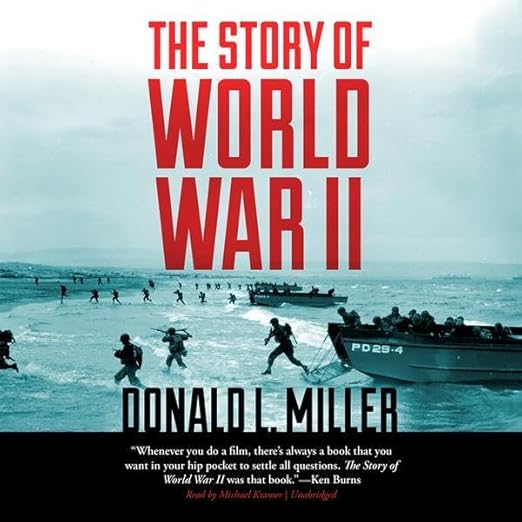
I came to The Story of World War II in the way most listeners probably approach a 25-hour history audiobook: with a long drive ahead of me and the conviction that I knew more about the subject than I actually did. By the time I reached the Pacific theater material, I had revised that conviction considerably. Donald L. Miller is not primarily interested in what you thought you knew. He is interested in what the people who were there actually saw and experienced, and the gap between those two things is where this book does its most important work.
Miller draws on previously unpublished eyewitness accounts and builds his narrative from soldiers, journalists, and civilians caught in the war’s reach. The effect is different from conventional military history in ways that matter at 25 hours of listening time. You are not primarily tracking the movement of armies. You are tracking what it was like to be inside those armies, what the bomber war over Europe looked and sounded like to the crews flying it, what the island fighting in the Pacific cost at the level of individual men, what the liberation of the death camps required of the soldiers who entered them.
Our Take on The Story of World War II
Miller’s decision to use eyewitness testimony as his primary source material is both the book’s greatest strength and its organizing principle. The accounts of soldiers from previous eras were often censored or shaped by official concerns about morale and public perception. Miller draws on material that was suppressed at the time, and the difference between this book’s portrait of the war and what Americans on the home front would have read is one of its running themes. This is the war as it happened, not the war as it was managed for civilian consumption.
Multiple reviewers note the effect of reading this after years of the sanitized version. One reviewer described moving from a semi-abstract understanding of WWII as consisting of Nazis, Kamikaze pilots, the Holocaust, and the nuclear bomb to a much more thorough and detailed understanding of decisions made and consequences carried. That transition is precisely what the book is designed to produce, and at 25 hours it has sufficient space to accomplish it without compression.
Why Listen to The Story of World War II
Michael Kramer is one of the most reliable narrators working in long-form nonfiction, and his performance here sustains across nearly 25 hours without fatigue or decline. His handling of the eyewitness material is particularly important: the testimony of soldiers requires a narration that keeps the human presence alive without imposing theatrical interpretation, and Kramer calibrates that balance well throughout. The Pacific island fighting sections and the bombing campaign chapters, both among the most intense material in the book, are rendered with the restraint that makes documented horror more affecting than dramatized horror.
The book covers the entire war: land, sea, and air, including new coverage of the brutal Pacific island fighting, the bomber war over Europe, the liberation of the death camps, and the contributions of African Americans and other minorities who served. The final section on the atomic bombing of Nagasaki, built from interviews with the men who flew the mission, is described in the synopsis as never-before-told, and the accumulation of detail across 25 hours gives that section its full weight.
What to Watch For in The Story of World War II
This is an American history of an American war, which means the European perspectives and the experiences of other combatant nations are present but not primary. Listeners who want a balanced multinational account will need to supplement this book with other sources. Miller’s focus is on the American experience of the war, its soldiers, its journalists, its civilians, and the testimony he has assembled is filtered through that focus.
At 25 hours, pacing yourself is the practical challenge. The material is dense with specific detail, and the eyewitness accounts accumulate in ways that can become emotionally heavy over extended listening sessions. Miller’s writing is not designed to protect you from the weight of what happened, and the book is more honest for it. Several reviewers noted reading many pages before bed and many more upon waking, which suggests the material compels forward momentum even when the subject matter is difficult.
Who Should Listen to The Story of World War II
Listen if you want to understand World War II through the testimony of the people who fought and survived it rather than through the official narrative. Listen if you are comfortable investing 25 hours in a subject you want to understand thoroughly. Skip if you want a shorter overview or a balanced multinational perspective, since Miller’s focus is distinctly American. This is one of the most significant single-volume audio histories of the war available.
Frequently Asked Questions
How does The Story of World War II differ from other WWII histories in its use of eyewitness accounts?
Miller specifically draws on testimony that was censored or unpublished during the war, showing Americans what soldiers actually experienced rather than what was managed for public consumption. This is the key distinction: it is not a revision of the strategic or political history but a recovery of the human experience that was suppressed at the time.
Does the book cover the Pacific theater and the European theater with equal depth?
Yes, and the Pacific island fighting and the bomber war over Europe are singled out as areas where Miller provides new coverage beyond standard treatments. The final section on the Nagasaki bombing is built from interviews with the mission crews and is described as a never-before-told account.
Is Michael Kramer the right narrator for 25 hours of dense military history?
He is among the best choices for this type of material. Kramer’s narration is measured and authoritative over long listening sessions, and his handling of the eyewitness testimony keeps the human presence alive without theatrical dramatization. The performance sustains the full length without noticeable fatigue.
Does the book address the contributions of African American soldiers and other minorities, or is it primarily a white American perspective?
Miller explicitly includes coverage of African Americans and other minorities who served, which the synopsis flags as part of the book’s expanded scope. How comprehensive that coverage is relative to the overall narrative is harder to judge from outside, but it is present as a deliberate inclusion rather than an afterthought.