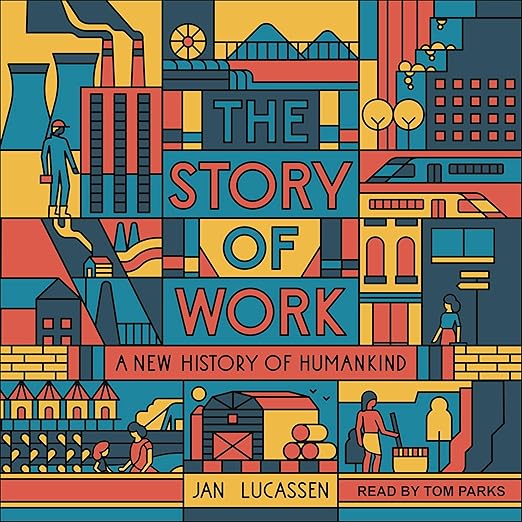
Quick Take
- Narration: Tom Parks delivers a measured, academic cadence that suits the scholarly scope of the material, though the dense passages occasionally flatten out over a 22-hour runtime.
- Themes: Labor history, economic anthropology, global inequality across time
- Mood: Dense and deliberate, best absorbed in short sessions
- Verdict: A genuinely ambitious global labor history that rewards patient listeners with a strong interest in economic anthropology, but it will test anyone hoping for a more accessible popular-history ride.
I came to this one on a recommendation from a colleague who studies economic history, and I queued it up for a series of long train commutes through November. By the time I reached the midpoint, somewhere around the Roman Empire’s labor arrangements, I understood both why this book gets praised and why it frustrates a certain kind of listener. Jan Lucassen has spent a career as one of the world’s leading labor historians, and that expertise is visible on every page. What is also visible, though, is the weight of that expertise pressing down on the narrative.
The Story of Work sets out to do something genuinely rare: to trace how humanity has organized labor from hunter-gatherer societies more than 700,000 years ago right through to today’s gig economy platforms. Spanning China, India, Africa, the Americas, and Europe, it refuses the Eurocentric frame that shapes so many macrohistories. That alone makes it worth knowing about. The question is whether it works as an audiobook experience.
Our Take on The Story of Work
Lucassen’s central argument is both clarifying and, at times, a little deflating. He demonstrates that the three fundamental labor arrangements we think of as modern, unfree labor, wage labor, and self-employment, have coexisted in various proportions for roughly five thousand years. The invention of money, the rise of agrarian states, the collective action of workers, the specific burdens placed on women and children: all of it is traced with meticulous care. The global scope is the book’s genuine strength. A chapter on labor relations in pre-colonial West Africa or the rice economies of medieval Southeast Asia offers exactly the kind of perspective you rarely encounter in histories written for a Western audience.
What is harder to absorb in audio form is the volume of data points. Lucassen’s method involves sustained comparison across dozens of societies and centuries, which means the prose carries a density that works better on a page, where you can pause and cross-reference a map or a table. Tom Parks narrates with steady professionalism, but even he cannot entirely rescue a passage cataloguing labor-tribute arrangements across seven different ancient states. Some listeners, as one Canadian reviewer put it, found it “neither as intriguing as popular history nor as engrossing as the academic”, and that assessment is fair. The book occupies an uncomfortable middle zone.
Why Listen to The Story of Work
The payoff for patient listening is real. The sections on the watershed invention of money and its transformation of labor relations are genuinely illuminating. Lucassen’s analysis of slavery not as a historical aberration but as one variable in an ongoing human negotiation over labor is both unsettling and clarifying. The treatment of migration as a labor force mechanism, tracing it from ancient empires to the precarious existence of modern seasonal workers, gives the contemporary gig economy a historical depth that most commentary on the subject entirely lacks.
The book also refuses a simple progressive or declinist narrative. Work has not straightforwardly improved or worsened over human history; instead, the configurations of coercion and consent have shifted, often cyclically. That nuanced argument is the book’s real contribution, and once you settle into its rhythm, it is intellectually satisfying in a way that more polished popular histories rarely achieve.
What to Watch For in The Story of Work
Be prepared for the long game. At 22 hours, this is not a book you can half-listen to while doing something else. The density of proper nouns, place names, and cross-cultural comparisons means your attention needs to be fairly focused, or you will lose the thread of which labor regime is being contrasted with which. The opening chapters are the most demanding; things become more readable once Lucassen reaches the early modern period and the examples grow more familiar.
The critiques in the available reviews are worth taking seriously. One reader noted that after more than 400 pages, Lucassen arrives at conclusions that feel somewhat anticlimactic, that the big structural categories of labor have changed less than we might expect. Whether that reads as a profound insight or a letdown depends on what you bring to the book. Listeners who enjoy sitting with a long, carefully built argument will feel rewarded. Those who prefer a driving narrative or a more personal cast of historical actors may find themselves restless well before the final chapter.
Who Should Listen to The Story of Work
This audiobook is well suited to listeners who have already read accessible popular histories of capitalism or labor, think David Graeber or E.P. Thompson, and want to go deeper into the global, pre-capitalist dimensions of the story. Academic listeners, students of economic history, and anyone working in labor policy or anthropology will find it genuinely useful. If your interest in the subject is more casual, or if you prefer your history driven by individual stories rather than structural analysis, it is worth knowing what you are getting into before committing to 22 hours. The material rewards sustained attention; it just does not do much to court it.
Frequently Asked Questions
Does The Story of Work cover non-Western labor history in meaningful depth, or is it primarily Europe-focused?
Lucassen explicitly rejects the Eurocentric frame. The book spans China, India, sub-Saharan Africa, the Americas, and Southeast Asia across different eras, making it one of the few genuine global labor histories available in audio form.
Is 22 hours of dense academic content manageable as an audiobook, or is this better read in print?
It is manageable but challenging. Tom Parks narrates clearly, but the high volume of cross-cultural comparisons and data-dense passages rewards attentive listening in shorter sessions rather than long passive stretches.
Does the book reach any surprising conclusions about how modern work compares to labor arrangements in ancient history?
One of its central arguments is that unfree labor, wage labor, and self-employment have coexisted for roughly five thousand years, suggesting that modern labor arrangements are less novel than we tend to assume. Some find this illuminating; others find the conclusion underwhelming given the length of the argument.
Is any prior knowledge of labor economics or history required to follow the book’s argument?
No formal background is required, but some familiarity with basic economic history concepts will help you track the comparisons. Readers who have engaged with works on the history of capitalism or global trade will find themselves on firmer ground from the start.