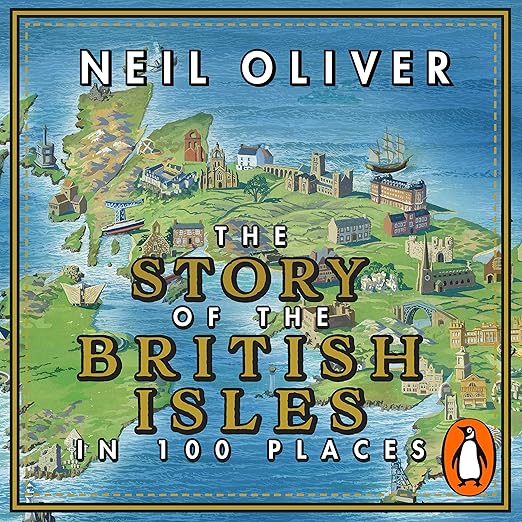
Quick Take
- Narration: Oliver reads his own text with genuine warmth and the cadence of a seasoned television presenter, making even dense historical passages feel like a guided walk.
- Themes: Deep time and landscape memory, British identity across millennia, the weight of place as historical witness
- Mood: Sweeping and elegiac, the auditory equivalent of standing on a windswept headland
- Verdict: For listeners who want history delivered through personal attachment to place rather than chronology, Oliver’s self-narrated tour is deeply satisfying.
There is a particular pleasure in listening to a book read by the person who clearly loves the subject most in the world. Neil Oliver is a Scottish archaeologist who became a television fixture in the UK, and his enthusiasm for the British landscape comes through on every page of The Story of the British Isles in 100 Places. I listened to the opening chapters on a grey Saturday morning with coffee I kept letting go cold, and found that the format, short essay-chapters built around individual sites, made it almost impossible to find a natural stopping point.
The conceit is deceptively simple: Oliver selects one hundred locations from across England, Scotland, Wales, and Ireland, and uses each as a lens for a particular moment or thread in British history. In practice this means the book opens with human footprints almost a million years old discovered in Norfolk mud in 2013, and closes on an eroding beach in Kent with a nuclear plant humming in the distance. The range in between covers Romans, Vikings, civil war, the industrial revolution, and two world wars, without feeling like a conventional survey history.
Our Take on The Story of the British Isles in 100 Places
What elevates this above a standard historical anthology is Oliver’s prose. Multiple reviewers single it out, one calling him a vastly talented essayist, another describing the book as poetic. That is accurate. Oliver has the ability to make a site feel inhabited rather than catalogued. When he writes about Stonehenge or Lindisfarne, he is not reciting what happened there. He is trying to transmit why being there feels different from being anywhere else, that lingering of past spirit he describes in the synopsis. For most of the 100 entries, he succeeds.
Why Listen to The Story of the British Isles in 100 Places
Oliver reading his own work is the right choice for this particular book in a way it is not always right for author-narrated audiobooks. His voice has the natural authority of someone who has spent decades presenting archaeology documentaries, which means he knows exactly how to pace a complex point about geological strata or Viking settlement patterns without losing a general listener. The emotional passages land cleanly too. He is not performing sentiment. He genuinely feels the weight of these places, and the audio format lets you feel him feeling it. Reviewer Robert Moody notes that only twenty-one of the hundred sites were personally familiar to him, yet the book remained absorbing throughout. That is the test of writing about place: whether it works even for readers who have never been there.
What to Watch For in The Story of the British Isles in 100 Places
The essay format, while its greatest strength, also creates minor unevenness. Some entries feel more fully realized than others. The famous sites like Stonehenge or the Somme battlefields get the full treatment, while a handful of the more obscure locations feel slightly underpowered by comparison. This is not unusual in any collection of this scope, and the standard is high enough that even the lesser entries are worthwhile. Listeners who prefer a strict chronological narrative may find the place-by-place structure occasionally disorienting. Oliver does signal the historical period at each entry, but the book does not build toward a single argument the way a conventional history does. It accumulates, which is a different, and in this case more fitting, mode of understanding a landscape with a million-year human story.
Who Should Listen to The Story of the British Isles in 100 Places
Perfect for anyone who has ever stood at a historical site and wanted more than a placard could offer. Particularly strong for listeners planning a visit to the UK who want context for what they will see, and equally rewarding for those who will never go but find British history and landscape worth understanding on their own terms. Less suited to listeners who want argument-driven narrative history with a strong thesis. This is deliberately impressionistic and cumulative, and its pleasures are atmospheric as much as informational.
Frequently Asked Questions
Do you need to be British or have visited the UK to enjoy this audiobook?
Not at all. Several reviewers note enjoying it without having visited most of the 100 sites. Oliver’s writing works hard to make each place vivid for listeners who know it only from the page, and the broader historical themes are legible regardless of familiarity with the geography.
How does Oliver’s self-narration compare to professional audiobook narrators?
He is unusually well-suited to reading his own material given his documentary presenting background. His pacing is confident, his emotional register is controlled, and he handles both lyrical passages and historical exposition without flattening either. It is one of the more successful author-narrated audiobooks in the historical nonfiction space.
Is this a book for archaeology enthusiasts specifically, or does it cover broader British history?
Broader. While Oliver’s professional background is in archaeology and some entries lean into physical evidence and landscape archaeology, the 100 sites span Roman occupation, medieval religion, industrial history, and twentieth-century conflict. A general history listener will be well served.
At 14 hours, does the essay-per-chapter format make it easy to listen in short sessions?
Very much so. Each chapter is a self-contained essay tied to a single place, making it one of the better audiobooks for commutes or fragmented listening. You do not need to hold the thread of a continuous narrative across gaps between sessions.