Quick Take
- Narration: Jim Meskimen delivers the financial history with clarity and authority, keeping complex economic arguments accessible over ten hours.
- Themes: Commodity markets and political power, the Hunt brothers silver corner, monetary history and its modern relevance
- Mood: Intellectually engaging with genuine narrative momentum
- Verdict: A well-researched financial history that reads more like thriller plotting than textbook, strongest in its treatment of Nelson Bunker Hunt and the 1970s silver crisis.
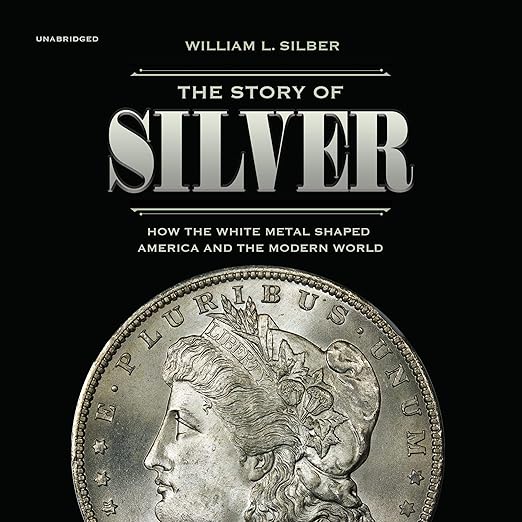
I have a complicated relationship with financial history audiobooks. The best of them do something that orthodox economics rarely manages: they make the system feel like a story with actual human beings in it, people who wanted things, made errors in judgment, and suffered or prospered as a result. William L. Silber’s The Story of Silver is, at its most effective, that kind of book. I put it on during a long drive on a Saturday morning and found myself still listening, parked in my driveway, twenty minutes after I had arrived home because the Hunt brothers chapter had me genuinely gripped.
Silber, a professor of economics and finance at NYU, brings serious academic credentials but writes with a journalist’s instinct for what makes a story move. His central subject is silver’s role in American and world history across two centuries, from its demonetization in the 1870s through FDR’s Depression-era price manipulation and into the extraordinary 1970s episode in which Nelson Bunker Hunt, the Texas oil billionaire, attempted to corner the silver market and very nearly succeeded before losing his fortune in the collapse.
Our Take on The Story of Silver
The book’s strongest material is the Hunt brothers episode, and Silber knows it. The portrait of Bunker Hunt as a man simultaneously brilliant at certain kinds of accumulation and catastrophically wrong about others is genuinely compelling. One reviewer described laughing out loud while reading passages to their spouse, which captures the mixture of absurdity and high financial stakes that Silber maintains throughout those chapters. The detail of how close the silver corner came to triggering a broader financial crisis, and how specifically it was unwound, is the kind of granular historical account that rewards readers who want to understand the plumbing of modern markets.
The earlier chapters, covering the nineteenth-century politics of silver versus gold and FDR’s Depression-era interventions, are more contested. One reviewer argues these should have been cut entirely in favor of deeper coverage of the Hunts and their nemesis, commodity trader Henry Jarecki. That is a reasonable editorial position, and there is some validity to it. The section on silver’s geopolitical consequences for China in the 1930s, where FDR’s price manipulation effectively weakened the Chinese economy and accelerated Japanese imperial expansion, is genuinely important history that is rarely told in this context. But it does require the listener to stay engaged through material that is denser than what follows.
Why Listen to The Story of Silver
Jim Meskimen narrates with the kind of measured authority that financial history requires. He does not dramatize in ways that would distort the material, but he also does not flatten it into a lecture. The pacing across ten hours is well-managed, and Meskimen handles the technical economic content clearly without either oversimplifying or letting it become opaque.
Silber also has the good sense to bring the story forward into the present. Silver’s role as a hedge against inflation and political instability is not merely historical, and he connects the patterns of the past to ongoing economic behavior including Warren Buffett’s well-known silver purchases in the 1990s. For listeners with any interest in commodity markets or monetary history, these connections make the book feel useful rather than merely educational.
What to Watch For in The Story of Silver
The book’s first quarter, covering the so-called Crime of 1873 and William Jennings Bryan’s Cross of Gold campaign, is the densest section and the one most likely to lose listeners who came specifically for the Hunt brothers story. Silber does eventually connect these threads, but if you find yourself flagging early, it may be worth knowing that the narrative momentum picks up considerably once the twentieth century begins.
One reviewer who describes himself as a long-time gold and silver investor was surprised by how much the book corrected his existing understanding of events he thought he knew well. That is a meaningful endorsement from someone who had direct context for the period. The book earned a reputation among financially literate readers for genuine informational depth rather than surface-level storytelling.
Who Should Listen to The Story of Silver
Strong choice for listeners interested in commodity markets, monetary history, and the intersection of politics and economics. Readers who enjoyed Michael Lewis’s financial journalism, Sebastian Mallaby’s work on hedge funds, or Lewis Lehrman’s monetary history writing will find Silber’s approach familiar and satisfying. General history readers with patience for economic context will also find enough narrative payoff to justify the investment. Listeners primarily interested in popular economics without technical depth should look elsewhere.
Frequently Asked Questions
Do you need a background in economics to follow The Story of Silver?
No, though some familiarity with basic monetary concepts helps. Silber writes for an educated general audience rather than specialists, and Jim Meskimen’s narration keeps the technical material accessible.
Is the Hunt brothers silver corner the main focus of the book?
It is the most dramatic and extended episode, but the book covers two centuries of silver’s role in economic and political history. Some reviewers wish the Hunts received even more coverage; others value the broader historical context Silber provides.
Does The Story of Silver have anything relevant to say about contemporary markets?
Yes. Silber explicitly connects the historical patterns to modern behavior, including Warren Buffett’s silver investments, and addresses silver’s ongoing role as an inflation hedge and store of value for a broad global population.
How does the early nineteenth-century material compare to the twentieth-century sections?
Most reviewers find the earlier chapters denser and slower. The book gains considerable momentum once it reaches the Depression era and especially the 1970s. A reviewer who suggested skipping the first hundred pages is in the minority, but the pacing shift is real.