Quick Take
- Narration: Currivan reads her own work with a quality of deep familiarity – this is her life’s work and that shows, though the density of the prose strains even a self-read and multiple passes help.
- Themes: Conscious evolution, cosmic sentience, scientific spirituality
- Mood: Expansive and wonder-saturated, occasionally demanding
- Verdict: A genuine intellectual achievement for listeners who can stay with its density – Currivan synthesizes astrophysics, evolutionary biology, and cosmological consciousness theory into a unified argument that is unlike anything else in this space.
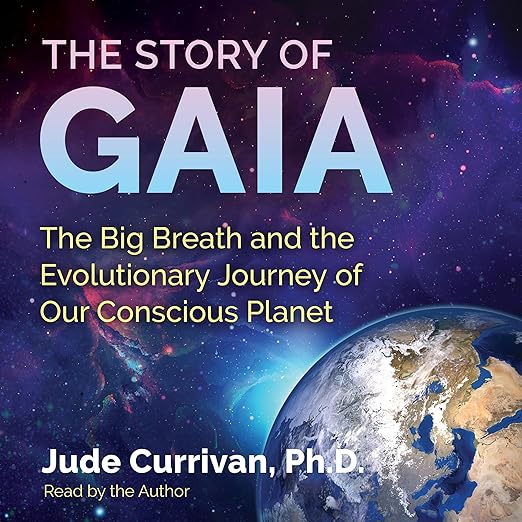
I started The Story of Gaia on a long flight, expecting to skim it. Somewhere over the Atlantic, around the section where Jude Currivan begins explaining what she means by the Universe as a cosmic hologram of in-formation, I realized I was not going to skim anything. This is a book that asks you to follow a specific argument from its foundations, and if you step off the train midway, the later stations stop making sense. I had to restart two chapters before I trusted myself to be genuinely tracking what she was building.
Currivan, who holds a Ph.D. in physics and spent years in international business before devoting herself to what she calls whole-world research, occupies a rare and somewhat uncomfortable intellectual position. She is too scientifically serious for the pure spirituality audience and too explicitly spiritual for the mainstream science audience. The Story of Gaia, winner of a 2023 Nautilus Gold Award, is her most ambitious attempt to bridge that gap.
Our Take on The Story of Gaia
The core argument is a rewrite of Darwinian evolution, and it is genuinely radical rather than merely contrarian. Currivan does not dispute the facts of evolutionary history. What she disputes is the interpretation: that random mutations and environmental pressures are the sole driver. Instead, she argues for what she calls intelligently informed information flows – a view in which the Universe’s apparent tendency toward greater complexity, diversity, and self-awareness is not an accident but a manifestation of inherent cosmic sentience. She frames the Big Bang not as a chaotic explosion but as the first moment of a fine-tuned Big Breath, and traces from there the 13.8-billion-year journey from protons to planets to people. She is, as one reviewer put it, giving form to a new emergent cosmology at the point where Western science and universal spirituality are beginning to converge. Whether you find that convergence convincing or wishful thinking will determine your relationship to this audiobook entirely.
Why Listen to The Story of Gaia
The self-narration is both an asset and a point of caution. Currivan reads with a quality of deep familiarity – this is her life’s work, and that shows in how she inhabits the material. There is no sense of a narrator translating from a page; she is speaking from inside the ideas. The prose in its best moments is genuinely beautiful, and one reviewer who had experienced her in talks noted a lyricism that is present here too, even if the book’s density sometimes obscures it. For the right listener – someone with genuine interest in consciousness science, cosmology, or the philosophy of evolution who is willing to sit with difficulty – this audiobook offers twelve hours of ideas that do not appear in this combination anywhere else.
What to Watch For in The Story of Gaia
The density is real, and one reviewer was honest about this even from a position of deep familiarity with the subject matter. Currivan does not write for accessibility; she writes for precision, and the precision sometimes tips into opacity. The book covers astrophysics, cosmology, geology, chemistry, and biology within a single argument, and the connective tissue between disciplines occasionally strains. Listeners who came to this via Currivan’s companion volume, The Cosmic Hologram, will be better prepared; those arriving cold may find the opening chapters require significant patience before the structure becomes clear. The spiritual dimension is not decorative – it is the thesis. Readers who want Gaia theory examined through a purely scientific lens will not find it here.
Who Should Listen to The Story of Gaia
Ideal for listeners already engaged with consciousness science, new cosmology, or the kind of interdisciplinary spirituality represented by authors like Rupert Sheldrake or Lynne McTaggart. Readers of Currivan’s earlier work will find this a natural continuation and deepening. Those new to the territory should approach with patience and perhaps a notebook. Not suited for listeners who want clean, linear science communication or who find spiritual frameworks off-putting in scientific contexts.
Frequently Asked Questions
Should The Story of Gaia be listened to before or after The Cosmic Hologram?
Reviewers describe Gaia as a companion to The Cosmic Hologram rather than a sequel. The Cosmic Hologram establishes the in-formation framework that Gaia builds on. Starting there would ease entry into this book’s more demanding terrain.
How does Currivan’s self-narration affect the listening experience given the material’s complexity?
She reads with deep authority and genuine presence – there is no interpretive distance between the author and the ideas. But the density of the prose is intrinsic and does not become simpler because she is the one reading it. Active listening, and possibly replaying sections, is necessary.
Is The Story of Gaia a science book, a spirituality book, or something else?
Both, and neither will fully satisfy listeners who want just one. Currivan’s explicit project is to show that leading-edge science and traditional spiritual visions of Earth as a living being are converging on the same conclusion. That synthesis is the point.
What does Currivan mean by calling the Universe a cosmic hologram of in-formation?
She draws on quantum physics and information theory to argue that the Universe is fundamentally constituted by meaningful information – that physical reality is the expression of an underlying informational reality. The hologram metaphor captures how each part contains the whole, and the hyphenation of in-formation signals that the information is actively forming reality rather than merely describing it.