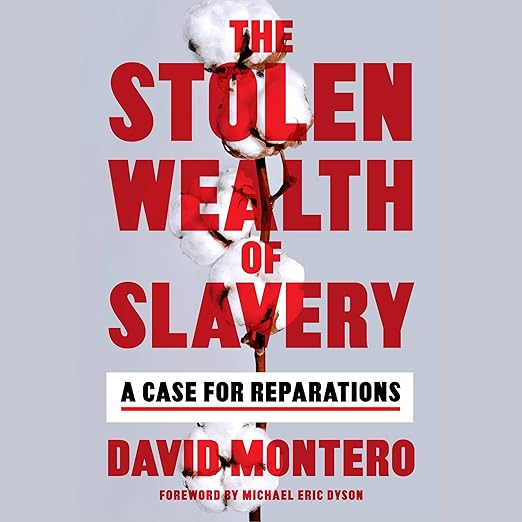
Quick Take
- Narration: Eric Jason Martin brings measured authority to David Montero’s investigative prose, navigating dense financial history without losing the human stakes.
- Themes: Economic history of slavery, Northern complicity, the case for corporate reparations
- Mood: Rigorous and unsettling, with accumulating moral weight
- Verdict: A meticulously researched work that dismantles a convenient national myth about who profited from slavery and follows the money across two centuries.
I was about three hours into this one on a Saturday afternoon, making notes between chapters, when I realized I had stopped writing anything down and was just listening. David Montero does something that is genuinely difficult in investigative history: he makes financial documents and banking ledgers feel like evidence in a live case. At fourteen hours, The Stolen Wealth of Slavery is a substantial commitment, but it earns the time.
Eric Jason Martin handles the narration with the kind of restrained authority the material calls for. He does not editorialise with his voice, and that restraint is appropriate. The book makes its arguments through evidence, not tone.
Our Take on The Stolen Wealth of Slavery
The book’s most striking contribution is its sustained focus on Northern financial institutions. Montero names names: Citibank, Bank of New York, Bank of America. He traces how these institutions financed the slave trade not as peripheral participants but as central enablers, and how the profits moved from antebellum bondage into the industrialization of the country after the Civil War. The core thesis is that the wealth generated by slavery did not disappear at Emancipation but was absorbed into corporate and financial structures that form the bedrock of the modern American economy. This is not entirely new territory, but the archival detail Montero brings to it is distinctive. One reviewer called it a compelling historical account that follows the money trail from beginning to end, and that is an accurate description. This is a book that wants to change what you think you know about economic geography and moral responsibility.
Montero also pushes back directly on the common historical narrative that most white Southern enslavers were wealthy planters. The data he presents suggests that many were barely making ends meet, while Northern businessmen and financial institutions captured the largest share of bondage-based profits. That reorientation of the geographic and class story of slavery is one of the book’s more important contributions to the public record.
Why Listen to The Stolen Wealth of Slavery
What distinguishes this from similar titles in the reparations discourse is the specificity of Montero’s argument. He is not making a general claim about the legacy of racism in American institutions. He is making a particular claim: here is what was stolen, here is who stole it, here is where the money went, here is to whom it is owed. That specificity is both the book’s strength and its provocation. A reviewer paired it with William Darity Jr.’s From Here to Equity and The Black Reparations Project as necessary companion reading, and those three books together form a fairly comprehensive library on the economic argument for reparations. Montero’s contribution to that conversation is the investigative reporting lens, moving through primary sources and corporate archives in a way that policy arguments alone cannot replicate. Another reviewer was struck by learning that some pro-Union Northerners were in fact anti-abolition, having calculated that slavery served their financial interests. That kind of revision of received history is what this book does repeatedly and with care.
What to Watch For in The Stolen Wealth of Slavery
The book is dense with financial and historical detail. Listeners who prefer narrative history with a strong character focus may find the corporate and institutional through-line harder to sustain at pace over fourteen hours. The audiobook format makes the evidence accumulation somewhat harder to track than the print version would for readers who want to reference specific claims or return to key passages. Montero also makes his normative position on reparations clear throughout, which makes this an argument as much as a historical account. Readers looking for a neutral historiography will not find it here, and that is a fair expectation to set before starting.
Who Should Listen to The Stolen Wealth of Slavery
This audiobook is essential for listeners interested in the economic history of American slavery, the reparations debate, or the genealogy of modern financial institutions. It is also well suited to anyone whose understanding of the Civil War era was shaped by the North-as-liberator narrative that Montero systematically dismantles. Those looking for emotional memoir or narrative history centered on individual stories should look elsewhere. This is a work of investigative journalism with an institutional focus, and its power comes from the accumulation of documented evidence rather than personal narrative.
Frequently Asked Questions
Does the book focus primarily on the antebellum South or does it trace the money further?
Montero’s central argument is that the most significant profiteers were Northern financial institutions, not Southern planters. The book follows the money from pre-Civil War financing through industrialization and into the contemporary economy, challenging the North-as-liberator narrative directly.
How does Eric Jason Martin handle the density of financial and historical material?
Martin reads at a measured pace that suits the weight of the evidence. He does not dramatize the material, which is the right call for investigative history of this kind. The listening experience is clear and authoritative rather than performed.
Is this book specifically about making a legal or policy case for reparations?
Montero builds toward a corporate reparations argument and details contemporary accountability movements, but the bulk of the fourteen hours is historical documentation rather than policy prescription. The argument follows from the evidence rather than leading it.
What prior knowledge helps a listener get more from this audiobook?
A basic familiarity with the economic history of the antebellum period and Reconstruction helps but is not required. Montero contextualizes his claims as he goes. Pairing this with Darity and Mullen’s From Here to Equity provides additional policy framework if you want to go deeper.