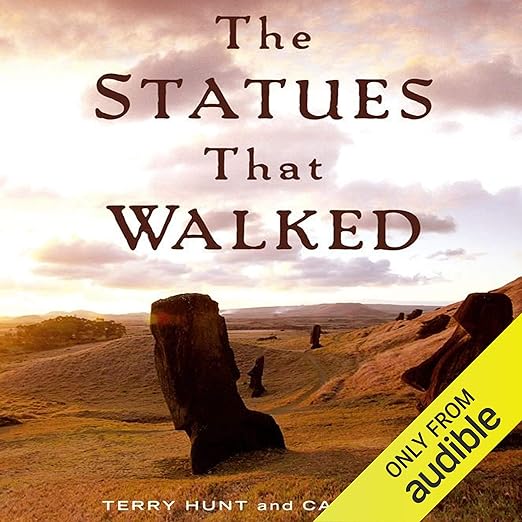
Quick Take
- Narration: Joe Barrett brings calm authority to a book that argues against received wisdom, letting the archaeological evidence speak without editorializing.
- Themes: Revisionist archaeology, colonial projection onto indigenous peoples, ecological resilience versus collapse
- Mood: Intellectually charged and quietly corrective
- Verdict: One of the more persuasive examples of how new fieldwork can dismantle a cherished myth, narrated cleanly and argued carefully.
There is a particular kind of intellectual pleasure in listening to a book that has the nerve to say the dominant story is wrong and then actually backs it up. The Statues That Walked gave me that pleasure on a long drive across state, the flat landscape outside doing nothing to distract from what Terry Hunt and Carl Lipo were dismantling chapter by chapter. I had absorbed the eco-suicide narrative about Easter Island years ago, the kind of factoid that lodges firmly because it feels like a parable. Deforestation, statue cult, collapse. Simple and grim. Hunt and Lipo spent years on Rapa Nui proving it was more complicated than that, and this book is their account of what they found instead.
Joe Barrett is a reliable narrator for this kind of material. He does not impose drama on findings that carry their own. His pacing through the archaeological argument is deliberate without being slow, and when the book shifts from methodology to implication, he shifts with it. For a book that is partly a corrective to Jared Diamond’s Collapse, which popularized the eco-suicide reading and which Hunt and Lipo address directly, the tone needs to be measured rather than combative, and Barrett gets that right.
What the Archaeological Record Actually Shows
The book runs just over six and a half hours, which is tight for the ground it covers. Barrett’s steady pace means there is no dead time: every chapter advances the argument, and the progression from field methodology to broader implication is logically coherent throughout.
Hunt and Lipo began their work on Rapa Nui in 2001 expecting to confirm the prevailing account. What they found instead was a sequence of revelations. The timeline of deforestation does not match the population collapse. Radiocarbon dating places the arrival of Polynesian settlers later than previously assumed, compressing the window in which the supposed ecological catastrophe could have unfolded. The rats that came with the settlers, it turns out, did most of the damage to the palm forest, gnawing seeds before they could germinate. The islanders were not mindlessly destroying their environment. They were adapting to it.
The moai themselves, the great statues everyone asks about, turn out to be central to the reinterpretation. Hunt and Lipo conducted experiments demonstrating that the statues could have been walked upright on ropes by small teams, which eliminates the need for the massive labor force and the forest of rollers that the eco-suicide hypothesis required. One reviewer who visited Easter Island described the book as a scientist’s perspective offering an objective presentation of competing theories, which is accurate, though Hunt and Lipo are clearly not neutral. They believe the old story is wrong. They argue it well.
The Harder Question: What Did Happen?
The book’s most intellectually honest section deals with the actual collapse, which did happen, but was caused by European contact and the slave raids of the 1860s rather than by indigenous self-destruction. This is a meaningful distinction, and Hunt and Lipo pursue it without letting it become a simple reassignment of blame. What they end up arguing is that the Rapa Nui people demonstrated remarkable resilience and ingenuity in a difficult environment, building a culture sophisticated enough to produce those extraordinary statues, and that they were brought low by forces entirely outside their own choices.
That argument is politically charged, and some listeners will find the authors’ framing too corrective. One reviewer acknowledged being familiar with Easter Island and described the book as offering new theories while remaining interesting. That is a fair characterization. The core archaeology is solid, the argument is clearly presented, and Barrett’s narration keeps the technical passages from losing momentum.
Who Should Listen and Who Should Skip
This is the audiobook for anyone who read the eco-suicide account of Easter Island in Collapse or in a National Geographic feature and wants the revision. It is also an excellent entry point for thinking about how archaeological narratives get constructed and how they can be overturned. The discussion of experimental archaeology, the actual rope-walking experiments with replica moai, is the kind of thing that works well in audio because Barrett walks you through the mechanics with precision.
Skip it if you need vivid narrative scene-setting. This is argument-forward, not story-forward. The human drama is muted in favor of the evidentiary case, which is the right call for the book’s goals but may frustrate listeners who came for characters. This is ultimately a work of science writing with a corrective agenda, and it rewards that framing. At six and a half hours, the book is efficiently packed. Hunt and Lipo do not pad their argument, and Barrett’s steady narration keeps the analytical passages from pooling into abstraction. Listeners who finish it and want to continue with the Easter Island story will find that the bibliography points toward both the original scholarly literature and the sources Hunt and Lipo are arguing against, which makes this a genuine entry point into a live archaeological debate rather than a closed account. The island itself, Rapa Nui, remains inhabited and politically complicated, and the book earns more weight knowing that.
Frequently Asked Questions
Does The Statues That Walked directly argue against Jared Diamond’s Collapse?
Yes, explicitly. Hunt and Lipo address Diamond’s Easter Island chapter directly and argue that the evidence does not support his eco-suicide narrative. Their book functions partly as a point-by-point rebuttal grounded in newer fieldwork.
How did the moai actually move? Does the book explain it?
Yes. Hunt and Lipo conducted experiments demonstrating that statues could have been walked in an upright position using ropes and small teams of people, a technique the islanders’ own oral traditions described. The book details the experimental archaeology behind this finding.
Is this book accessible to listeners without a background in archaeology?
Yes. The methodology is explained clearly as part of the narrative, and Barrett’s narration keeps the technical passages accessible. No prior knowledge of archaeological fieldwork is assumed.
Does the book explain why the statues face inward rather than outward toward the ocean?
Yes. The positioning of the moai is discussed as part of a broader argument about what the statues meant and how they functioned within Rapa Nui society, including their relationship to ancestor veneration and clan territories.