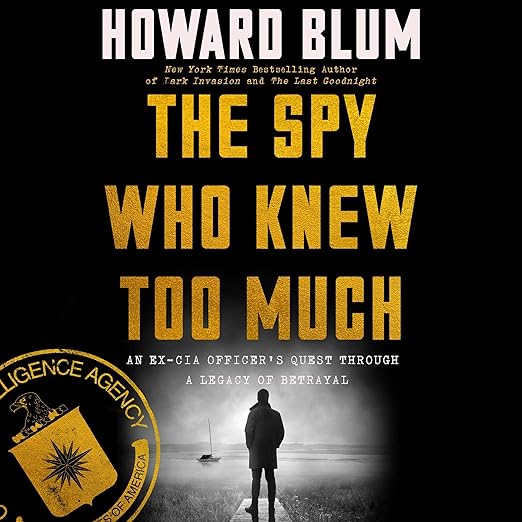
Quick Take
- Narration: Steve Hendrickson delivers with steady authority, handling the layered timeline and intelligence jargon without losing the personal undercurrent of Pete Bagley’s story.
- Themes: Cold War mole hunts, professional redemption, father-daughter estrangement
- Mood: Methodical and quietly suspenseful, like reading a classified file by lamplight
- Verdict: If you have patience for real-world spy mechanics over cinematic action, Howard Blum’s reconstruction of the Paisley mystery is one of the more satisfying Cold War narratives in audio.
I picked this one up on a Thursday evening after a long week, fully intending to listen for an hour and then switch to something lighter. I did not switch. Steve Hendrickson’s measured cadence pulled me through the Chesapeake Bay prologue, past the initial setup of Pete Bagley’s ruined career, and into the labyrinthine logic of CIA counterintelligence before I had any real sense of how far in I was. Howard Blum has a particular gift for making bureaucratic paranoia feel like a human story, and that gift is well served here.
The premise is one of those real-life situations that fiction writers would reject as too convoluted: in September 1978, a sloop drifts unmanned across the Chesapeake. Aboard are classified documents, live ammunition, and a top-secret satellite communications transmitter. The boat belongs to John Paisley, a former CIA officer whose disappearance becomes the thread Blum pulls to unravel a much larger story about moles, loyalty, and the cost of being right at the wrong moment.
The Man Behind the Mystery
What gives this book its emotional gravity is not the Paisley case itself but the figure investigating it: Tennent Pete Bagley, a man who once seemed destined for the top of American intelligence. His career collapsed when the very suspicion he directed at others, that a mole had burrowed into the CIA’s core, turned back on him. He was investigated, cleared, but never fully restored. That kind of institutional wound tends to fester, and Blum understands this. Bagley’s personal investment in solving Paisley’s disappearance is inseparable from his desire to vindicate a career that was stolen from him by innuendo.
Blum received strong praise for the depth of his research, and one reviewer noted that sometimes it takes a lifetime to get to the truth. That observation captures something real about this book. The full picture of what happened emerges only after years of declassification and the deaths of key players. Blum could not have written this book earlier, and that timing lends the material a completeness that many spy histories lack.
When the Personal Complicates the Professional
The subplot involving Bagley’s daughter Christina adds a dimension that distinguishes this from standard Cold War procedural. Christina, a CIA analyst, married an intelligence officer who was the son of the man who had played a key role in investigating her father. That family entanglement is almost Shakespearean in its structure, and Blum does not oversell it. He lets it sit alongside the espionage without forcing a neat resolution. The reconciliation between Pete and Christina, which runs quietly beneath the spy investigation, gives the book a warmth it would otherwise lack.
Steve Hendrickson is a good fit for this material. He does not inflate the drama, which is the right call for a story that earns its tension through accumulation rather than incident. His pacing respects the complexity of the counterintelligence world Blum is reconstructing, and he navigates the parade of agency insiders, Soviet handlers, and congressional investigators without losing the thread. A reviewer who found the book absorbing and relentless also noted its frustration, which is an accurate description of the emotional arc. The Paisley case does not hand you a tidy answer, and Hendrickson lets that ambiguity sit without trying to compensate with dramatic inflation.
Where the Book Tests Your Patience
One reviewer gave it a C-minus as a beach read, and that assessment, while harsh, contains a grain of truth. This is not a thriller that resolves cleanly. Blum does reach a conclusion, but it is the kind of conclusion that answers some questions and leaves others deliberately open, because reality does not provide the tidy denouements that fiction does. The Paisley case remains genuinely ambiguous: murder, suicide, or something stranger? Blum stakes a position, but he cannot prove it, and the more rigorous readers may find that unsatisfying.
The early chapters require some patience with the procedural mechanics of 1970s CIA structure. Blum contextualizes well, but if you have no prior interest in the mole-hunt literature of that era, the first few hours may feel dense. Those who push through will find the payoff significant. The convergence of Bagley’s career, Paisley’s death, and the broader question of Soviet penetration into American intelligence is genuinely compelling once all the pieces are on the table. One reviewer, who brought detailed prior knowledge of the Angleton and Oswald threads of CIA history, found the book answered questions that other sources had left open. That is a particular recommendation for listeners who already have some footing in this material.
Listeners Who Will Find This Rewarding
This one is for listeners who have already enjoyed works like Tim Weiner’s Legacy of Ashes or David Wise’s Molehunt and want a narrative that feels more intimate than institutional. If you came to Howard Blum through The Last Goodnight, his WWII espionage biography, you will find a similar approach here: deep research, strong character focus, and the patience to let complexity breathe. Casual thriller listeners looking for momentum and clean resolution should look elsewhere. But if the specific geography of Cold War paranoia draws you in, Blum and Hendrickson will reward the commitment. The combination of mole-hunt intrigue and the quieter father-daughter story is what makes this particular book worth the ten hours.
It is worth noting that the supplemental PDF accompanying the audiobook contains the source notes and bibliography that serious readers of Cold War history will want to consult. The audio narrative itself is complete without it, but the depth of Blum’s research is most visible when you can trace which conversations and which declassified documents underlie specific claims. That research, accumulated over what amounts to a career-long interest in American intelligence, is the real substrate of the book. Hendrickson delivers it faithfully.
Frequently Asked Questions
Do I need prior knowledge of Cold War CIA history to follow this audiobook?
Some familiarity with the broad outlines of the mole-hunt era helps, but Blum provides enough context that attentive first-time listeners can follow the main threads. The early chapters are the densest, so give it two or three hours before deciding.
Does Howard Blum reach a definitive conclusion about what happened to John Paisley?
Blum argues for a specific interpretation but acknowledges the evidence is circumstantial. The case remains officially unresolved, and the book is honest about that ambiguity rather than forcing a clean verdict.
How does the father-daughter storyline with Pete Bagley and Christina fit into the larger spy narrative?
It runs as a quieter parallel thread throughout. Christina married the son of someone involved in the investigation that damaged Bagley’s career, creating a family dynamic that mirrors the professional betrayals at the center of the book. The reconciliation gives the ending emotional weight beyond the espionage resolution.
Is Steve Hendrickson’s narration a good match for this kind of nonfiction spy history?
Yes. He narrates with controlled authority rather than dramatizing, which suits the material well. The book’s power comes from accumulation of detail, not from sudden reveals, and Hendrickson’s steady pacing reflects that structure.