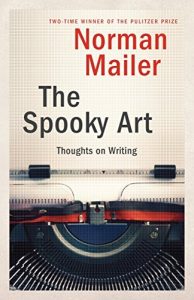
"Writing is spooky," Norman Mailer announces early in this audiobook, and that single admission sets the tone for everything that follows. The Spooky Art gathers more than fifty years of Mailer's criticism, private observations, and hard-won advice about the writer's life into one long, conversational session, and Arthur Morey reads it less like a lecture than like an evening spent listening to a working novelist think out loud. No ghostwritten polish sits between listener and subject, no tidy three-act structure organizes the advice. Instead, Mailer circles the same obsessions from different angles across decades: discipline, ego, envy, the terror of the blank page, and the strange faith it takes to keep filling it anyway.
Morey's Steady Hand Across Fifty Years of Opinions
Mailer became a literary sensation practically overnight when The Naked and the Dead made him famous at twenty-five, and one of the real pleasures of this collection is hearing him admit, decades later, how unprepared that early triumph left him for the long grind that followed. He offers no false modesty about the failures and difficult years that came next; he simply describes them, the way a boxer might describe a fight he lost badly. That candor holds through the whole audiobook. Mailer talks about jealousy toward rival writers, about the mechanics of revision, and about why he believes talent is common while discipline is rare, and he does it in the same direct, occasionally combative voice that made his journalism famous decades ago.
What keeps the collection from feeling like scattered magazine clippings stitched together is Morey's steady hand as narrator. He reads Mailer's opinions, some of which have aged better than others, with the same even authority whether Mailer is praising Hemingway or picking a fight with a rival novelist. The Philadelphia Inquirer called the book "the richest book ever written about the writer's subconscious," and while that is a considerable claim, the audiobook earns a fair share of it simply by refusing to smooth Mailer's rough edges into something more comfortable. Dr. Wilson Triviño's review traces a similar thread, noting how candidly Mailer discusses whether he was even ready for the literary rung he had suddenly been thrust into after his debut.
The praise stacked at the top of this edition is almost comically abundant, and worth sampling on its own merits: Entertainment Weekly called it "striking" and "entrancingly frank." The Washington Post went further, naming Mailer "indispensable, an American treasure." Big claims, certainly, but the audiobook itself makes a reasonable case for them simply by letting Mailer talk uninterrupted for the better part of twelve hours, opinions, contradictions, and all, without a co-author or interviewer smoothing his rougher edges into something more consumable.
Fierce About the Overpraised, Generous to the Underread
The appeal here is specificity. Mailer does not deal in vague inspirational platitudes about following your passion; he talks about actual mechanics, actual output targets, actual bad days at the typewriter, and what he thinks separates writers who finish books from writers who only talk about finishing them. For anyone who has tried to sustain a long project, the material lands with real weight, not because Mailer offers easy answers but because he refuses to pretend easy answers exist. Brett_Bloom calls it "an absolute treat" and says it belongs among the books "every writer who loves Literature must possess." That enthusiasm tracks with how the material actually plays across nearly twelve hours of listening.
Real value also comes from hearing Mailer engage with his contemporaries and predecessors directly, the kind of literary gossip and genuine critical insight that rarely survives translation into a tidier, more academic format. He is fierce about writers he thinks are overpraised and generous about writers he thinks are underread, and Morey's narration never tips that material into either reverence or mockery. It simply lets Mailer remain Mailer, opinions intact, for listeners who want the unfiltered version rather than a sanitized greatest-hits reel of writing advice, and that honesty is precisely what the Baltimore Sun praised when it noted the book should "nourish and inform" serious readers of the novel.
The New Yorker once called him "a writer of the greatest and most reckless talent." Life magazine described him as possessing "a devastatingly alive and original creative mind." That kind of praise could easily read as dated jacket-copy hype if the audiobook itself did not keep delivering moments that justify it, particularly whenever Mailer turns his attention to the sentence-level mechanics of prose style.
Aged Opinions, Left Unsoftened by Morey
This is not a linear craft manual, and listeners hoping for numbered steps or a clean beginning-middle-end argument should recalibrate expectations going in. Mailer's opinions on gender, on other writers, and on his own legend occasionally show their age, and Morey wisely does not try to soften or contextualize the more dated passages with any added editorial distance. Some of the material reads more like a snapshot of one writer's mind across five decades than a unified thesis, and the audiobook format, without chapter breaks that clearly signal a shift in subject, can make it hard to tell exactly when Mailer has pivoted from one era of his career into another.
The praise excerpted at the start of the audiobook, drawn from outlets like the Chicago Tribune and the New York Review of Books, sets expectations that occasionally outpace what any single listening session can deliver. Being called the owner of "the largest mind and imagination" in American literature is a lot to live up to chapter by chapter, and a few stretches, particularly extended passages on literary rivals few contemporary listeners will recognize by name, sag under the weight of that reputation. Newcomers to Mailer's nonfiction might do better sampling a chapter at a time rather than working straight through eleven hours and fifty-seven minutes in one continuous sitting.
Ambitious Novelists Get the Most From Mailer
Working writers, especially novelists early in their careers, get the most out of this one, since Mailer's specific anxieties about ambition, comparison, and creative stamina speak directly to that stage of a writing life. Literature students and general readers with a serious interest in the writer Mailer was, warts and rivalries included, will also find plenty to chew on, particularly in the sections where he discusses his own early missteps with unusual honesty for a writer of his stature. Morey's narration gives the whole thing a lived-in, unhurried quality that suits long-form listening across a string of quiet evenings or a long commute.
Readers hunting for a tidy how-to manual with exercises and checklists should look elsewhere; this audiobook rewards patience and a genuine interest in Mailer the person, not just Mailer the craftsman, and it can feel meandering to anyone wanting a fast, practical takeaway. Casual listeners without much background in twentieth-century American fiction may also find some references sail past them unexplained. For the right audience, though, few writing-craft audiobooks offer this much unguarded access to how one difficult, brilliant career actually got made, one hard morning at a time.