Quick Take
- Narration: A Virtual Voice AI narrator handles the dense, catechism-style question-and-answer format competently but without the interpretive warmth a human narrator might bring to a text this philosophically demanding.
- Themes: The nature of the soul, life after death, moral law and spiritual evolution
- Mood: Meditative and systematic, demanding sustained attention but rewarding it with conceptual scope
- Verdict: The foundational text of Spiritism in a modern English edition, best approached as serious philosophical inquiry rather than casual listening.
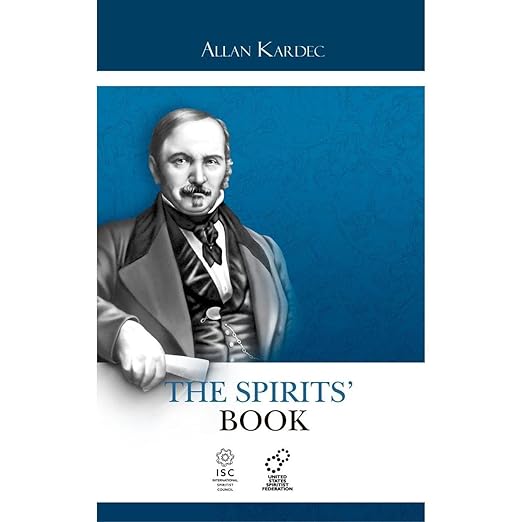
I want to be honest about my relationship with this category of text. Allan Kardec’s The Spirits’ Book occupies a specific and historically significant place in the literature of spiritualist thought, and approaching it as a literary critic requires setting aside both dismissiveness and credulity in favor of something more useful: attention to what the book actually does and how this edition does it. I came to this audiobook on a quiet Wednesday evening, interested in the particular challenge of rendering a 19th-century catechetical text into modern English, and in what it means to listen to nearly seventeen and a half hours of question-and-answer dialogue between a medium and entities described as highly evolved spirits.
First published in French in 1857, The Spirits’ Book is the foundational text of Spiritism, a philosophical and spiritual system that developed primarily in France and Brazil and has maintained a significant following globally for over 150 years. Its format is unusual: the book consists of 1018 numbered questions on subjects ranging from the nature of God and creation to the destiny of the soul, moral law, and the conditions of spiritual existence, each answered by what Kardec describes as communications received through mediums from evolved spirits. The modern English edition reviewed here represents an attempt to make this accessible to contemporary English-language readers and listeners.
The Challenge of Translating Kardec in 2024
The translation question matters here more than in most audiobooks, and it is not a minor issue. One reviewer, who describes holding a college major in French and reading Kardec in the original, identifies specific lexical errors in this edition, confusing “civilization” with “civility” and “morale” with “morals” across multiple questions. This reviewer ultimately recommends alternative translations, specifically those by Luchnos and Dutra, as more reliable modern English versions. That is a serious criticism from a credentialed source, and prospective listeners should weigh it.
The Virtual Voice narrator used in this edition handles the structural repetitiveness of the question-and-answer format without obvious difficulty, the format is mechanically regular, which actually suits AI narration reasonably well. But it also strips the text of the interpretive warmth that a skilled human narrator might bring to passages of genuine philosophical complexity. Seventeen hours of catechism delivered in an AI voice is demanding in a particular way, requiring listeners to supply their own emotional texture for concepts that, read with genuine conviction, could be genuinely moving.
What the Text Actually Claims and Delivers
The Spirits’ Book makes substantial claims. It proposes answers to questions about the existence and nature of God, the origin and destiny of the soul, reincarnation and spiritual progression, the nature of good and evil, and the moral laws governing human existence. For readers within the Spiritist tradition, these are not speculative claims but received wisdom from authoritative sources. For readers approaching from outside that tradition, the text operates as an extended philosophical argument, one that is more internally consistent than most outside accounts suggest.
Reviewers with no prior connection to Spiritism describe the book as eye-opening and as providing a logical framework for understanding intuition, dreams, and the purpose of life. One reviewer describes it as a guidebook for all humans, noting that the answers in the text sound more compassionate and intelligent than most earthly authorities. Whether one accepts the claimed source of that wisdom or reads it as the synthesis of an unusually thoughtful 19th-century mind, the content has genuine philosophical substance worth engaging with.
Who Should Listen and Who Might Want to Skip
This audiobook is well suited to listeners with genuine curiosity about Spiritism as a philosophical and spiritual system, those interested in 19th-century occult thought, and readers willing to engage with a catechetical format across a long runtime. Those who find AI narration alienating for serious philosophical material will have a harder time with seventeen hours of it. If you are drawn to this text, it may be worth comparing available translations before committing, given the concerns raised about this edition’s lexical accuracy. And if you are approaching this text for the first time, one reviewer’s practical suggestion holds: the Kindle edition with dictionary support may be a useful companion to the audio, particularly for the older theological vocabulary that appears throughout.
Frequently Asked Questions
Is this the best English translation of The Spirits’ Book available in audiobook form?
This is a debated point. At least one reviewer with French language expertise has identified lexical errors in this edition and recommends translations by Luchnos and Dutra as more accurate. The audiobook is broadly accessible but prospective listeners who want scholarly reliability may want to investigate alternative editions.
How does the Virtual Voice AI narration affect the listening experience for a text this dense?
The AI narration is technically competent with the question-and-answer format, which is structurally regular enough to suit automated delivery. However, it removes the interpretive warmth that a skilled human narrator might bring to philosophically complex or emotionally resonant passages across a seventeen-hour runtime.
Do you need to have prior knowledge of Spiritism to engage with this audiobook?
No prior knowledge is required. The book itself is structured to introduce the system from first principles, beginning with the nature of God and proceeding through increasingly specific questions. However, some familiarity with 19th-century spiritualist thought provides useful context for the historical claims Kardec makes about the communications.
Is The Spirits’ Book a religious text, a philosophical one, or something else?
It is foundational to Spiritism, which Kardec positioned as a philosophical doctrine with moral and scientific dimensions rather than a religion in the institutional sense. The text addresses questions about soul, God, moral law, and the afterlife, but it does so in a systematic question-and-answer format that has more in common with philosophical catechism than liturgical writing. Readers approach it from both religious and philosophical angles, and it functions differently in each context.