I started The Spider Network on a morning when the news cycle was grinding through another story about financial malfeasance at scale, and the particular exhaustion that comes with that, the sense that the same story keeps repeating with different names and numbers, was still present when I opened this one. What I did not expect was how quickly Enrich's access and specificity would cut through that numbness. This is not a general account of how banks behave badly. It is a very specific account of how one man, Tom Hayes, became both the architect and the scapegoat of one of the largest financial scandals since the 2008 crisis, and Enrich was the only journalist with access to Hayes before his fourteen-year prison sentence was handed down.
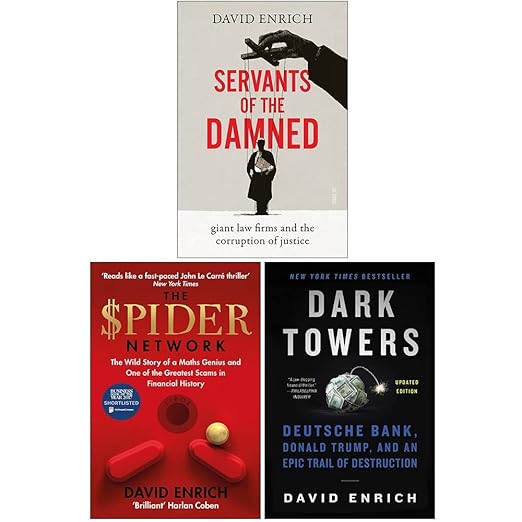
A note on this listing: the product appears to be bundled with two other David Enrich titles, Servants of the Damned and Dark Towers, but the editorial focus here is on The Spider Network itself, which is the work that established Enrich's reputation and for which the primary reviews and listener interest apply. At fifteen and a half hours, the audio runtime reflects the bundle rather than the single title, and prospective listeners should be aware they are getting three substantial works rather than one.
Tom Hayes, Neither Villain nor Victim
The Libor scandal is the kind of story that is very easy to describe in abstract terms and very difficult to make concrete. Libor, the London Interbank Offered Rate, was an interest rate benchmark that underpinned hundreds of trillions of dollars in financial contracts globally. The fact that it was set by a small group of bank traders submitting self-reported figures created an obvious opportunity for manipulation, and that opportunity was taken. Enrich traces how Hayes, a derivatives trader working across Tokyo and London for a succession of major banks, built a network of relationships specifically designed to nudge those submissions in his favor.
What makes Enrich's account compelling is that he refuses to flatten Hayes into either villain or victim. Hayes is depicted as brilliant, genuinely difficult as a personality, and operating in an environment where the behavior he engaged in was not only tolerated but in some cases encouraged by supervisors who knew exactly what was happening. The question of why Hayes ended up serving fourteen years while his institutional superiors faced no criminal consequences runs as a persistent undercurrent through the narrative. Enrich does not answer that question with a clean prosecutorial argument, but he provides enough detail that readers can form their own view, and the evidence he assembles points in a fairly clear direction.
Chamberlain's Measured Read on a National Scandal
Enrich notes that the ramifications of the scandal stretch across the British establishment, and that dimension of the story is handled with the same specificity he brings to the financial mechanics. The regulatory failures, the political cover, the way institutional reputations were managed against individual accountability: these elements are present and documented rather than gestured at. For listeners who came to the scandal primarily through news coverage, the depth of access Enrich was able to secure through his direct relationship with Hayes gives the book a texture that summary journalism cannot replicate.
Mike Chamberlain's narration is well matched to this material. Financial journalism at this level requires a narrator who can move through technical terminology without either stumbling or performing false confidence, and Chamberlain has both the diction and the pacing to keep listeners oriented through complicated explanations of derivatives trading and rate manipulation. He reads with the measured authority of a documentarian rather than a dramatist, which is the right choice for Enrich's reportorial tone. There are no flourishes here, no artificial drama imposed on material that has more than enough inherent drama to sustain itself.
Why Spider Network Outshines Its Bundle-Mates
The bundle format places The Spider Network alongside Dark Towers, Enrich's account of Deutsche Bank's history from financing Auschwitz to serving as Donald Trump's lender of last resort, and Servants of the Damned, covering the law firm Jones Day's remarkable concentration of institutional power. Taken together they form a coherent picture of how legal, financial, and corporate institutions interact with and often enable the worst behavior of their members. Separately, The Spider Network stands as the strongest of the three from a narrative standpoint, built as it is around the singular access Enrich had to its central figure. Hayes is a character in a way that Deutsche Bank and Jones Day, however fascinating as institutions, cannot quite match.
For listeners who want to understand how financial manipulation at the level of benchmark rates actually works, and how accountability is structured to protect institutions while exposing individuals, this is a remarkably clear account. It requires no specialist background. Enrich explains the Libor mechanism and the derivatives context in terms that a general audience can follow, and the human story of Hayes provides an emotional through-line that keeps the technical explanations from feeling like homework.
Specificity Instead of a Clean Verdict
Listeners expecting a prosecutorial takedown will find the book more ambivalent than that framing suggests. Enrich is a journalist rather than a polemicist, and his goal is clarity about what happened and who knew it rather than a verdict on the system. Those who find that register frustrating, who want the book to be more explicitly angry on Hayes's behalf or more explicitly damning of the institutions, may find the measured tone unsatisfying. The book's strength is its specificity, and the trade-off for that specificity is a resistance to the kind of clean moral conclusions that make for more emotionally cathartic listening. What you get instead is something more durable: the actual record of what happened, told by someone who was close enough to see it clearly.
Quick Take
- Read by: Mike Chamberlain handles the dense financial and legal material with clean diction and steady authority, keeping the material accessible without oversimplifying.
- At its heart: Financial system manipulation, insider culture in banking, the gap between individual culpability and institutional corruption
- Vibe: Methodical and quietly outraged
- Short version: David Enrich's access to Tom Hayes before his sentencing makes this the definitive account of the Libor scandal, and Chamberlain's narration makes the complex financial mechanics followable for non-specialist listeners.