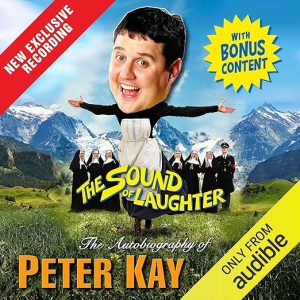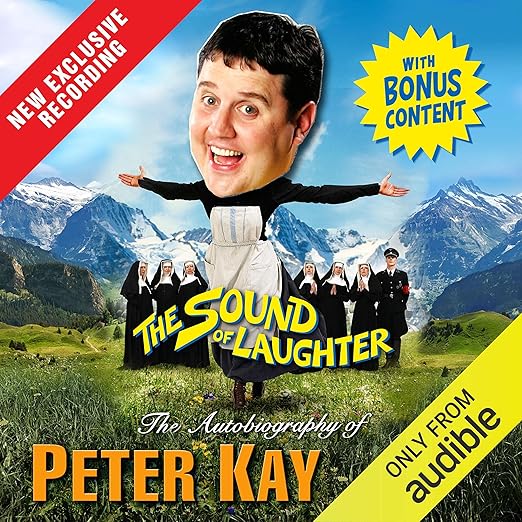
Britain's best-selling hardback autobiography of all time reached audio in September 2021, with Peter Kay himself credited as narrator, recorded, according to the publisher, in his own front room, and carrying two chapters that exist nowhere else. Those facts settle most of the question of whether this audiobook earns a place beside a print copy you may already own. The Sound of Laughter covers a Bolton childhood, a first driving lesson, a long parade of dead-end jobs and the slow accident of fame, and the publisher's pitch is that you get all of it from the person whose delivery built the material to begin with.
Garlic Bread, Cheesecake, and a Mother's HRT
Its shape is a classic ascent story, and the best stretches are the ones furthest from the stage. Kay works through the jobs, the school years, the near misses, and Carole H, one of five voices on the listing, identified why that section holds: it is "great to know how Peter arrived at the foothills of his career", the dead-end work and the business of "being in the right place" that eventually opened a door. Comedy autobiographies usually rush to the first gig. This one lingers in the years before, which is where the material actually came from.
Comedy here is domestic and specific rather than topical. The publisher's own list of subjects gives the flavor accurately: garlic bread, cheesecake, weddings, funerals, elderly relatives and a mother's HRT. Nothing is edgy and nothing is cruel, which is the quality Carole H singled out in writing that "his humour is real, not vindictive or vulgar, and that is why the country has taken him to their heart". That judgment explains the scale of the book's success better than any statistic on the cover, and it also predicts who will bounce off it. Comedy built on recognition needs you to recognize things.
Easily the most interesting review on the page is the three-star one. John, writing in 2008, read the book as a class document: a "Decent northern British bloke who had a typical 70's working class life" of back-to-back terraces, poor schools and worse food, who chose to mine humor out of that rather than bitterness. That was meant as faint praise. I would take it as the book's actual achievement, because the alternative version of this memoir, the angry one, would have been far easier to write and much less durable.
Kay Wrote the Jokes and Knows the Beats
Those two exclusive bonus chapters are the concrete argument, and they are the reason this edition is not merely a convenience purchase. Anyone who already owns the hardback gets new material here, which is unusual enough that it deserves more prominence than the product copy gives it. The front-room recording is the second argument. Rather than a studio, the publisher describes a comedian talking from his own living room, and that informality is a deliberate aesthetic rather than a corner cut. It suits a book whose whole method is a bloke telling you about his family.
Self-narration is close to non-negotiable with this kind of material. Written-down stand-up is a transcript of something that only fully exists when spoken, and a hired reader would have to reverse-engineer the timing from punctuation. Kay wrote the jokes, performed them for years, and knows exactly where each beat lands, so the audio edition has a decent claim to being the primary text rather than a derivative of it. Whether the room tone and the pacing suit your ear is a separate question, and it is one only a sample can settle.
Structure matters more here than it usually does in a memoir. The book is assembled from self-contained set pieces: the first driving lesson, a run of jobs, a wedding, a funeral, a relative behaving badly at close quarters. Very little depends on what happened three chapters earlier. For a listener that is a practical advantage, because a continuous narrative of this length demands unbroken attention while a sequence of anecdotes tolerates being picked up and put down across a fortnight. One reviewer reported remembering every place Kay went, which is exactly what an episodic book leaves behind. I suspect the episodic build is part of why it sold in the numbers it did.
Reviews Predate This Edition by Years
Look at the dates before you trust the reviews. Every written response here was posted between 2008 and 2016, which is to say every one of them predates the September 2021 audio edition by somewhere between five and thirteen years. They are reviews of the printed book, and not one of them mentions the recording, the bonus chapters or the front-room production. That is unusually clean evidence, and it means the praise here should be read as a verdict on Kay's writing, with the audio edition still awaiting public comment.
Nor is the score field much use. It shows 4.4 derived from a single rating, an arithmetic impossibility that tells you the aggregate has not settled rather than telling you anything about quality. Check the product page directly if the number matters to your decision. The other flag is cultural: two reviewers make the point themselves, one wishing Kay's television work were available in the United States, another observing that a British reader will already know the shows and a non-British one very likely will not. A third builds a review entirely around a series most American listeners have never seen. The jokes survive the crossing, but the frame of reference takes work.
Reading Aloud From His Own Life
British listeners of a certain vintage will need no persuading, and neither will anyone who grew up in a northern English town and recognizes the terraces, the school dinners and the relatives. Beyond that, the book suits people who like comedy memoir where the comedy comes from observation rather than confession, and who prefer the pre-fame chapters of any showbusiness life to the famous ones. It also works well as a companion listen for anyone who has enjoyed Car Share or Phoenix Nights and wants the biography behind them.
Steer clear if British domestic comedy of the seventies and eighties is a register you find impenetrable, because nothing here is translated for you and the specificity is the point. Anyone hoping for score-settling or a dark night of the soul should know that this memoir stays warm throughout and treats hardship as raw material rather than grievance. Everyone else should know that eight and a quarter hours in this company passes quickly, that the bonus chapters make this the fullest edition of the book, and that a comedian reading his own life aloud is exactly the form the material was waiting for.
The Short Version
- Narration: Two bonus chapters exist only in this edition, and the publisher says the whole thing was captured in Kay's own front room, with Kay himself credited.
- Themes: Bolton childhood, dead-end jobs before the big break, the comedy of ordinary family life
- Mood: Chatty, affectionate, unhurried
- Verdict: The rare audio edition that justifies rebuying a book you already own, as long as British domestic comedy is a register you enjoy.
Good to Know
What do the two bonus chapters add to the audiobook?
The publisher describes them as completely new and exclusive to this edition, which makes this the most complete edition available rather than a straight reading of the hardback. Nobody on the listing describes their content, because every visible review predates the 2021 audio release.
Does Peter Kay narrate it himself, and where was it recorded?
He is the credited narrator, and the publisher states that the recording was made live from his own front room rather than in a studio. That informality suits a memoir whose method is conversational throughout, and it is presented as a deliberate choice rather than a compromise.
Why does the rating look strange on this audiobook?
The listing shows an average of 4.4 drawn from a single rating, which cannot be right, with five written reviews beside it dating from 2008 to 2016. Treat the number as unsettled and read the written responses instead, remembering they describe the print edition.