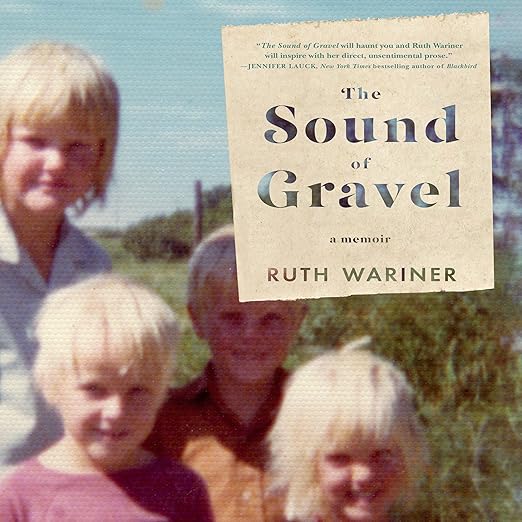
The Sound of Gravel is a memoir audiobook narrated by its own author, Ruth Wariner, who was the thirty-ninth of her father's forty-two children in a polygamist community on a farm in rural Mexico with no indoor plumbing or electricity.
Library Journal Calls the Narration Captivating and Emotional
Wariner reads her own account, and Library Journal singled out exactly why that pairing works, praising a narration that compliments the candid nature of her story and calling the result captivating and emotional, delivered in a straightforward way without an ounce of self-pity. That trade assessment lines up with what the reader reviews describe: a story told from a child's point of view even as it covers her father's murder by his own brother, her mother's second polygamous marriage, and years spent crossing the border for government assistance.
The synopsis frames the book around Wariner's slow realization that the community she was born into, one where preachers taught that women reach heaven only through polygamous marriage and large families, might not be the life she wants. That coming-of-age throughline, delivered in her own voice, gives the audiobook an intimacy a hired narrator could not fully replicate.
Macmillan Audio produced this at just over nine hours, a runtime that gives Wariner room to sit inside individual scenes, the ramshackle house, the church services, the trips back and forth across the border, rather than compressing four decades of family history into a rushed summary.
Doctrine Gets Stated Outright, Never Softened
The synopsis also situates the church's teachings plainly rather than leaving them implied: preachers taught that God would punish the wicked by destroying the world, and that women could only ascend to heaven by entering polygamous marriages and having as many children as possible. Hearing those specific doctrinal claims stated outright, rather than softened into vague references to a strict upbringing, is part of what makes the memoir feel unusually direct from its opening pages.
A Mother Described as Tragically Lovable
Reader reactions here run unusually strong. CaliforniaSam finished the book in tears, calling it a work of art about love within a family, and Carpool Book Club stayed up reading until roughly three in the morning, describing the story as heartbreaking and heartwarming often on the same page. Chanel Crigler cried multiple times and still calls it a great story worth recommending, with a warning that it is upsetting at times.
Mary Ward's review adds useful context for anyone drawn to this subject specifically, describing several other books read about escaping polygamy and calling this one of the strongest, detailing how Wariner's mother remarried a man named Lane after her father's death and how the family crossed the border to collect food stamps. Catherine's review notes a family photograph included in the print edition and praises how thoroughly Wariner renders sensory detail, the smells and sounds of each scene, throughout the account.
What separates this from a purely bleak survival story, according to several reviewers, is the sibling relationships running through it. CaliforniaSam specifically calls out Wariner's love for her siblings as the emotional core of the book, alongside a complicated but never simplified portrait of a mother who is, in that reviewer's words, tragically lovable even at her most frustrating.
Carpool Book Club's review also points to something worth naming directly: the memoir does not resolve into a tidy redemption arc so much as it tracks Wariner's slow, uneven realization that leaving is even possible. That absence of an easy resolution is part of what several reviewers describe as the book's honesty, rather than a flaw in its structure.
Forty-Two Siblings Are Hard to Keep Straight
Several reviewers flag how large and difficult the cast of characters becomes. Catherine mentions needing to write personal notes just to keep everyone straight, given forty-two siblings and a rotating cast of adults across two households and two countries. In audio, without a page to flip back to, that same complexity may take more concentration to track.
This is genuinely difficult material: a murder, child poverty, religious coercion, and the slow psychological toll on Wariner's mother are all present and are not softened. Chanel Crigler's warning that it is upsetting at times is worth taking seriously before starting, particularly for listeners who are themselves navigating questions about a controlling faith community.
Catherine's review also notes the prose leans heavily on sensory description, the smells and sounds of one scene carrying into the next, which some listeners find immersive and others may find slows the pacing in sections where the underlying events are already emotionally heavy.
The memoir also spans two countries and, effectively, two economic realities: a subsistence farm in Mexico without plumbing or power, and periodic stretches in the United States where the family relied on welfare and odd jobs. Listeners expecting the story to stay confined to one setting should know it moves back and forth repeatedly, which is part of how young Wariner comes to see her own community with outside eyes.
Ranks Near the Top, Mary Ward Says
Readers of memoir who want a first-person account narrated by the person who lived it, and anyone interested in polygamous communities, religious coercion, or resilience narratives, will find this a rewarding listen, helped considerably by Wariner reading her own words.
It also rewards anyone who has appreciated other insider accounts of leaving high-control religious groups, since Mary Ward's review specifically situates this among several similar memoirs and ranks it near the top of that list.
Leave it alone if you need a lighter or more distanced true story, since the emotional weight here is immediate and the delivery is intentionally unguarded rather than clinical. For listeners ready for that intensity, the combination of the author's own voice and Library Journal's praised delivery is a genuine strength.