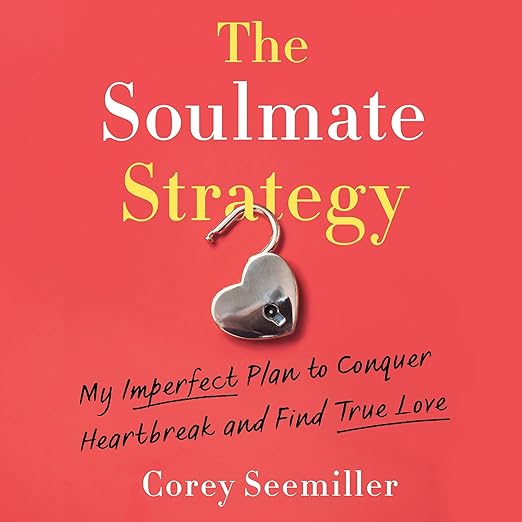
Days after a breakup, a photograph of the ex turns up on Facebook wrapped in the arms of somebody new, and it goes viral. That is where this audiobook starts, and Corey Seemiller reads it in her own voice, which means the humiliation in the opening chapter is spoken aloud by the woman it belongs to. Eight hours and fifteen minutes later the question the book is asking has quietly changed, and the change is the whole point of the thing.
A Checklist With Eminem as One Consultant
Corey is forty-something, newly single, and unusually specific about the problem. The description does not offer a woman drifting toward heartbreak; it offers somebody "plagued with the burden of her own failure in finding happiness and love," which is a harsher self-assessment than most memoirs open with. The trigger is not the breakup by itself but what the description calls a "gleeful boast" about happily ever after, and the observation is precise: the injury is public, performed and algorithmically distributed. The response to it is characteristic and mildly absurd: a meticulously crafted checklist, worked through with the seriousness of a project plan and roughly the same expectation of results.
Checklists are where the book finds its comedy and its argument simultaneously. The list comes with consultants, and the description names them without apparent irony: psychics, a breakup coach, and "the legendary rapper Eminem." Anybody assembling an advisory board out of that particular combination is either desperate or unusually honest about how people really make decisions in the months after a separation. Amanda M., reviewing in February 2026, singled out exactly that as the part that landed, praising the "determined (and sometimes humorous) attempt to 'plan' her way back to love with checklists, coaches, and unlikely sources of wisdom."
Eminem aside, the shape will be familiar to memoir readers, and the description gives it away cheerfully. The plan fails, the hope fades, and then she is "suddenly torn between two." Anyone who wants that turn to arrive as a turn should stop reading the listing now. Whether it is earned depends entirely on execution, and the three responses on the page all say it is, without any of them being long enough to count as evidence.
You Cannot Hold the Narrator at a Distance
Eight hours and fifteen minutes delivered in the writer's own voice changes what a breakup memoir does to a listener. The events happened to the person describing them, as they do in every memoir; what shifts in audio is that you cannot hold the narrator at the distance a printed page politely allows. When Corey describes the photograph going around, somebody is talking about her own humiliation out loud, in the first person, at conversational speed, with no page to look up from.
Self-narration carries its familiar risk alongside that gain. Authors are not trained readers, and eight hours is a long haul for an untrained voice to sustain pace, variety and the difference between a scene and a reflection. Most memoir listeners take that bargain willingly, because the alternative is a professional delivering somebody else's grief with flawless technique and no stake in the outcome.
She Writes Press released it on February 24, 2026, and the entire public record for it dates from a two-week window around that date. Three responses exist, all three award five stars, and the counter agrees with them exactly, so the average settles on the badge with nothing left over. That is uncommon enough on a listing to say so plainly: the numbers on this page are doing what numbers are supposed to do.
A Five-Star Review Describing a Different Book
One of the three responses is describing a different book. Filed under the initials A.M.A. on February 17, 2026, it calls The Soulmate Strategy "a thoughtful and practical take on modern relationships," commends it for emphasizing "self-awareness, intentional dating, and personal growth as the foundation for lasting love," and signs off by naming it "a motivating guide for those ready to be more intentional about finding the right partner." Nowhere does it mention Corey, the breakup, the photograph, or the fact that what it is describing happens to be a memoir at all.
Timing compounds the problem. February 17 sits seven days in front of a February 24 release, so praise for writing that is "clear and encouraging" went up while the recording was not yet on sale. Taken together with the contents, the date makes this the least useful of the three, and also the one a browser meets in the middle of a column of fives.
Amanda M.'s response, by contrast, is the substantial one, and it arrives with a disclosure that does real work. "As a straight woman who's been happily married for years, I wasn't sure how much I'd relate," it begins, before landing on the conclusion that "heartbreak is universal." That is precisely the review a buyer outside the target audience will want, and the only one long enough to describe anything specific about what happens in it.
The third response, from BT, runs to three sentences: a "nicely written memoir with interesting ideas about how to get through a breakup," delivered in a "conversational and entertaining style." Conversational is a useful word for anybody weighing the format, since conversational is the register self-narration handles best and formal prose is the register it handles worst. Two of the three call this a memoir. The third calls it a guide. The listing sides with the two.
No Method Here Is Actually Being Sold
Listeners who want a queer midlife memoir that is funny about its own methods are the exact audience here, as is anybody who has ever tried to project-manage a way out of grief. The LGBTQ tag on the listing is accurate without being the whole story: the description puts a forty-something lesbian at the center and then gives its length to heartbreak, planning, and the limits of what planning can do. Anybody in the middle of their own version of this will find it uncomfortably recognizable, either as a warning or as a recommendation depending on the week.
Nobody hoping for the dating manual that one review describes is going to find it here, because this is a first-person account of one specific breakup, with no program in it that anybody else could run. The checklists, the coach and the psychics are the material here, and no method is being sold. Anybody allergic to the vocabulary of self-help should stop here.
A Few Questions About The Soulmate Strategy
Is The Soulmate Strategy audiobook a memoir or a dating guide?
A memoir, according to the listing, the description and two of the three reviews. The remaining response reads it as a practical relationship guide about intentional dating and personal growth, and never once mentions the author, the breakup or the queer framing. Treat that one as an outlier and read past it.
Does Corey Seemiller narrate this audiobook herself?
Yes. Author and narrator are one name on this listing, so the eight hours and fifteen minutes come from the person the events happened to. That collapses the distance a printed page normally provides, and the closeness is the whole argument for memoir on audio. It is also the usual bargain, since authors are seldom trained readers.