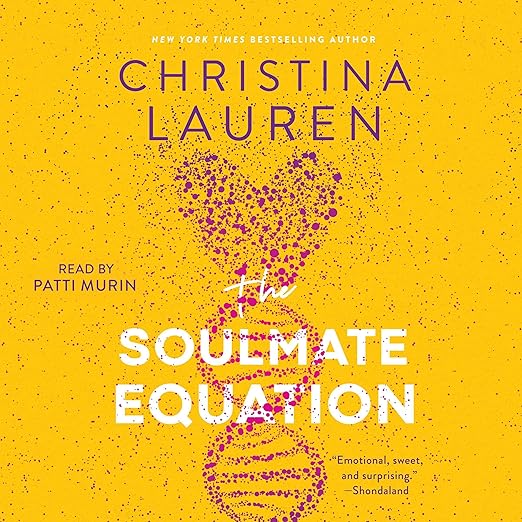
Jess Davis runs on data: she is a statistics professional, a single mother who has calculated exactly why stepping back into the dating world is a losing proposition, and someone whose defenses are so well constructed that even good evidence struggles to get through. That setup is the engine of The Soulmate Equation, the audiobook from Christina Lauren, narrated by Patti Murin, which asks what happens when a woman who trusts numbers more than feelings discovers she is a 98 percent compatibility match with a man she can barely tolerate.
First, the Big Picture
Christina Lauren, the writing duo of Christina Hobbs and Lauren Billings, has built a catalog on smart romantic premises, and this one ranks among their more conceptually inventive. GeneticAlly, the DNA-based matchmaking startup at the center of the novel, is a satisfying vehicle for the central question: can quantitative analysis identify romantic compatibility, and would you trust it if it did? Jess's resistance to River Pena, GeneticAlly's founder, is not merely the standard romance antagonism. Her skepticism of her own match result reflects genuine psychological complexity about a woman whose trust in people was systematically damaged before the story begins, and who has protected herself and her daughter accordingly.
The novel handles the slow-burn dynamics with care. Jess and River are pushed together by GeneticAlly's PR needs, which means their growing understanding of each other develops through staged public appearances rather than organic encounters. That structural device forces a kind of performance that reveals character rather than concealing it, and Murin plays the layers of what Jess is allowing herself to feel versus what she is admitting beautifully. One reviewer noted the pairing has definite connection while acknowledging the chemistry builds slowly; the audio performance makes that build feel rewarding rather than frustrating.
The supporting cast deserves particular mention in audio. Jess's daughter Juno and her friend Fizzy are voiced distinctly enough that the secondary characters feel alive without pulling focus from the central relationship. Murin differentiates these voices with enough character that the scenes involving Juno carry real emotional weight, which matters because Juno's wellbeing is one of the primary reasons Jess is reluctant to take any romantic risk. The depth given to the supporting cast makes the world of the novel feel more fully inhabited than the average romantic comedy.
Why The Soulmate Equation Works as an Audiobook
Murin is the argument for choosing the audiobook over the print version. Her comedic timing is sharp: the line about wanting to commit a felony when she sees River lands with exactly the right dryness, and Jess's internal contradictions, aware of her own attraction and unwilling to admit it, are rendered with precision rather than played for farce. At 10 hours and 26 minutes, this is a well-paced listening experience for the genre, and the audiobook structure suits the chapter-by-chapter revelation of Jess's past that Christina Lauren builds throughout.
The novel's humor earns its description as laugh-out-loud in places. Christina Lauren writes comedy that works through specificity rather than broad strokes, and Murin's delivery honors that precision. The scene-level comedy tends to come from character logic rather than situation, which means it has a longer shelf life than jokes that depend entirely on circumstance. Listeners who return to romantic comedy audiobooks for the warmth of a good performance will find the combination of this material and this narrator genuinely satisfying over the full runtime.
A Few Reservations
One reviewer flagged a mid-novel moment where River's withdrawal from contact reads as inconsistent with his stated feelings. The ghosting beat exists, and some listeners feel the follow-up reassurance does not fully account for it emotionally. This is a structural criticism of the source material rather than the audio production, but it represents the point where the novel's internal logic is most strained. Listeners who are sensitive to trust-related plot mechanics in romance should know this sequence is present before investing 10 hours.
The GeneticAlly concept, while clever, also requires a certain suspension of disbelief about how a startup would handle a situation where its founder is personally matched with a research subject. The novel does not work through the professional ethics of that scenario with the same rigor it applies to Jess's emotional defenses. Listeners who come to this primarily as a conceptual story about biotech and consent will find the science handled more loosely than the romance. The premise is best treated as a romantic catalyst rather than a scientifically plausible system, and the book is most enjoyable when you allow it that latitude.
Who Should Pick Up The Soulmate Equation
This audiobook is built for listeners who want romantic comedy with genuine emotional stakes and a concept that does more than set up the meet-cute. Fans of Abby Jimenez's contemporary romance will find similar emotional intelligence here. Single parents who have been outside the dating world and recognize Jess's specific defensive logic will likely find the character more immediately relatable than the genre average. Readers looking for a straightforward, high-heat romance without the slow-burn structure should know this is a patient story that earns its ending rather than delivering it early. The audiobook format, with Murin's performance, is the definitive version of this title. Her ability to hold Jess's romantic conflict and her maternal protectiveness in the same emotional space is what lifts this above the genre average and makes the resolution feel genuinely satisfying rather than formulaic.
Does the audiobook version of The Soulmate Equation add anything over reading it in print?
Patti Murin's comedic timing is the primary argument for the audio version. The internal monologue sequences where Jess is processing her feelings about River have a particular sharpness when delivered aloud that reading silently does not replicate. If you are choosing between formats, the audiobook is a meaningful upgrade for this title.
How much science is actually in this audiobook, and do you need any background to follow the GeneticAlly concept?
The science is presented at a popular, accessible level and no biology background is required. The novel uses the DNA compatibility concept as a romantic premise rather than a scientifically rigorous argument, and it does not ask you to believe that real science works this way.
Is The Soulmate Equation audiobook a standalone, or does Christina Lauren's other work require reading in order?
Fully standalone. The novel has no series connections. Prior Christina Lauren titles like The Unhoneymooners or Love and Other Words share no characters or plot threads with this book.
How does Patti Murin handle the dual register of Jess as a data professional and as a single mother in this audiobook?
Murin shifts between these registers naturally rather than treating them as separate modes. Her Jess sounds like the same person who runs statistical analysis and tucks a child in at night, which is exactly the character coherence the role requires.