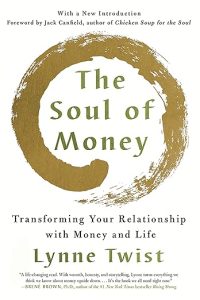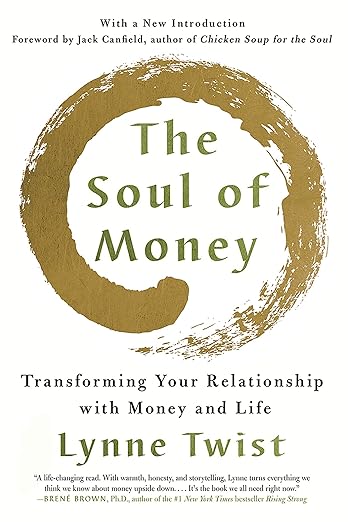
Nine hours about your feelings toward money sounds like a hard sell, and this audiobook mostly earns it. Lynne Twist has one argument, repeated from many angles: the belief that never enough exists is a story we absorb rather than a fact we verify, and almost everything unhappy about the way people earn, spend and give follows from it. Whether that lands as revelation or as a truism you already agree with depends less on the writing than on how much of your own life you are willing to hold up against it while listening.
Is The Soul of Money Worth Your Time?
Twist's central move is to take money out of the accounting frame entirely. The description sets it up plainly: examining what we do when we earn, spend and give away money produces insight into the rest of a life, and that insight, rather than any allocation strategy, is the product on offer. One five-star response puts the shift better than the marketing copy manages, calling this a book not about personal money problems but about using money as an instrument and giving it a job to do good. That reframing is the whole engine.
Another five-star maps the territory with real precision, describing two rival value systems that rarely appear on the same shelf. On one side sits the quantitative approach, analytical and science-flavored, carrying the status conferred by financial institutions and advisers. On the other sits the qualitative, the memoir-shaped, feeling-based psychology of money, which is granted far less respect. That response also passes along the author's own name for the first mode, Money and Me. Placing the two side by side and refusing to concede that only one counts as serious is what makes the book unusual.
The Best Parts of The Soul of Money
Method matters more than thesis here, and the method is story. Twist works through personal accounts rather than data, which is why the book travels well across audiences who share no financial circumstances at all. A five-star from a financial professional describes using exactly this framework with clients, helping them move out of a state of fear and scarcity toward a sense of sufficiency, and that response reports buying a hundred and fifty copies. Whatever else that is, it is evidence the material survives contact with practitioners.
Genre-wise the book sits astride a line, and a four-star names the balance well: part economics, part spirituality, an invitation to keep the entire picture in view rather than one column of it. That hybrid is the reason it has outlasted most of its shelf-mates and also the reason some listeners bounce. Neither half is diluted for the other. Nine hours and seventeen minutes gives both room, and the pacing never rushes the reflective passages into being tidy takeaways.
Voicing deserves a thought before purchase. This is a first-person book, built from a life, and the reading credit goes to Cynthia Barrett rather than to the author, so the I belongs to Twist while the voice belongs to someone else. Memoir-inflected nonfiction is where that gap is most audible, for better and worse: a professional reader can shape a paragraph an author would flatten, and can also smooth the hesitation that makes a confession sound true. Three minutes of a sample will settle which of those you are getting, and I would spend them before buying.
Before You Commit to The Soul of Money
The rating badge on this record cannot be believed. It displays 4.5 with a grader count of exactly one, and a single vote can only land on a whole star, so no arithmetic over one rating produces a half. Five written responses sit visibly below it, four at five stars and one at four, which is a second problem for a counter reading one. Whatever that number is counting, it is not the column beneath it, and it should carry no weight in a purchase decision.
Edition is the second thing to pin down. The description says the book now includes a foreword by Jack Canfield and a new introduction in which Twist takes up the aftermath of the Great Recession along with environmental pressure on how we use money. Both are print-edition additions announced in print-edition language, and nothing on the record states whether the recording carries them. Front matter is precisely what gets quietly dropped in audio, so anyone who wants the updated framing should confirm it first.
Register is the last caution and the most likely to decide things. One five-star describes the book healing a wound left by a father's early death and by generations of dysfunction caused by excess, and passes it next to a sixteen-year-old son. That is a real response to a real strength, and it also tells you the temperature. Listeners who want money treated as a system rather than as a relationship will find the emotional pitch high and sustained across the full runtime.
The Right Listener for The Soul of Money
If conversations about money in your household run on guilt, avoidance or a permanent sense of shortfall, this is the book that gives those conversations different vocabulary. It suits people in the helping professions, anyone with more resources than they are comfortable with, anyone with fewer and tired of feeling defined by it, and the fundraising and nonprofit world, where the argument about sufficiency does the most practical work. It also rewards a slow listen with long gaps between sittings.
Skip it when what you actually need is a plan with numbers in it, because none appear, and skip it too if inherited-story arguments strike you as evasion rather than diagnosis, since the entire case rests on the premise that scarcity is learned. The book asks for a kind of participation most nonfiction does not. Give it that and nine hours will genuinely rearrange something. Refuse it and you will hear an amiable lecture about attitude that never quite reaches you.
At a Glance
- Narrator: Cynthia Barrett reads a first-person book by someone else, which is the standard arrangement and the one memoir-shaped nonfiction feels most.
- Subjects: sufficiency versus scarcity, money as an instrument rather than a scorecard, generosity, values-driven spending, the psychology of enough.
- Tone: Reflective, warm and unhurried.
- Bottom line: A durable argument about attitude rather than allocation, worth nine hours if you are prepared to apply it to your own accounts rather than admire it from a distance.