Zig Ziglar reads his own book here, which for a sales audiobook is closer to a requirement than a bonus. He made his name on stages, and the material was built to be spoken: a definition delivered aloud, a close demonstrated in dialogue, a joke landed and then converted into a principle. Four hours and four minutes of it, put out in 2004 by Simon and Schuster Audio. The first thing worth saying is that the running time and the promises in the description do not obviously fit together.
MAKE 'EM SAY YES sits at the top of the copy in capitals, and underneath it comes the claim that does the actual work: all of us are selling every day, whether we are presenting a product, informing a client or instructing a child. Widening the definition that far is a sales move in itself. It converts a trade manual into a life skills book, and it is the reason this title has outlived almost everything published alongside it.
A 2014 entry describes the method precisely: dozens of closes and hundreds of questions delivered in a well known and folksy style, entertaining the reader while informing the sales professional. Folksy is the right word. The technique arrives wrapped in anecdote, and the anecdote is doing structural work, because a named close with a story attached is remembered and a named close on its own is not.
Whether that survives contact with a modern buyer is a separate question, and the honest answer is that some of it does. Questions are questions. Objection handling is objection handling. What ages is the framing around it, the assumption of a seller who controls the information and a buyer who arrives without having researched anything.
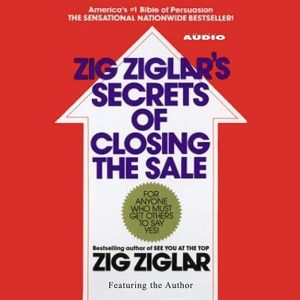
Nothing about the packaging has been refreshed for a modern buyer either. America's selling sensation is how the copy introduces him, a phrase that dates the pitch as plainly as the recording date does, and the promise underneath it is unusually direct: no matter your age, gender, occupation or lifestyle, these techniques can work for you. Sales writing has since learned to sound like consulting. This one still sounds like a seminar, and a seminar is exactly what it is.
Highlights
One 2015 response tracks the outcome all the way through: bought before a first sales job in that listener's early twenties, applied, and followed by becoming both the top grossing and the most profitable seller at a business-to-business company of forty-eight people. Testimony like that has obvious limits as evidence. As a description of how the book gets used, though, it is exact. People buy it at the start of a career and work from it.
Audio is the format the content wants. A close is a piece of timing, and timing is invisible on a page. Hearing where the pause falls, which word gets the weight, how long the silence after the question runs, teaches more in thirty seconds than a transcript teaches in three pages. Ziglar performing his own closes turns the book into a demonstration rather than a description of one.
Four hours is also short enough to repeat, which matters for material meant to be internalized rather than understood once. Nobody reads a sales manual for the plot. They run it again before a quarter starts, or before a difficult meeting, and a file this length can be run again without clearing a weekend to do it.
What to Watch For in Secrets of Closing the Sale
Nothing about the score on this record can be right. It displays 4.7 while the rating counter reads one, and a single vote can only land on a whole number of stars, so no arrangement of one grade produces 4.7. Five written responses are visible beneath that counter as well, every one of them at five stars, and five unanimous fives would display a flat 5.0 rather than 4.7. Whatever the badge is measuring, it is not the column underneath it.
A 2013 entry raises the question the book has always attracted, by quoting the passage where Ziglar draws his line: if you feel the sales process is something done to the prospect, you are a manipulator, and the dictionary definition of manipulation follows, fraud included. Ziglar wants persuasion and manipulation held apart. Some listeners will accept the distinction, some will find it convenient, and knowing which camp you are in before you start will decide how the whole four hours land.
Then the arithmetic of the running time. The description advertises vital strategies for specific closes, hundreds of sales questions and dozens of persuasion procedures, and four hours cannot hold all of that at speaking pace. Nothing on the record says whether this is the complete text or a condensation, which is the omission that matters most on a 2004 recording of a book people quote by page. The copy itself is sloppy enough to make you check, missing a word in its second sentence and a plural in its third.
Is This One for You?
This one lands for anybody in the first three years of a selling career, and it lands hardest for people who have never been formally trained. The vocabulary alone is worth the four hours, because naming a technique is the first step toward noticing it being used on you. A 2026 entry from a reader on a third pass through the book describes the effect fairly: not new information every time, but a reset.
Teachers, fundraisers, founders pitching investors and anyone else who has to move a room will also find the definition wide enough to include them, which is exactly what the opening claim intends. Persuasion is the subject; commissions are only the setting.
Look elsewhere if you want research rather than conviction, or a method built for buyers who have already read every review before speaking to you. Nothing here is evidence-based in the modern sense, and the book never claims to be. What it offers is a hall-of-fame speaker running his own material at pace, and on those terms the runtime is very good value indeed.
Key Details
- Read by: Ziglar reads himself, which strips out the interpretive layer entirely and leaves a platform speaker running his own lines
- At its heart: Closing technique, objection handling, persuasion versus manipulation, selling as a universal skill
- Vibe: Warm, anecdotal, relentlessly upbeat
- Short version: The vocabulary of closing taught by the person who popularized it, short enough to run twice and old enough to need translating.
Is the Secrets of Closing the Sale audiobook the complete book?
The record does not say. Four hours and four minutes is tight for a text the copy credits with strategies for named closes plus a very large stock of questions, and no abridgment statement appears anywhere on the page. Anybody wanting every close catalogued should treat that silence as a caution.
Why does the rating look wrong on this listing?
Because it is broken. A 4.7 average sits above a counter that reads one, and one grade cannot land between two whole stars. Treat the badge as damaged metadata rather than as a verdict, and read the written entries instead, since they are the only part of that column carrying any information.
Does the audiobook still work for selling online rather than in person?
Partly. The recording dates from 2004 and the material is older, so it presumes an uninformed buyer sitting across from a seller who holds all the facts. Question technique and objection handling survive that shift intact. Prospecting, pricing conversations and anything involving a researched buyer need updating from elsewhere.