Quick Take
- Voice: Mike Michalowicz self-narrating adds an irreplaceable authenticity to his business framework, and his delivery throughout the audiobook has the rhythm of someone who has told these stories in front of live audiences many times.
- Big ideas: Customer selection and focus, the danger of serving everyone equally, growth through deliberate elimination
- Atmosphere: Energetic and counterintuitive, like a mentor who just told you to fire your most demanding client
- Worth it?: One of the more practically actionable small business frameworks available in audiobook form, strengthened significantly by the author's own narration.
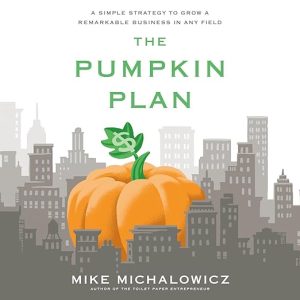
Mike Michalowicz's Pumpkin Plan argument begins with a fact about giant pumpkin farming: you do not grow a champion pumpkin by tending every pumpkin on the vine equally. You identify the most promising ones early, remove the rest, and pour every resource into the few with the greatest potential. Michalowicz built The Pumpkin Plan audiobook around the realization that this is exactly what struggling entrepreneurs fail to do with their customers. They chase every piece of business, serve every client regardless of how much energy they drain, and never have enough left to build something remarkable. He narrates this himself, which turns out to be crucial to why it works.
This is part of the Entrepreneurship Simplified series, and the framework Michalowicz presents grew directly from his own experience running a company that was making steady money while leaving him exhausted and stunted. The punishing sell-it-do-it cycle he describes, where you acquire a client, complete the work, acquire another client to replace the revenue, and never gain actual ground, is recognizable to anyone who has tried to build a service business on the logic that any paying customer is a good customer. Michalowicz challenges that logic systematically and with the credibility of someone who has tested the alternative.
What Mike Michalowicz Delivers
The three-part framework at the book's core is elegant in its simplicity: plant the right seeds by identifying what you do better than anyone else and focusing all attention on that; weed out the losers by eliminating customers who drain more than they generate; and nurture the winners by delivering exceptional care to your highest-value clients. Reviewer GMP noted that Michalowicz carves out a story that business readers can follow and apply, which is the exact challenge this kind of framework book must solve. Abstract principles are easy to agree with and impossible to implement. Concrete analogies with specific application steps are what actually change behavior.
The weeding section is where The Pumpkin Plan becomes genuinely provocative. Most business culture tells you that any paying customer is a good customer and that saying no to revenue is a failure of nerve. Michalowicz argues the opposite with specific data from his own experience: the clients who take the most time, complain the most, and pay the least are actively preventing you from serving the clients who would actually grow your business. Firing those clients is not a loss; it is the prerequisite for growth. Reviewers consistently cite this section as the one that changed how they thought about their businesses, and it is the section where Michalowicz's self-narration is most effective because the personal conviction is unmistakable.
What Mike Michalowicz Gets Right
The audiobook includes exclusive author commentary throughout and a bonus author interview at the end of the program, which meaningfully extends the value of listening over reading. Michalowicz uses these interjections to update examples, clarify application in specific industries, and acknowledge where his original framework needed refinement. That conversational texture makes the listening experience feel closer to a coaching session than a book on tape, and it rewards listeners who engage actively with the material rather than treating it as background content during a commute.
At seven hours and seven minutes, The Pumpkin Plan has enough room to develop its case fully without padding. The stories of successful entrepreneurs who applied the framework are specific enough to be instructive rather than decorative, and Michalowicz's own origin story, the moment he found the farmer article and began testing the analogy on his struggling company, is told with the self-deprecating honesty that makes his writing voice genuinely enjoyable. Reviewer Tatyana wrote her praise in French, describing the strategy as remarkably simple and effective and expressing surprise at not having identified it independently, which speaks to the clarity of Michalowicz's explanations across language barriers.
Where Mike Michalowicz Loses Some Ground
The framework works best for service businesses and professional practices where the customer relationship is ongoing and the cost of a bad client is measured in time and energy rather than just transaction value. Michalowicz draws most of his examples from consulting, agencies, trades, and professional services. Entrepreneurs running product businesses with high volumes of anonymous transactions will find some of the framework requires significant translation before application.
The pumpkin analogy is returned to throughout the book with the enthusiasm of someone who genuinely loves his central metaphor, which most listeners will find energizing and a small number will find overwrought by the final chapters. The core ideas are sound regardless of how one feels about sustained agricultural metaphor, and the actionable sections more than compensate for any moments where the framing device is pushed a touch too far.
Who Should Pick Up The Pumpkin Plan
Small business owners running service businesses who feel trapped in the sell-it-do-it cycle and cannot understand why growth feels impossible despite constant effort will find this audiobook immediately relevant. Entrepreneurs who have been told to focus but have never had a framework for what to focus on will find Michalowicz's three-part system actionable and specific. Business coaches and consultants who work with entrepreneurs stuck in the revenue-chase pattern will find the framework useful as a teaching tool with clients. Founders of high-volume product businesses with anonymous customer bases may need to adapt the framework significantly before application. Anyone looking for a philosophy of business growth that requires firing clients will need to be genuinely open to that counterintuitive advice before committing to this listen.
Does The Pumpkin Plan audiobook work better than the print version, given that Michalowicz narrates it himself?
Most listeners who have experienced both favor the audiobook. Michalowicz's self-narration adds the energy of a live presentation, and the exclusive commentary sections extend the content beyond the original text. The author interview bonus at the end is audiobook-exclusive.
Is this audiobook relevant for businesses outside the United States, or is it primarily for the American market?
The framework is not geographically specific. Reviewer Tatyana wrote her review in French and found the strategy remarkably effective. The examples are primarily American, but the underlying customer-selection and resource-allocation logic applies to service businesses in any market.
Do I need to have read Michalowicz's other books, like Profit First, to get value from The Pumpkin Plan audiobook?
No. Each book in Michalowicz's Entrepreneurship Simplified series presents a standalone framework. The Pumpkin Plan covers customer and business focus strategy, while Profit First addresses cash flow management. They complement each other but do not require sequential reading.