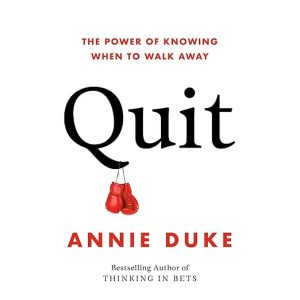
- Read by: Annie Duke narrates her own work with the confident precision of someone who has delivered the argument hundreds of times, though the pace occasionally prioritizes clarity over warmth.
- At its heart: Sunk cost fallacy, strategic abandonment, cognitive bias against quitting
- Vibe: Sharp and counterintuitive, like a good poker hand explained in reverse
- Short version: Duke delivers a rigorously argued case for treating quitting as a skill, and narrating her own book adds a layer of intellectual authority that serves the material well.
Annie Duke's central argument in Quit lands with the force of something obvious in retrospect: grit culture has spent decades telling us that winners never quit, and in doing so has built a systematic trap for intelligent people who refuse to abandon bad bets. Duke, the former World Series of Poker champion and author of Thinking in Bets, arrives at this audiobook having already established herself as one of the more rigorous popular thinkers on decision-making. Quit is her most focused work yet, and the self-narration makes that focus feel personal rather than clinical.
The audiobook runs seven hours and forty-three minutes, which gives Duke the room to move from foundational psychology through extended case studies without the compression that sometimes flattens these kinds of arguments. She works through escalation of commitment, status quo bias, and the desire for certainty with enough specificity that the concepts stay concrete. The examples range from Mount Everest climbers who continued past the turnaround point to Stewart Butterfield walking away from one company to build Slack, to Dave Chappelle's decision to leave a fifty-million-dollar deal at Comedy Central. These are not decorative anecdotes. They do real argumentative work.
The sharpest insight in Quit is what Duke calls the paradox of quitting: if you quit at the right time, it will feel like you quit too early. That single observation reframes almost every intuition we have about perseverance. We are conditioned to use feelings of discomfort as evidence that we need to push through, but Duke demonstrates that those feelings are also exactly what we experience when we have made the correct decision to stop. The cognitive machinery that should help us evaluate our choices is running against us the moment we most need it to work.
Her practical tools are concrete without being simplistic. Quitting contracts, where you establish in advance the conditions under which you will stop, address the problem that decisions made in the heat of commitment are compromised decisions. Premortems and backcasts help reorient thinking from the current loss to the future state. The chapter on expected value is the intellectual core of the book, and Duke handles it without condescension toward readers who do not come from a quantitative background.
Why Listen to Quit
The self-narration matters here. Duke's voice carries the cadence of someone who has argued these ideas in front of skeptical audiences repeatedly. When she says that the sunk cost fallacy is not just an error but a systematic bias that intensifies with investment, she sounds like she means it in a way that a professional narrator reading the same words would not. There is also an almost confessional quality to certain passages, particularly those where she acknowledges that even knowing the research, she has made the exact mistakes she describes. That self-awareness is one of the reasons listeners describe the argument as thoughtful and interesting rather than preachy.
At four-point-six stars with listener engagement that describes the first two-thirds as captivating, the reception tracks with the argument's architecture. The book is strongest in its diagnostic phase and slightly more diffuse in its prescriptive later sections. That structural observation from listeners is accurate: the framework chapters are sharper than the implementation chapters, though the implementation material still has value. Knowing the limitation going in helps you extract more from the whole. The Dave Chappelle case study is particularly effective at showing how even wildly consequential decisions benefit from cleaner exit criteria established in advance. Duke uses his fifty-million-dollar walk-away as a lesson in recognizing the moment when additional information would not change what you should do, and framing the decision in those terms removes the moral drama that made it so difficult at the time it was made.
What to Watch For in Quit
Duke is careful to distinguish between quitting as a response to difficulty and quitting as a strategic reorientation based on information. This is not a book that argues for giving up when things get hard. The distinction runs through every case study, and readers who come in worried the book will rationalize avoidance will find that concern addressed directly and early. The framework is about identifying the difference between expected value decreasing and mere discomfort, which is a more demanding task than either grinding forward or retreating.
The final section on increasing flexibility in goal-setting and anticipating optionality is worth particular attention for listeners who work in environments where sunk cost thinking is institutional rather than individual. Duke's point that organizations suffer from the same biases as individuals, often more severely because of social pressure and accountability structures, has implications for anyone navigating a workplace rather than just a personal decision.
Who Should Listen to Quit
Anyone who has stayed too long in a job, a relationship, a project, or an investment will recognize themselves in this audiobook's case studies. Decision-makers, founders, managers, and anyone whose professional life involves strategic resource allocation will find the framework directly applicable. The poker background is present but never prerequisite. Duke builds the behavioral economics scaffolding from first principles in a way that requires no prior knowledge of either poker strategy or academic psychology. The self-narration also makes the book feel accountable in a way that ghost-written or third-person narrated business titles rarely do.
Listeners already deep in behavioral economics will find some of the core concepts familiar, particularly the sections on cognitive bias. Where Quit distinguishes itself even for that audience is in its specific application of those frameworks to the act of abandonment rather than to decision-making more generally. That focus is uncommon enough to justify the listen even for readers who know the academic literature well.