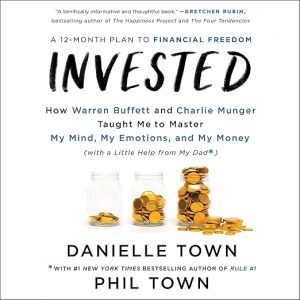
Danielle Town's craft decision in structuring Invested is more deliberate than it first appears. Most personal finance audiobooks choose between narrative warmth and technical instruction, and most sacrifice one to achieve the other. Town arranges her year-long learning journey as the binding structure, using monthly chapters to pace the introduction of investing concepts, and the result is a book that genuinely earns its comparison to Rich Dad Poor Dad and The Happiness Project without exactly resembling either. The learning arc is real: she begins the audiobook as someone for whom financial language caused her brain to shut down, and ends it as someone who can read and evaluate financial statements with Buffett-style rigor. Author Danielle Town and narrator Danielle Town are the same person, and that fact matters for everything that follows.
The ten-hour-and-nineteen-minute runtime gives her the space to honor both the story and the curriculum. That balance is the audiobook's central achievement, and it would not work without Town's self-narration, which grounds every conceptual section in the felt memory of having been confused by it.
The Review
The relationship at the heart of Invested is the teacher-student dynamic between Danielle and her father, Phil Town, the investor and author of Rule #1. What makes this dynamic work, rather than read as a celebrity endorsement from a famous parent, is that Danielle brings her own resistance to the material. She does not arrive as an eager student. She arrives as someone who has spent years actively avoiding the subject, driven by fear and a sense that finance belongs to a world she did not want to inhabit. Phil Town's patience, which she describes as mostly patient, is tested. That friction between expert and reluctant learner is where the best teaching happens, and it gives the book genuine tension that pure instructional titles cannot generate.
The investment framework taught is Warren Buffett-style value investing: identifying wonderful companies at prices below their intrinsic value. Town translates her father's methodology into twelve lessons that deliberately avoid complex mathematics. The focus is on understanding what a business actually is before looking at any numbers, which is a pedagogically sound sequence for beginners. By the time she introduces concepts like intrinsic value calculation and margin of safety, the reader has enough conceptual grounding to follow the reasoning without feeling abandoned.
Why Invested Works as an Audiobook
Self-narration in memoir-instruction hybrids is only as effective as the narrator's willingness to be vulnerable, and Town does not protect herself. She reads the passages about her fear with the same directness as the instructional content. One listener described the experience as hearing an actual story of learning investing that really gets into how afraid Danielle was of starting. That quality is not common in financial audiobooks, where the author usually appears already arrived, already successful, retroactively explaining a path that did not feel uncertain while it was being walked.
The InvestED podcast community that already follows her work will find the audiobook deepening what the show covers in episodes. Listener feedback specifically notes that while the podcast is hugely informative and motivating, Invested is even better because the book format lets Danielle break down how to value companies in an easy-to-understand way. Reviewer Virgil Minden, who came to Invested having already read Rule #1 and Payback Time, found the story format genuinely engaging across the full runtime, which is a meaningful endorsement from a reader who already knew the material. The supplemental PDF that accompanies the audiobook provides checklists and equations that are referenced in the audio.
The Caveats
Town structures each chapter as a month in her learning journey, which means the book has twelve substantial segments, each introducing new concepts while advancing the relationship story. The pacing is consistent rather than accelerating, which suits the material but means listeners looking for a plot-driven narrative will find the investment education holds equal weight throughout. This is genuinely a dual-strand book, and neither strand subordinates to the other.
The value investing framework she teaches is specifically Buffett-influenced, favoring patient, research-intensive long-term positions over active trading, diversification, or passive index strategies. If your investing philosophy differs significantly from that framework, the book will still offer value in its methodology, but the prescriptive chapters may produce friction where you expected confirmation. Knowing that orientation before starting is useful context rather than a warning.
Who Should Listen to Invested
Invested is an exceptional entry point for anyone who has felt excluded or intimidated by personal finance and investing. Town's documented transformation from avoidance to competence is a genuine roadmap for that journey, and the warmth of the father-daughter dynamic makes the material feel accessible rather than gatekept. Listeners who learn best through narrative and concrete examples rather than abstract principles will find the format particularly well-matched to how they absorb information.
Experienced investors already fluent in value investing methodology may find the early chapters paced for a different audience. The book is transparent about its target reader: someone who has been putting this off. If that is not you, the instruction will feel familiar. If it is you, few investing audiobooks will meet you more honestly where you are, or make the subject feel less like a locked room to which you finally have the key. Town does not pretend the transformation is easy or instant. The year-long structure is honest about how long it actually takes to move from confusion to competence, and the emotional cost she describes throughout makes the methodology feel worth the effort in a way that purely prescriptive investing books rarely achieve. Her account of the moment she placed her first real investment trade, after months of study and hesitation, is one of the most convincing portraits of adult beginner confidence in personal finance audio.
- Read by: Danielle Town's self-narration is one of the audiobook's core strengths, carrying the book's personal story with the authenticity of someone who lived the fear and the transformation she describes.
- At its heart: Value investing, father-daughter mentorship, financial self-determination
- Vibe: Warm and methodical, like a good tutorial from someone who remembers being a beginner
- Short version: The combination of personal memoir and investing curriculum works better in practice than it sounds in theory, and Town's voice makes the instruction feel like a conversation rather than a lecture.
Common Questions
Does Danielle Town's self-narration of the Invested audiobook help with the more technical investing content?
Significantly. Town narrates both the personal memoir and the instruction, which means the emotional context for each concept is always present. When she explains intrinsic value calculation or margin of safety, her voice carries the memory of having been confused by those terms, which makes the explanation feel patient rather than clinical. Several listeners specifically credit her narration as why the book succeeded where other investing books had not.
Do I need to have read Phil Town's Rule #1 before listening to the Invested audiobook?
No prior reading is required. Town introduces her father's framework from the ground up through the lens of a beginner encountering it for the first time. Listeners familiar with Rule #1 will recognize the methodology and may find some concepts move quickly in the early chapters, but Town adds substantial personal context and updated examples throughout.
Is the supplemental PDF worth using alongside the Invested audiobook?
If you intend to apply the investing methodology rather than just understand it conceptually, yes. The PDF contains checklists, equations, and structured frameworks referenced in the audio. Listening without it is a complete experience, but the PDF converts the instruction from something you understand to something you can actually use at a computer with a company's financials in front of you.
How does the Invested audiobook compare to other personal finance audiobooks for someone starting from scratch?
Most investing audiobooks either stay conceptual or assume prior financial literacy. Invested occupies an uncommon middle position: it teaches real methodology, including the ability to read financial statements and assess intrinsic value, while documenting the full arc of a beginner's genuine confusion and gradual competence. For someone who feels the subject is not for them, the emotional narrative does work that pure instruction cannot.