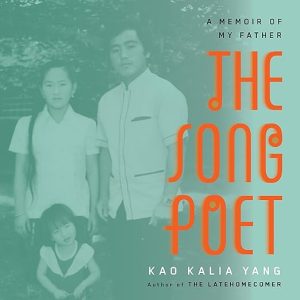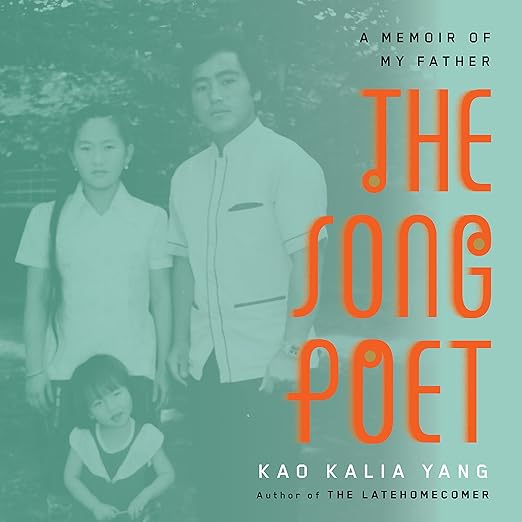
Kao Kalia Yang gives her father back his voice in this audiobook, which is a stranger act than it sounds. Bee Yang was a song poet, a practitioner of a Hmong oral form in which one person carries the history of a people. His daughter tells his story in prose, in English, and then reads it aloud herself. Eight hours and five minutes, published by HighBridge. A book about a lost oral tradition, delivered orally, by the person who inherited the loss.
When the Songs Stop, So Does the Inspiration
The description sets out the tradition with precision: the song poet 'recounts the story of his people, their history and tragedies, joys and losses,' extemporizing or drawing on folk tales, keeping the past alive and recording courtships, births, weddings, and wishes. Bee Yang came to it after losing his own father young, wandering between neighbors and collecting what they said to one another, whispering the words at night until a song formed. He kept singing through jungle warfare and through a refugee camp in Thailand, and he carried the practice north to Minnesota after the conflict the description names as America's Secret War pushed his family out of the Laotian mountains.
Then the songs stop. That is the structural fact this book is built around, and it is the reason the story refuses to become inspirational. In a Minneapolis housing project and on a factory floor, the form falls away, and when Bee's mother dies the songs leave him for good. Everything the tradition was for, memory, continuity, the naming of a people, gets no purchase in the new country. What Yang does with that is the achievement. She writes the book her father can no longer sing, and the substitution is both the gift and the wound.
Self-Narration Isn't a Bonus, It's the Argument
Self-narration is not a bonus feature on a book like this. It is the argument. A daughter reading aloud the account of a father who lost his ability to perform is itself an act of transmission, the very thing the book says stopped happening in Minnesota. Choosing a hired reader would have left the story intact and hollowed out its point. Whatever else you weigh about this production, that decision is correct at a level most audiobooks never have to think about.
The reception evidence is unusual and worth dwelling on. Two of the five visible reviews are written in the second person, addressed directly to Kao Kalia Yang rather than to a prospective buyer. One tells her that 'Your written word does honor to your father's poems.' Another, from a reader who did not expect to find their own parents in the book, writes about finally understanding what that family went through and is still going through. People do not usually write to authors in a review field. That they do here says something about how the book positions its reader, closer to a listener at a gathering than to a consumer.
The strongest single piece of evidence for what this book actually does comes from that same reviewer, who says 'I've always wished I could understand kwv txhiaj.' and reports that 'This book made me admire it even more.' What follows is the detail I keep coming back to: after reading, they searched out recordings of Bee Yang's song poetry late at night, and woke the next morning to find their mother listening to it. A book that sends its readers looking for the sound of the thing it describes has succeeded at something no summary conveys.
A Decade of Ratings, a Durable Verdict on the Writing
The grief load is heavy and lands unevenly. A reviewer who identifies as the daughter of Hmong refugees writes 'As a daughter of Hmong refugees this one hit me hard.' and then, plainly, 'I cried a lot of tears reading this book.' Anyone in that position, or anyone who has lost a parent recently, should choose their moment. Yang does not sentimentalize, which paradoxically makes the material harder rather than easier: poverty, displacement, and a father's slow silencing are given in ordinary detail and left there.
Set expectations about form, too. This is a prose retelling of a life, not a recording of the tradition itself. The description is explicit that Yang retells her father's life, and the songs reach you through her sentences rather than through performance. That is the correct choice for a memoir in English, and it also means a listener hoping to encounter kwv txhiaj as an art form will want to go looking separately, exactly as one reviewer did. Take the book as the door rather than the room.
One practical note about the numbers. This recording dates from 2016, and the score sitting on it has accumulated across nearly a decade of readers who came to the memoir through several formats, so it functions as a durable verdict on the writing rather than as a snapshot of any single edition. That is worth knowing, because a book this well established tends to attract responses to its reputation as much as to itself. What more than one reviewer describes is a reading experience that changed how they understood their own family, which is a fairly specific claim and a hard one to arrive at by accident.
A Companion Volume to The Latehomecomer
Readers of refugee and diaspora memoir will find this among the best of that literature, and anyone who admired The Latehomecomer has an obvious reason to continue, since Yang follows her own earlier book with her father's side of the same history. Poetry readers should note too that the book is about a form of composition, improvised and sung, and takes that craft as seriously as any account of a written art. Hmong readers and the children of refugees generally are the audience the reviews suggest it reaches hardest. It also belongs in the hands of anyone interested in oral tradition as a living practice rather than as an anthropological subject, because the book documents a form by documenting its disappearance.
Approach with care if you are recently bereaved, or if unrelenting accounts of poverty and displacement are more than you want in your ear right now. Anyone hoping for a broad history of the Secret War or of Hmong migration should note that this is one family, closely observed, with the wider history behind it rather than in front of it. Anyone else is getting eight hours of the finest kind of memoir: specific, unsparing, and written by someone with an obligation rather than an anecdote.
- Performance: Kao Kalia Yang reads her own account of her father's lost song poetry, which makes the self-narration structurally necessary rather than decorative.
- What it covers: Hmong oral tradition, refugee displacement, fathers and daughters, the cost of resettlement
- Feel: Quiet, grieving, and precise, with no reach for uplift
- Our call: A memoir that documents an oral form by recording its disappearance, and one of the best in its genre.