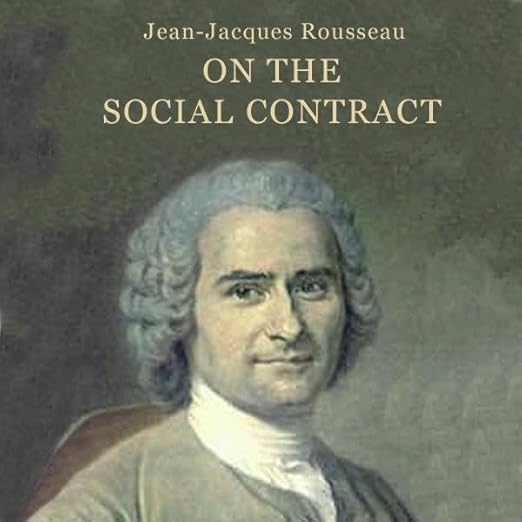
Quick Take
- Narration: Erik Sandval delivers a measured, academic reading that keeps Rousseau’s dense argumentation intelligible without oversimplifying it.
- Themes: Popular sovereignty, the general will, the legitimacy of political authority
- Mood: Dense and philosophically demanding, with flashes of incendiary clarity
- Verdict: Essential political philosophy that earns its reputation, and at five hours it is a genuinely manageable audiobook for listeners willing to pay close attention.
I first read The Social Contract in an undergraduate political theory course where the professor insisted we treat every sentence as a problem to be solved rather than a passage to be summarized. I have been meaning to return to it ever since, and the audiobook gave me the occasion I needed. I listened to the five-hour recording in two sittings, once during a long drive and once in the evening with the text open in front of me, which turned out to be the considerably better approach for catching the threads of the argument before they slipped past.
Jean-Jacques Rousseau published this work in 1762, and its opening line, “Man was born free, but everywhere he is in chains,” remains one of the most quoted sentences in the history of political thought. What is less commonly appreciated is how much intellectual density follows that opening, and how carefully Rousseau builds his case for popular sovereignty from first principles before arriving at conclusions that have been used to justify everything from liberal democracy to totalitarian rule. Both readings are genuinely available in the text, which is part of what makes it so generative and so dangerous.
The Argument and Its Contradictions
Rousseau’s central claim is that legitimate political authority can only derive from the people themselves, organized as a collective sovereign. He calls this collective will the general will, and he distinguishes it carefully from the sum of individual preferences, which he calls the will of all. This distinction is where the book becomes genuinely difficult and genuinely interesting. The general will, for Rousseau, represents what the community would collectively will if it were perfectly rational and oriented toward the common good. The gap between that ideal and actual human political behavior is the source of most of the book’s tension, and Rousseau does not resolve it cleanly.
Reviewer Luis Martinez noted that Rousseau’s work argues government is itself flawed, leading to societies built on inequality and servitude. That is an accurate summary of the diagnostic portion of the text. Rousseau’s prescriptive vision is more ambiguous and, in some readings, more troubling. The reviewer who described the book simultaneously as an encomium to democracy and a blueprint for totalitarianism was not being paradoxical; both readings are genuinely supported by the text, which is part of why this remains essential reading for anyone interested in how political ideas actually work and how they can be captured by movements their authors never intended.
Erik Sandval’s Narration and the Philosophy Problem
Philosophical texts in audio format are always a gamble. The density of argumentation that works on the page, where you can pause, reread, and annotate, becomes a sustained demand on attention in audio. Erik Sandval navigates this reasonably well. His pacing is deliberate enough to allow the arguments to register, and his pronunciation of Rousseau’s technical vocabulary is consistent throughout. He does not bring interpretive flair to the reading, which is probably the right choice for a text this philosophically loaded. A narrator who emphasized certain passages would risk editorializing in a work where editorial choices have political consequences; Sandval’s measured delivery leaves the interpretation to the listener.
At five hours and one minute, this is a manageable listen by the standards of philosophical audiobooks, but it is not a passive one. Listeners who engage with it actively, pausing to consider each section before moving on, will get considerably more from it than those who listen through without stopping. One reviewer described returning to the text after college to brush up, which is the right spirit. This is a book that repays multiple encounters, and the audiobook format makes those encounters easy to stage in different contexts and with different questions in mind.
Who Will Benefit Most from This Edition
Students of political theory, constitutional law, philosophy, and American history will find this the most immediately useful audiobook in those fields. The influence of Rousseau on the American founding, mediated through Locke and Montesquieu, is well documented, and hearing the text in full makes the connections between Rousseau’s arguments and the language of the Declaration of Independence considerably more vivid than reading about them secondhand. General listeners with a serious interest in political ideas who want to understand what the phrase social contract actually means, as opposed to how it is casually invoked, will also find this rewarding. Listeners who want accessible political philosophy without philosophical rigor will find the argument dense; this is not a book that simplifies itself for a general audience. That honesty is, ultimately, one of its enduring virtues, and one of the reasons it has remained essential reading across more than two and a half centuries of political change.
Frequently Asked Questions
Which translation does this audiobook use, and does it affect the listening experience?
The recording uses the G.D.H. Cole translation, which is among the most widely used English versions and is known for clarity and fidelity to Rousseau’s argument. One reviewer noted reading Cole’s translation alongside the original French and found the correspondence close. For audio purposes it is a strong choice.
Is this accessible to listeners with no prior background in political philosophy?
It is challenging without some background. Rousseau builds his argument technically and assumes familiarity with natural law theory and Enlightenment political concepts. A brief introduction to Locke or Hobbes before listening will make the text considerably more navigable.
How has The Social Contract influenced American political thought specifically?
Rousseau’s influence on the American founders was largely indirect, mediated through Locke and Montesquieu, but the concept of popular sovereignty and the idea that legitimate government derives from the consent of the governed are foundational to American constitutional theory. The book provides essential intellectual context.
At five hours, is this long enough to cover the full text of the original work?
Yes. The Social Contract is a relatively short book by the standards of major political philosophy. The five-hour runtime covers the complete text, including all four books, without abridgment.