At a Glance
- Narration: Carrington MacDuffie's measured, restrained delivery refuses to manufacture suspense, letting nearly thirteen hours of documented cold-case reporting carry its own weight.
- Themes: institutional cover-up, unresolved justice, victim-centered true crime
- Mood: Sober and unflinching, more journalism than thriller
- Verdict: One of the more responsibly handled true-crime audiobooks about child victims, worth the weight if you can sit with it.
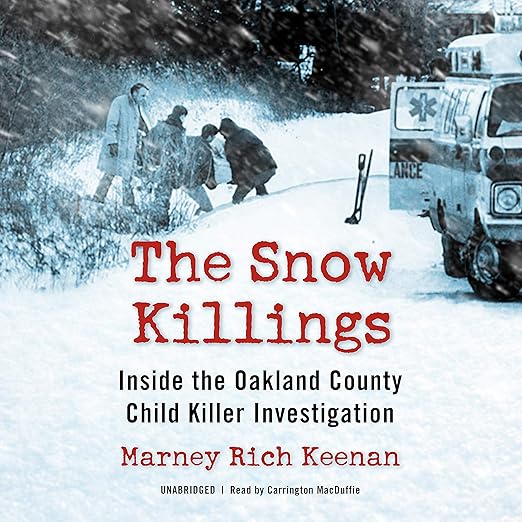
Four children vanished from the Detroit suburbs over thirteen months in 1976 and 1977, each one held for days before being left in the snow near a public road, and that detail, stated as plainly as Marney Rich Keenan states it throughout, is what makes this audiobook so hard to shake. I listened to most of The Snow Killings across two long winter evenings, arguably the wrong kind of weather to have chosen in hindsight, and Carrington MacDuffie's restrained, unhurried narration never once tries to manufacture suspense out of a case that already carries more than enough of its own.
The Most Extensive Manhunt in US History
The Oakland County Child Murders triggered the most extensive manhunt in US history at the time, and the task force investigating it was disbanded after less than two years without ever naming a suspect. Keenan, a veteran Detroit News reporter, picks the case back up more than three decades later, when a chance discovery by one victim's family pointed toward Christopher Brian Busch, the son of a wealthy General Motors executive and a convicted pedophile who had been released from custody mere weeks before the fourth child disappeared.
What separates this from a standard true-crime rehash is the access Keenan secured: the book is built from the perspective of the lead detective on the case alongside the family whose persistence reopened it, and it lays out evidence of a decades-long cover-up, obstruction, and institutional malfeasance that denied the victims' families anything resembling justice.
Treating Reconstruction as the Actual Narrative Engine
Cold-case journalism asks something different of a writer than a breaking investigation does: the physical evidence has aged, witnesses have died or their memories have shifted, and the paper trail itself often has to be reconstructed from records institutions would rather not revisit. Keenan's specific skill is treating that reconstruction as the actual narrative engine, showing her work rather than simply asserting a conclusion, which is part of why the book reads as convincing rather than merely confident about a case that was never formally closed.
The synopsis's own language is worth sitting with directly: victims held for days before their 'still-warm bodies were dumped in the snow near public roadsides.' That specific, awful detail, the bodies still warm, the roadsides deliberately public, signals a killer using visibility itself as part of the crime, and Keenan's reporting treats that detail as evidence to be traced rather than shock value to linger on.
Even the title carries a double edge worth noticing: snow both hid and revealed these crimes, the roadsides where the children were left going quiet and white each winter, and 'cold case' stopped being a figure of speech the moment the investigation itself went dormant for three decades under exactly that same seasonal cover.
An Ethical Choice as Much as a Stylistic One
Carrington MacDuffie's delivery is measured and restrained in a way that feels like an ethical choice as much as a stylistic one; she refuses to perform tragedy for material this grim, avoiding manufactured suspense pacing and instead letting the documented record carry its own weight across nearly thirteen hours of cold-case journalism. Not once does the narration reach for a false note.
One reviewer, who has clearly read widely in this specific subgenre, calls it 'an accurate and well-written account of the case,' while flagging possible spoilers for anyone still catching up on decades of prior reporting. A second reviewer praises the book directly for tonal control: 'This book was objective when it needed to be, describing the twists and turns of the investigation. It was compassionate when it needed to be, towards the victims and their families.' That combination, rigor without coldness, is exactly what MacDuffie's narration is built to carry.
MacDuffie's steadiness matters most in the sections describing Busch specifically: wealth, institutional protection, and a criminal record that should have kept him under far closer watch are exactly the kind of material that invites outrage-driven narration, and MacDuffie consistently declines to supply it, trusting Keenan's reporting to make the case on its own.
Isn't Coy About Her Conclusions
Her decades in regional journalism also mean she brings real institutional knowledge to material where institutional failure is the actual subject; she isn't parachuting into Michigan for one book, she's writing from inside a community she has covered for a career, and that familiarity shows in how precisely the book locates blame within specific departments and decisions rather than gesturing vaguely at systemic failure.
True crime as a category has grown crowded enough that listeners have real reason to be skeptical of a new entry's actual reporting depth versus its packaging, and this book's specific value is that Keenan isn't a true-crime specialist parachuting in for a trending case; her regional journalism credentials predate the genre's current popularity by decades.
One reviewer's spoiler warning is itself worth noting as a craft signal: the book reveals enough of its own findings that a reader genuinely unfamiliar with the case can be caught off guard, which tells you Keenan isn't coy about her conclusions the way some cold-case books hedge to preserve a false sense of mystery.
The Real Mystery Is Why This Hasn't Gotten More Attention
This is heavy material by design, not by accident. The victims are children, the crimes are described plainly rather than gratuitously, and listeners who find true crime involving child victims especially difficult should know that going in; nothing here is softened for the sake of an easier listen.
The case remains officially unsolved despite the strength of the circumstantial evidence against Busch, and a reviewer's own review title asks why this case hasn't received more attention, calling that question the real mystery. Listeners hoping for a tidy, courtroom-verdict ending won't find one here; the payoff is clarity about a cover-up, not a conviction.
Keenan's access to both the lead detective and the family that reopened the case gives the book a dual vantage point that a single-source true-crime account usually lacks, and it's part of why one reviewer specifically calls it probably the best book written on the case despite acknowledging its flaws. That combination of insider access and journalistic distance is rare enough in this genre to be worth naming as a real strength rather than a routine credential.
The Case's Details Are Handled Responsibly Throughout
True crime fans after journalism-grade rigor over sensationalized pacing, readers with a particular interest in Midwest cold cases, and anyone drawn to institutional-failure narratives alongside the crime itself will find this one of the stronger entries in the genre.
Readers who gravitate toward institutional-accountability journalism as much as toward the crime itself, in the vein of reporting that traces who knew what and when, will find that angle especially well served here.
Parents of young children, or anyone who finds true crime centered on child victims especially hard to sit with, have good reason to set this one aside; the case's details are handled responsibly throughout, but responsibly handled is not the same as softened.
Common Questions
Is The Snow Killings audiobook based on a solved case?
No. The Oakland County Child Murders remain officially unsolved. The book builds a strong circumstantial case pointing to Christopher Brian Busch and documents an alleged cover-up, but there was never a conviction.
How graphic is this true crime audiobook?
The crimes are described plainly and factually rather than gratuitously, but the victims are children, and the book does not soften that reality. Sensitive listeners, especially parents of young kids, should approach with that in mind.
Does this audiobook focus more on the victims and families or on the suspect?
Both, but the reviews specifically praise its balance: the book is told through the eyes of the lead detective and the family who helped reopen the case, giving equal weight to the investigation and to the people affected by it.
Is Carrington MacDuffie's narration appropriate for this subject matter?
Yes. Her restrained, unhurried delivery avoids manufactured suspense and lets the documented record carry the emotional weight, which suits the gravity of the case rather than working against it.